


© IE Online Media Services Pvt Ltd
Tags:


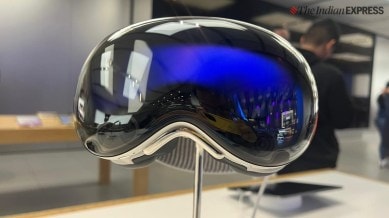
Following the recent report of Apple shifting its focus from the Vision Pro’s successor to a more affordable Vision Pro, Bloomberg now reports that Apple’s second spatial computer, codenamed N107, might not be a standalone device. Instead, it is said to rely on either an iPhone or Mac for its computational capabilities.
The report suggests that the more affordable Vision Pro might have a narrower field of view (FoV) and would need an external computing unit such as an iPhone or a Mac. This could help Apple reduce costs to make it a more budget-friendly device. The cheaper model is also expected to lack features such as the EyeSight display, which projects the user’s digital eyes to the outside world.

It has been reported that Apple may launch a more affordable version of the Vision Pro in 2025. Additionally, the company is reportedly restarting the development of the true Vision Pro successor, known internally as N109, in order to remain active in the high-end VR headset market.
The second-generation Vision Pro is rumored to feature a more powerful processor and enhanced external cameras. Apple is also reportedly working on making it lighter and more comfortable than the first version. If all goes well, Apple may announce the successor to Vision Pro in 2026. The company also introduced visionOS 2 at the Worldwide Developers Conference. Besides, the company is also working on AR glasses, which are expected to be ready in a few years.
Apple is reportedly considering Vision Pro as a multi-product enterprise, involving its international launch announced at WWDC 2024. The international version is referred to by the code name N301A, while the US version is referred to by the code name N301.


