


© IE Online Media Services Pvt Ltd
Tags:


Apple has put up a dedicated page defending the App Store, saying that they encourage competition. Apple’s latest move comes as it is facing lawsuits over its the 30 per cent commission that the company charges from software developers for allowing their apps to be sold on App Store, after the US Supreme Court allowed these cases.
Apple has also had a public spat with music-streaming service Spotify, after the latter filed a complaint with the European Commission alleging the iPhone-maker was using unfair tactics to suppress its competitors. The company had then issued a press release saying that Spotify wanted all the benefits of the App Store ecosystem without making any contributions to the marketplace. Apple had also denied that it tried to stop updates to the Spotify app.


The page also outlines some of the reasons on why apps could be rejected on the App Store, and how its teams work in order to approve some of these apps. The App Store page also seeks to reiterate that developers on the App Store have a better chance of making money compared to other stores, though it specifically does not mention the Google Play Store, which is the biggest competition.
Read more: Inside the Apple team that decides which apps get on iPhones
The page reads, “We also care about quality over quantity, and trust over transactions. That’s why, even though other stores have more users and more app downloads, the App Store earns more money for developers. Our users trust Apple — and that trust is critical to how we operate a fair, competitive store for developer app distribution.”
Apple says it has over 20 million developers in their Developer Program, and also talks about how they have helped create an entire industry generating over 1.5 million US jobs and over 1.57 million jobs in Europe.
On the topic of app rules, Apple says they only reject “apps for any content or behavior that we believe is over the line — especially when it puts children at risk.” Apple has outlined that apps with “pornographic material, discriminatory references, torture and abuse, or anything else in exceptionally poor taste,” are usually rejected.
The page has tried to demystify the app review processing saying they rely on “a combination of automated systems and hundreds of human experts,” and that the “team represents 81 languages across three time zones.”
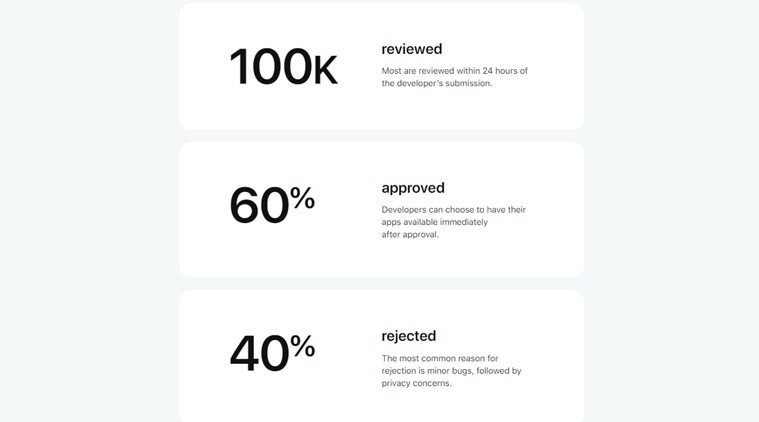
Another stat revealed is that the company has removed over 1.4 million apps from the App Store since 2016 due to lack of updates or the app not being compatible with the current version of iOS. The company says it is doing 100,000 weekly app reviews, and that most are reviewed within 24 hours of the submission with 60 per cent of these being approved.
The 40 per cent rejections are mostly due to minor bugs and privacy concerns, according to the company. “The team makes about 1,000 calls a week to developers to help them diagnose and resolve any issues that led to rejection,” explains the page.
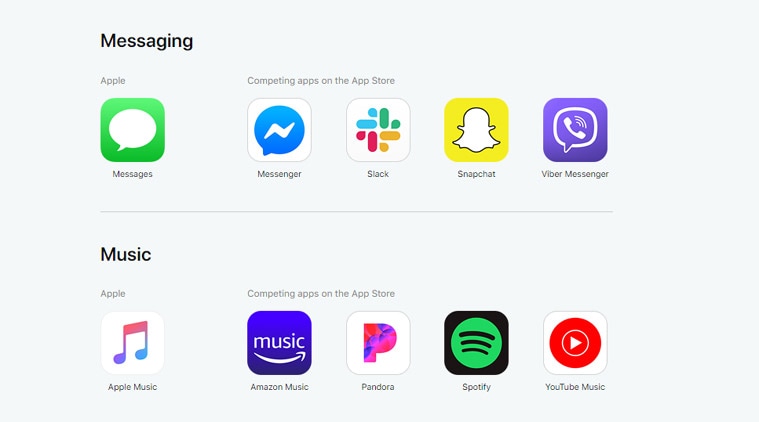
One whole section of the App Store page also talks about how Apple actually encourages competition with the company listing out its own app such as Messages, Camera, along with noteworthy competitive apps being placed next to each name.
The emphasis is important in light of recent controversies, which extend beyond Spotify. It was reported that Apple had removed several parental control apps from the App Store over privacy concerns, though the developers alleged that this was to eliminate competition to its own Screen Time, which offers something similar.
“We recently removed several parental control apps from the App Store, and we did it for a simple reason: they put users’ privacy and security at risk,” said the statement. Apple said the apps were using Mobile Device Management, or MDM, which gives a third-party control and access over a device’s sensitive information, including user location, app use, email accounts, camera permissions, and browsing history, which was a violation of their rules.
Apple is also answering the charges of unfair commission by saying that they “only collect a commission from developers when a digital good or service is delivered through an app.” The page says that 84 per cent of apps are free and these developers do not have to pay the company. Free apps with physical goods and services also do not pay a commission to Apple.
For free apps with in-app purchase, the developer earn 70% of sales, while Apple gets the 30 per cent commission.
“If developers choose to sell digital subscriptions inside the app, they use Apple’s In-App Subscription system. In that case, developers earn 70% of subscription sales for the first subscription year, and Apple collects a 30% commission. After the first year, the developer earns 85% for all successive years that the user remains a subscriber, and Apple collects a 15% commission,” explains the page.
For apps where users exclusively purchase or subscribe to content (such as music, videos, books) outside the app, but also enjoy access to that content inside the app on their Apple devices, the company says the developers receive all of the revenue.
For cross platform apps, which offer digital goods and services for sale within an app and also allow users to make those purchases on other platforms, Apple says it earns a commission on the purchases made directly in the app on the Apple device, though it did not give a percentage.


