


Tags:


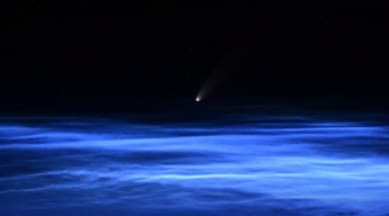
Star gazers in India will be able to catch a glimpse of the C/2020 F3 comet, also dubbed NEOWISE, from July 14 onwards as it soars across the solar system. The comet will be visible to the naked eye for around 20 minutes everyday for 20 days, according to the deputy director of Odisha’s Pathani Samanta Planetarium.
The comet, which was discovered by NASA’s Near Earth Wide-field Infrared Survey Explorer (NEOWISE) telescope in March, is expected to come closest to Earth on July 22-23. However, it will be visible in the north-western sky as early as next week, the Odisha planetarium’s Deputy Director, Dr. Subhendu Pattnaik, told ANI.

Explained| What is Comet C/2020 F3 Neowise, one of the brightest comets in decades passing Earth?
“From July 14, C/2020 F3, a comet discovered on March 27, will be clearly visible in the north-western sky. It will be visible after sunset for around 20 minutes for the next 20 days. People can observe it from naked eyes,” he said.
The comet will appear low in the northwest sky (20 degrees from the horizon) on July 14, Pattnaik told ANI. “In the evenings to follow, the comet will rapidly climb higher in the sky and will be visible for a longer period,” he added.
By August, the comet is expected to quickly fade away and will no longer be visible to the naked eye. Binoculars or a telescope can enhance its visibility, Pattnaik advised.
Read|Here’s how you can see the rare Neowise comet
NEOWISE is currently hurtling through space nearly 200 million kilometres away from the Earth. On July 22, it will come closest to our planet, when it will be at a distance of 64 million miles or 103 million kilometres while crossing Earth’s outside orbit.
Earlier this week, NASA astronaut Bob Behnken took pictures of the comet from the International Space Station (ISS) and shared them on Twitter. Several people across the world — in countries like Lebanon, Israel, Austria, Switzerland and France — have also managed to spot the comet.
The comet is expected to start fading away as it enters the outer parts of the solar system in August.


