


Tags:


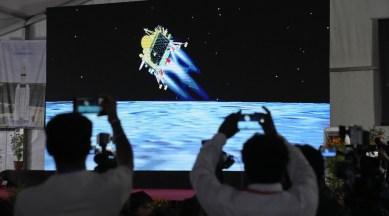
“India took a walk on the moon!,” the Indian Space Research Organisation (ISRO) said on Thursday morning after the rover rolled out of the lander late Wednesday night, hours after India made history with a soft landing of Chandrayaan-3 near the south pole of the moon at 6.04 pm.
Nearly four hours later, the foldable ramp on one side of the lander opened up. And, the six-wheeled, 26 kg lander with two science payloads came out of it. “Chandrayaan-3 rover: Made in India, Made for the MOON!” ISRO said.

The 17-minute descent phase went exactly as planned, with the lander autonomously guiding itself – slowing down from 1,680 metres per second to almost 0 metres per second, selecting the exact spot, and landing slowly and steadily as the country watched with bated breath.
Follow live updates on the moon mission here!
The mission has already achieved its goals of soft landing and roving, with the science experiments now getting 14 days to operate. With the lander and rover completely being operated on energy from solar cells, they will stop functioning when the landing spot goes into the lunar night. The electronics on board are unlikely to survive as temperatures plummet to -130 degrees Celsius on the lunar surface.
ISRO Chairman S Somanath has said previously that the space agency will check the viability of the lander-rover after the night and see whether it can be revived.
India became the fourth country to land on the moon after the United States, Russia, and China. It became the first country to do so near the lunar South Pole after the Russian mission that was to land a couple of days before it crashed. Prime Minister Narendra Modi congratulated the country from South Africa.
The Chandrayaan-3 payloads will further the science of the two predecessors by studying lunar quakes, mineral compositions, and the electrons and ions near the surface of the moon. The mission will attempt to study water ice, the presence of which was first confirmed by its predecessor.
There are two scientific experiments on the rover. The LASER Induced Breakdown Spectroscopy (LIBS) will determine the chemical and mineral composition of the lunar surface. The Alpha Particle X-ray Spectrometer (APXS) will determine the composition of elements such as magnesium, aluminium, silicon, potassium, calcium, titanium, and iron in the lunar soil and rocks.


