3 min read
© IE Online Media Services Pvt Ltd



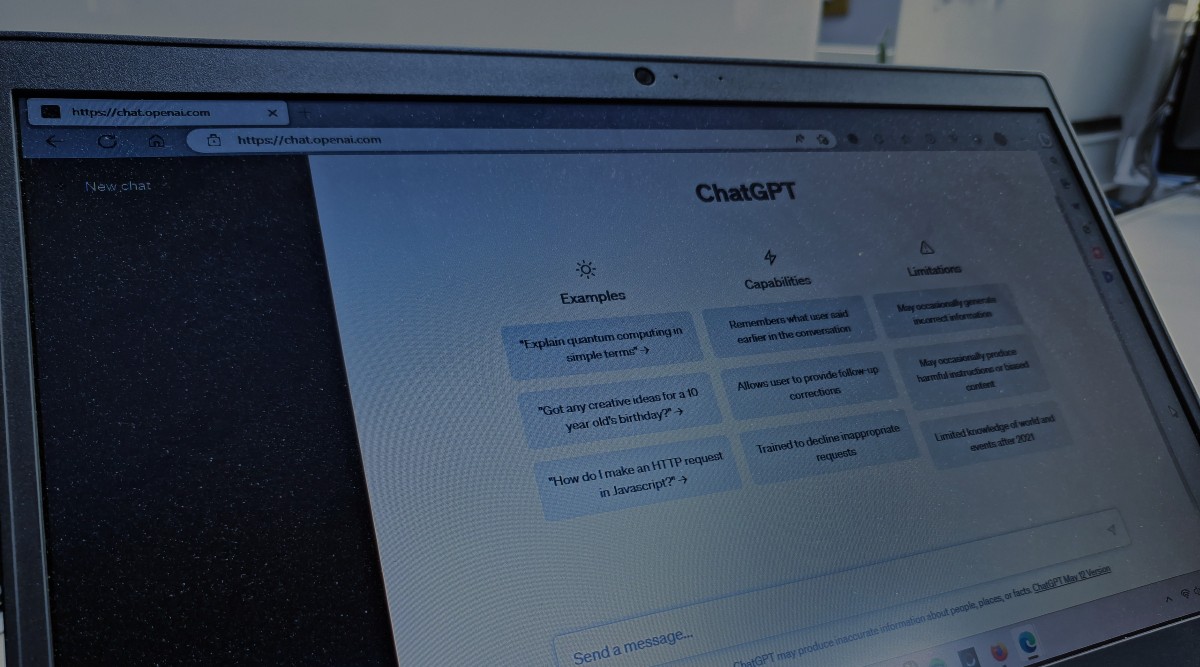 ChatGPT is a model that interacts in a conversational way and can answer followup questions, admit its mistakes, challenge incorrect premises, and reject inappropriate requests. (Express photo)
 ChatGPT is a remarkable AI product that has endless applications and constantly reveals new possibilities. However, it doesn’t come without concerns. Its privacy policy suggests that the chatbot can record what you enter into it. Fearing the exposure of confidential information, several firms, such as Samsung, JPMorgan, and Apple, have already banned their employees from using ChatGPT.
If you are concerned about your personal information as well, then there’s an alternative you can try. Called PrivateGPT, this open-source model runs locally on your device and can be customised to provide answers relevant to your own files and documents. Making it even better is the fact that the chatbot doesn’t even require an internet connection and is capable of running fully offline.
The chatbot, created by a developer named Iván Martínez Toro, needs to be downloaded first on the user’s system to get started. Then, users are instructed to copy all their relevant files into a folder so that the chatbot can ingest all the data. The PrivateGPT documentation stresses that no data leaves your local environment during the ingest process, which again can be performed without an internet connection.
Once the setup process is complete, you can ask your questions in a Python execution environment. Each prompt takes about 20-30 seconds to process, which is obviously slower than ChatGPT and Google Bard, but then again, your prompts are being processed on your machine entirely rather than on powerful supercomputers. When done, you should see your answer alongside 4 sources the chatbot used as context from your documents.
Toro told Vice that he created PrivateGPT after seeing how valuable ChatGPT is in the workplace, adding that in its current state, the AI chatbot is only a proof-of-concept to test the feasibility of creating fully localised ChatGPT-like chatbots.
As AI chatbots like ChatGPT become more powerful and versatile, they also raise privacy issues for companies that use them in various domains. To protect their sensitive data, some companies are looking into creating their own large language models (LLMs) that can be fine-tuned on their internal documents. This way, they can offer their employees personalised assistance with their tasks. A notable example of this is Samsung, which has reportedly teamed up with Naver to develop its own ChatGPT-like AI platform for internal use.