


Tags:


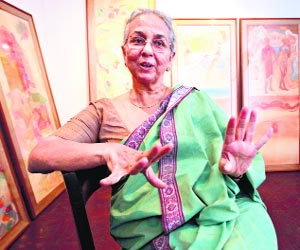
Artist Nilima Sheikh weaves words and images in her new collection of paintings on Kashmir
Six years ago,artist Nilima Sheikh entered Kashmirs fraught world through the poems of Agha Shahid Ali,drawing on her canvases his country without a post office,where searchlights chased shadows on curfewed nights and snow fell like ash on funerals. She returns to the region in her newest collection Drawing Trails,which goes on show at Gallery Espace in Delhi this week. This time,she is following the footsteps of another journeythe return of peace,of normal life,to Kashmir,but in a way that refuses simplistic resolutions. These paintings depict the unrest and talk about peace. They are an outcome of the turmoil but,at some level,surface my memories of Kashmir,as I often drove there with family as a child, says 63-year-old Sheikh,glancing at the 16 large works on sanganeer paper that make up the exhibition.
The colours are muted,almost gentle pastel shades,but thrown into sharp,sudden relief by bursts of red or blue. These are her notes on Kashmir,that tell the stories of trauma and grief in the lives of ordinary people. In Testimony,for example,against the familiar backdrop of snow-capped mountains,women try and rekindle a hearth. There is more to the region than violence, says the artist who lives in Baroda. As in the earlier collection,her paintings speak through both image and word,colours as well as poetry,drawing in the contemporary world through headlines and newsprint. A girl called Bhawan includes a poem by Nund Rishi/ Hazrat Nuruddin 1356-1440 C.E.. My hometown carries an excerpt from the article My Hometown by MK Raina,published in Communalism Combat,January 2005.


Like literature,the reference and use of the miniature technique of paintings is integral to her art. While most of her batchmates from MS University,Baroda,settled for oils,Sheikh abandoned the medium after pursing it for over a decade. I began to associate a lot of conceptual baggage with the easel. It became too pompous for me, she says. It was a casual conversation with teacher KG Subramanyan that drew her attention to the miniature tradition. He suggested that I look at it after he noticed that I had begun to thin my oils, says Sheikh. She borrowed elements from it,including the attention to detail and fine brushstrokes. That resulted in her first major work When Champa Grew Up in 1984. Through the collection of 12 tempera paintings,she documented the life of a young dowry victim.
Married to artist Gulammohammed Sheikh,she had,till then,lived a quiet life as a painter and a part-time teacherin the late 1970s,she taught for five years at MS University,where her husband too was a faculty member. Earlier one could not depend on art for a living. I let Gulam earn and decided to spend time with kids at home, she says. There is a glint in her eye when she talks about B.V. Suresh and V. Ramesh,who studied under her and are now established artists. A graduate in history from Delhi University,her art has mostly been a reflection of her surrounding. It led a fellow artist to comment that domesticity and femininity described her work. I didnt mind that. I like to paint what I see. It is the world I live in, says Sheikh.
Sheikh rues that she cannot dabble between paintings and installation the way younger artists do,but she is influenced by varied art traditions. If in The Country Without A Post Office,she merged techniques from Persian miniatures with 19th century Nathdwara temple backdrop,in her epic 1994 installation Shamiana,she attached scrolls to a canvas canopy to create a tent-like structure and painted it with classical iconographies from Indian manuscripts and Chinese scroll paintings. She is traditional in her choice of tools as well. While her paintbrush is made of squirrel hair,the stencils she uses are sourced from a family of sanjhi artists from Mathura.
What next? She admits she has become Kashmirs storyteller. There is so much to be shared about Kashmir,so much that the world should know, she says.


