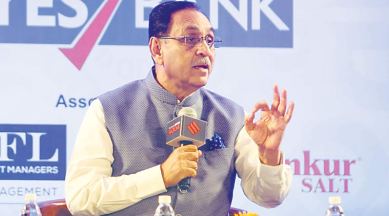
Gujarat CM Vijay Rupani. (Express Photo: Javed Raja)
Advertisement
Following the death of two Dalit safai workers while manually cleaning an underground sewer in Thangadh municipality area of Surendranagar district earlier this month, a memorandum has been submitted to Governor O P Kohli seeking to arraign Chief Minister Vijay Rupani as an accused in the case. The letter alleged Rupani as Chief Minister failed to ensure prohibition on manual scavenging in Gujarat. On December 11, two safai workers — Mohit Solanki (26) and Dipak Sodha (25) — from Thangadh had died of asphyxiation due to presence of poisonous gas after they entered a sewer line in Thangadh municipality to clean it. Both Solanki and Sodha were daily wagers.
Following their death, a criminal case has been registered by Thangadh police against chief officer of the municipality B C Chauhan for allegedly forcing them to enter the sewer without safety gear. The chief officer of the municipality is facing penal charges under provisions of the IPC, the Scheduled Caste & Scheduled Tribe (Prevention of Atrocities) Act and the Prohibition of Employment as Manual Scavengers and Their Rehabilitation Act. A complaint in this regard has been lodged by one Gelabhai Sodha, who works as a full-time safai worker with the municipality.
You’ve Read Your Free Stories For Now
Sign up and keep reading more stories that matter to you.
Keval Rathod, a human rights activist, said, “The complainant is a regular employee of the municipality and he has stated in his complaint that the chief officer forced the victims to go and clean the sewer line without safety equipment.” Rathod, along with many other locals from Thangadh, has submitted a memorandum to the Gujarat Governor seeking to arraign Rupani as an accused in the case.
“Under the provisions of the Prohibition of Employment as Manual Scavengers and Their Rehabilitation Act, 2013, manual scavenging has been prohibited. And as per data available through RTI applications, more than 200 Dalits have died while doing manual scavenging in the state in the last five years. As the head of the state, the CM is responsible for it,” Rathod said. The case is being investigated by Deputy Superintendent of Police P G Jadeja. However, so far, no arrest has been made in the case.
Jadeja said, “The complainant has named the chief officer of the municipality as an accused. How can we arrest him just because he has been named in the FIR? We will have to investigate as to who was the contractor who hired the deceased. We will ascertain it soon.”
Meanwhile, the Thangadh municipality has paid Rs 10 lakh each of the families of the two safai workers. This town falls in Chotila constituency which went to the Congress in the just-concluded election. Three Dalit youths were killed in police firing in Thangadh in September 2012. The government has not tabled the inquiry report on this incident in the Assembly.
Parimal A Dabhi works with The Indian Express, focusing on the state of Gujarat. Leveraging his seniority and access, Dabhi is recognized for his reporting on the complex interplay of law, politics, social justice, and governance within the region.
Expertise & Authority (E-E-A-T)
Core Authority (Social Justice and Law): Dabhi is a key source for in-depth coverage of caste-based violence, discrimination, and the state's response to social movements, particularly those involving Dalit and OBC communities. His reporting focuses on the societal and legal fallout of these issues:
Caste and Discrimination: He has reported extensively on social boycotts and instances of violence against Dalits (such as the attack on a Dalit wedding party in Patan), the community's demands (like refusing to pick carcasses), and the political responses from leaders like Jignesh Mevani.
Judicial and Legal Affairs: He tracks significant, high-stakes legal cases and judgments that set precedents in Gujarat, including the convictions under the stringent Gujarat Animal Preservation Act (cow slaughter), and developments in cases involving former police officers facing charges of wrongful confinement.
Political and Administrative Oversight: Dabhi provides essential coverage of the inner workings of the state government and the opposition, ensuring a high degree of Trustworthiness in political analysis:
State Assembly Proceedings: He frequently reports directly from the Gujarat Assembly, covering Question Hour, debates on budgetary demands for departments like Social Justice, and ministerial statements on issues like illegal mining, job quotas for locals, and satellite-based farm loss surveys.
Electoral Politics: His work details key political developments, including election analysis (voter turnout records), party organizational changes (like the end of C R Patil’s tenure as BJP chief), and campaign dynamics. ... Read More