


Stay updated with the latest - Click here to follow us on Instagram
© The Indian Express Pvt Ltd
Tags:


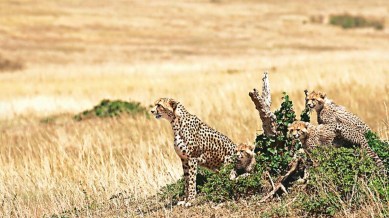
Focus on protecting contiguous forested habitats across Madhya Pradesh and Rajasthan will be key to achieve a metapopulation of 60-70 cheetahs in the future, according to the government’s 2023-24 annual progress report of Project Cheetah.
Establishing a metapopulation of wild cats is one of the long-term goals of Project Cheetah. Conserving the broader Kuno-Gandhi Sagar landscape — spread across protected areas and forest divisions in Madhya Pradesh and Rajasthan — would help in serving the goal, the report stated.


Metapopulations refer to the population of a species spread over a large but interconnected landscape.
Outside the Kuno National Park in MP, there is a contiguous forested habitat spread over 6,800 sq km and of which 3,200 sq km has high potential for cheetah occupancy, it said, adding that the landscape outside Gandhi Sagar Sanctuary also forms a contiguous habitat of savannah grassland and open woodlands spread across about 2,500 sq km.
“Cheetahs are a landscape species and it is in their natural behaviour to explore large areas,” said Qamar Qureshi, scientist, Wildlife Institute of India, who is also one of the report’s lead authors. However, once they settle, they might use smaller areas, Qureshi said, underlining that a large space is needed for their conservation.
“The landscape conservation plan would need a minimum of 10 years to achieve its targets,” he said.
The Kuno-Gandhi Sagar landscape is spread across Sheopur, Shivpur, Gwalior, Morena, Guna, Ashoknagar, Mandsaur and Neemuch in MP and Baran, Sawai Madhopur, Karauli, Kota, Jhalawar, Bundi and Chittorgarh in Rajasthan.
Regarding the prey population of herbivores, the annual report said leopards pose a significant competition to cheetahs in Kuno, vying for a small prey base, resulting in the population of chital, mainstay of cheetah diet, being in deficit. This calls for an immediate augmentation of prey, it said. Similarly, at Gandhi Sagar sanctuary, the next site for cheetah reintroduction, there is a prey deficit of nearly 1,500 chitals.
“Districts of Bhind and Datia in MP, Dholpur in Rajasthan as well as Lalitpur and Jhansi in Uttar Pradesh adjacent to this landscape would be incorporated as part of the landscape depending on cheetah’s use of the region,” it said.
Regarding the prey population of herbivores, the report said leopards pose a significant competition to cheetahs in Kuno, vying for a small prey base, resulting in the population of chital, mainstay of cheetah diet, being in deficit.
This calls for an immediate augmentation of prey such as chital and blackbuck, as well as captive breeding of these animals in predator-proof enclosures at multiple locations inside KNP, it said.
Similarly, at Gandhi Sagar sanctuary, the next site for cheetah reintroduction, there is a prey deficit of nearly 1,500 chitals.
As part of Project Cheetah, which has completed two years, 20 animals were translocated in two batches during 2022-23. At present, 24 animals survive of which 12 are adults and 12 are cubs, while 13 cheetah deaths have been reported.
In the coming months, the project will see two important developments. In Kuno, a few cheetahs will be released from enclosures into the larger unfenced area of the national park and a new batch of 6-8 cheetahs would be brought to Gandhi Sagar sanctuary.


Stay updated with the latest - Click here to follow us on Instagram


