ONE NIGHT in the early 1970s, dinner took an unexpected turn at Dhanmondi 32, the residence in Dhaka of Sheikh Mujibur Rahman, the founding father and first Prime Minister of Bangladesh. Distressed over a famine in the newly formed nation, Rahman refused to eat the meal served by his wife Sheikh Fazilatunnesa Mujib. He was disturbed, the food reminded him of the Bengal famine of 1943.

The legendary director, now 86, is helming Bangabandhu, an ambitious biopic on Mujibur Rahman. Featuring well-known Bangladeshi actors Arifin Shuvoo (Rehman) and Nusrat Imrose Tisha (Fazilatunnesa), the film is a joint production by Bangladesh Film Development Corporation (BFDC) and National Film Development Corporation of India (NFDC).
Shyam Benegal, now 86, is helming Bangabandhu, an ambitious biopic on Mujibur Rahman. (Express Photo by Amit Chakravarty)
“Bangabandhu was meant to celebrate the birth centenary of Mujibur Rahman (who was born on March 17, 1920) as well as the 50th anniversary of Bangladesh (Rahman declared Independence from Pakistan on March 26, 1971). Unfortunately, the film could not be ready in time to celebrate these landmarks as we were stopped in our tracks by the pandemic,” says Benegal, who came on board in early 2019.
Shooting has been on in Mumbai since January 21, 2021, with the current schedule slated to continue till mid-April. The film’s release date has not been decided, but production has picked up at a time when Prime Minister Narendra Modi is scheduled to visit Bangladesh on March 26 to take part in the 50th anniversary celebrations — his first trip abroad since the pandemic broke out.
“The remaining crowd and war sequences for the movie will be filmed in Bangladesh once the monsoon is over,” says Benegal.
The movie’s set is modelled on the original Dhanmondi 32, which was converted into Bangabandhu Memorial Museum in 1994. Reflecting the couple’s simple lifestyle, Shuvoo is dressed in a checkered lungi and white banian while Tisha is wearing an off-white handloom sari.
Story continues below this ad
“(Rahman) is almost like a protagonist of a Shakespearean tragedy. He was a man who loved his country too much. He also trusted his countrymen too much. In spite of multiple warnings, he never believed in increasing his personal security,” says Benegal, while referring to Rahman’s assassination on August 15, 1975 in a military coup.
For “Bangabandhu”, Benegal was clear about making the movie in Bengali. (Express Photo by Amit Chakravarty)
Rahman’s wife, three sons, and several other members of his family were also killed in the attack. His daughters, Sheikh Hasina and Sheikh Rehana, survived as they were in West Germany at that time. Sheikh Hasina is now the Prime Minister of Bangladesh.
“Bangabandhu won’t be following his life chronologically. It will touch upon certain turning points and aspects of his life that made Mujibur Rahman who he was… While making a biopic of a popular figure, one has to be careful about not falling into the area of hagiography. At the same time, you should not become too critical of the subject,” says Benegal, adding that the movie will go beyond the “public image of a leader” and offer glimpses of his private life.
Following his acclaimed debut with “Ankur” in 1973, Benegal has made several award-winning movies such as “Nishant” (1975), “Bhumika” (1977), “Junoon” (1979), “Mandi” (1983), “Sardari Begum” (1996) and “Zubeidaa” (2001). He has also directed biopics such as “The Making of the Mahatma” (1996) and “Netaji Subhas Chandra Bose: The Forgotten Hero” (2005).
Story continues below this ad
For “Bangabandhu”, Benegal was clear about making the movie in Bengali. “That’s why I chose to cast Bangladeshi actors in main roles. Though the original script written by Shama Zaidi and Atul Tiwari was in English, we have writers who adapted it in Bengali and brought in the local idiom,” he says.
The legendary director and his team visited Bangladesh, where most of the movie was to be shot originally before the pandemic arrived. (Express photo by Amit Chakravarty)
The legendary director and his team visited Bangladesh, where most of the movie was to be shot originally before the pandemic arrived. Zaidi and Tiwari also met Rahman’s family members and associates, and visited different locations linked to the leader. Nearly two years later, the set in Film City by Nitish Roy recreates the feel of 1970s Dhaka in great detail. The living room in Dhanmondi 32 has beautiful cane furniture while the coffee table sports a crochet cover. Kept in a corner is a TV enclosed in a wooden box with a vase of red roses on top.
After a lunch break, the unit rearranges the lights for the next scene. The camera moves to the bedroom where the Bangladeshi leader is relaxing with his wife and Hasina. In one corner is a study table with neatly arranged inkpots, letters, and a bunch of books by Rabindranath Tagore.


 5 min read


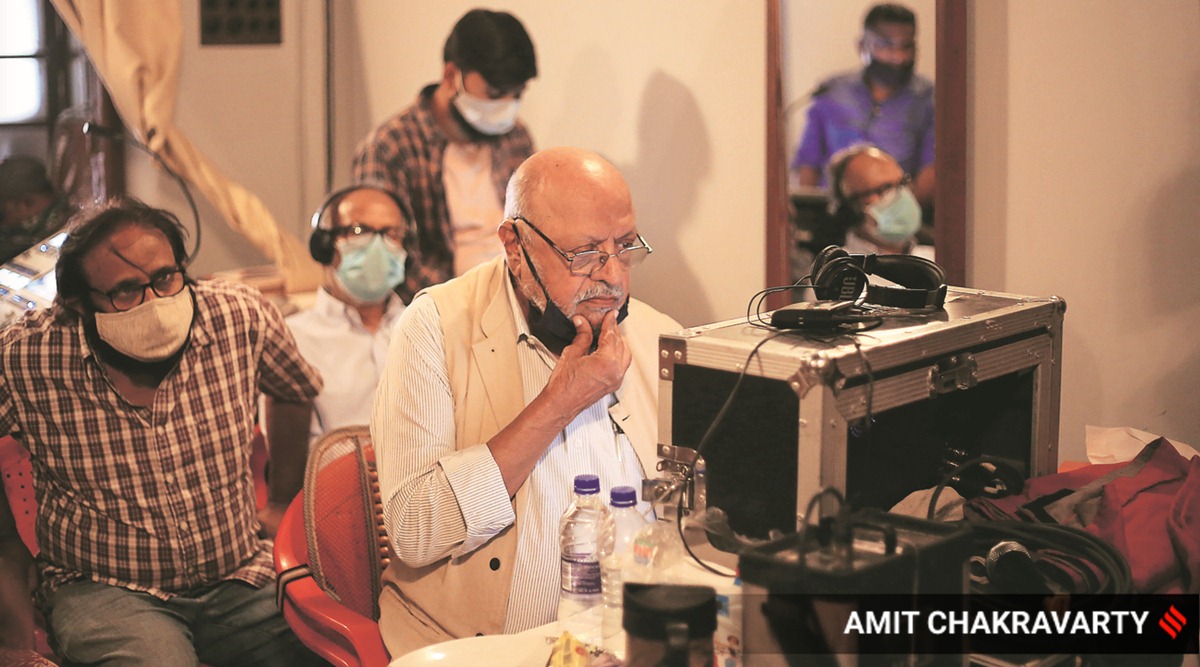

 Shyam Benegal, now 86, is helming Bangabandhu, an ambitious biopic on Mujibur Rahman. (Express Photo by Amit Chakravarty)
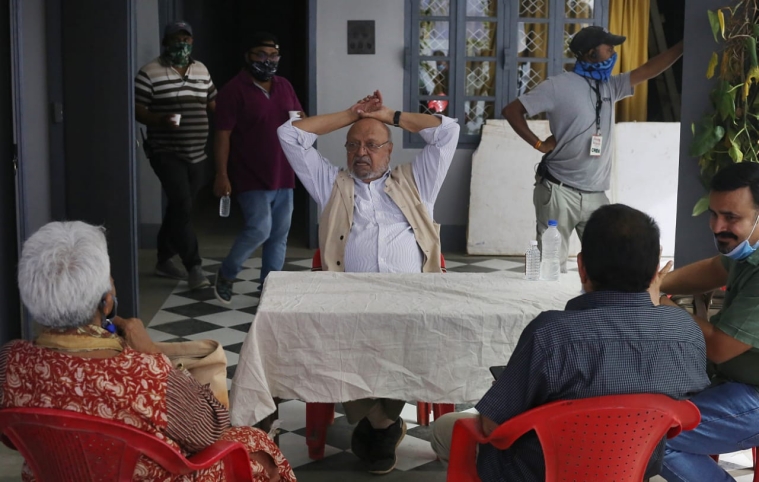 For “Bangabandhu”, Benegal was clear about making the movie in Bengali. (Express Photo by Amit Chakravarty)
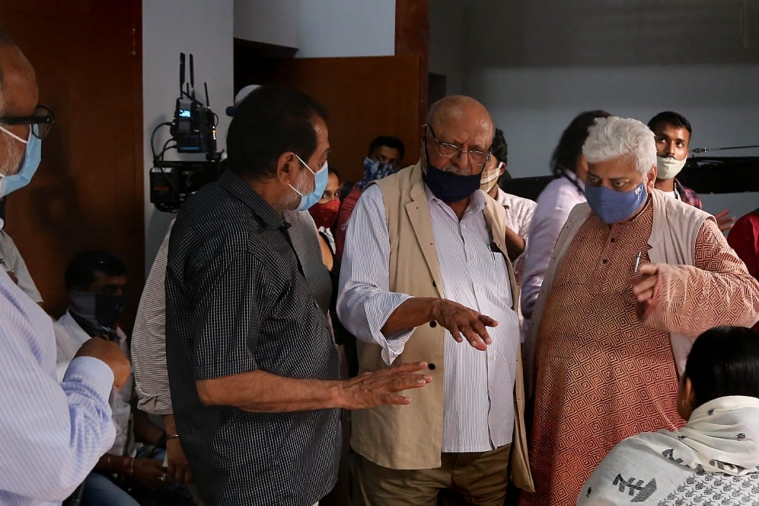 The legendary director and his team visited Bangladesh, where most of the movie was to be shot originally before the pandemic arrived. (Express photo by Amit Chakravarty)