Premium
This is an archive article published on November 4, 2015

Bihar polls: Away from broader poll rhetoric, caste comes first in Mithilanchal

Prime Minister Narendra Modi’s accusation that Nitish Kumar government was “sheltering terrorists” during a rally in Darbhanga has become a point of discussion.

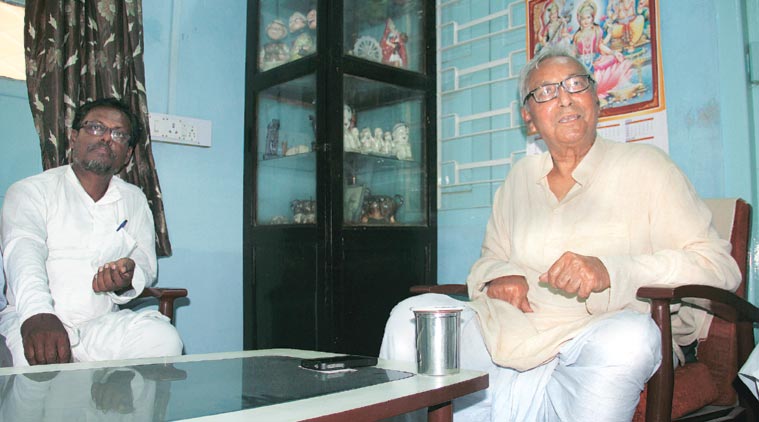
bihar elections, bihar polls, bihar elections 2015, bihar polls 2015, bihar, narendra modi, nitish kumar, bjp, jdu, lalu prasad, caste politics, caste, caste in bihar, caste politics in bihar, india news, news, latest news, politics R K Mahaseth (right), former RJD minister, has worked out why caste equations favour his son Sameer in Madhubani Town. (Source: Express Photo by Muzamil Jaleel)

Amid attempts to give the election in Mithilanchal region a Hindu majority-versus-Muslim minority complexion, the divide along caste remains deep as ever.

Prime Minister Narendra Modi’s accusation that Nitish Kumar government was “sheltering terrorists” during a rally in Darbhanga has become a point of discussion. “Such last-minute efforts won’t make a difference, for all voters have already made up their mind though they might not say so,” said Hazari Sah. He said the terrorist reference was to a few Muslim youths arrested from Barsamela village in Keoti constituency.

bihar caste

“They have been in jail for years. One of them was even killed in jail,” said Amresh Kumar. “Bha-Ja-Pa ki majboori hai. This election is becoming like the 1990 election and the only way to change it is to unite Hindus across castes. That is what they are trying.”

bihar elections, bihar polls, bihar elections 2015, bihar polls 2015, bihar, narendra modi, nitish kumar, bjp, jdu, lalu prasad, caste politics, caste, caste in bihar, caste politics in bihar, india news, news, latest news, politics Nitish Kumar with the RJD’s Faraz Fatmi Tuesday. Son of former MP M A Fatmi, Faraz is contesting from Keoti, where he lost by 29 votes in 2010. (Source: Express Photo by Prashant Ravi)

At Barsamela village, Arshad Ahmad’s reading is that attempts to divide voters along communal lines haven’t worked. “Our relations are very strong here and I don’t think people will respond to that effort,” he said. “Last time, RJD candidate Faraz Fatmi lost by 29 votes and the JD(U) was then with the BJP. This time Fatmi is in a good position.”

Fatmi faces the BJP’s Ashok Yadav. Another local Yadav leader, former MLC Misri Lal Yadav, has deserted the RJD and joined the BJP, which has fielded him in neighbouring Ali Nagar. This has led to various shifts of allegiance. While many Yadav voters are behind the BJP candidate, many Brahmins with an old grouse against Misri Lal have been talking about voting for Fatmi.

[related-post]

Far from the larger discourse of parties, what seems to matter for each candidate is how well he fits into the caste equations and his/her image with locals. For example, the maha gathbandhan seems to have given itself an edge in Harsidih with its choice of Rajendra Kumar, of the Ram caste. The battle here in 2010 was between two Paswans, which divided that vote while the Ram vote consolidated behind the BJP’s Krishna Nandan Paswan, who won. This time, the RJD has dropped its previous candidate, Satish Paswan, although he is well-known here. The BJP has renominated its candidate, who faces anti-incumbency.

The contest in Madhubani Town has many twists. Of its 12 candidates, two are Muslim – Samajwadi Party and Bharatiya Mitra Party – and three Brahmins, all independents. The fight is between the RJD’s Sameer Mahaseth and the BJP’s Ramdeo Mahato, sitting MLA since 2000. The SP has fielded an RJD rebel, Naiyar Azam, who lost by 500-odd votes to Mahato last time.

Story continues below this ad

Why did the maha gathbandan drop such a strong challenger, especially when there is a substantial Muslim population? With voters in Madhubani Town traditionally backing the BJP, the gath bandhan wanted to divide the vote of the business community.

Sameer’s father, R K Mahaseth, now 84, had won the election from here several times since 1968 and was a minister in the RJD government before he left the party 10 years ago. He explained: “Azam is a very close friend. He comes from among forward Muslims and the Ansari biradari didn’t let him become MLA; that’s how he lost by 500 votes last time. Laluji had a lot of faith in him but told him that he has only 100 tickets, and that he wants vidhayaks and not faces. He reached the conclusion that Sameer is a winnable candidate.”

The Mahaseths belong to the Suri caste and the family has influence in the town. “We have a very good reputation in the market here, votes that would otherwise go to the BJP,” the senior Mahasheth said. He said the BJP MLA did “nothing to develop the town”.

Anti-incumbency was indeed visible. At Subhash Chowk, youths Shiv Shankar Mahato, who manages a petrol pump, and Bablu Thakur, who works as a driver and is a Brahmin, both hoped Mahaseth will win “because the BJP candidate didn’t even step out of the car”. “The BJP shouldn’t have repeated Mahato,” said Thakur, otherwise a BJP fan. He felt Muslims wouldn’t go with Azam.

Story continues below this ad

Mahato, for his part, is confident about caste combinations in his favour. “Neither the Paswan nor the Manjhi vote will go with the RJD. That is with us,” he said. “The Brahmin vote will come to us. In 2014, the BJP led by 8,500 votes from this segment.”

He predicted a division of the maha gathbandhan vote. “There are around 70,000 Muslim votesand thankfully Naiyar Azam sahib will cut into at least 10 per cent of it, which will help us. It is true that some Suri votes will go to the RJD because of Mahaseth, but it will be limited to 3,000-4,000 from a total 15,000… I feel I will win comfortably.”

He agreed there is anti-incumbency against him. “It is natural that some people would feel let down because I have been the legislator for 15 years But then I don’t have any scandal against me,” he said. “Modiji is a big factor; that will work wonders for me.”

At a tea stall, around 15 people were chatting about the elections. Narendra Kumar Mishra said Modi would remain the PM for 20 years. “India will become a Hindu Rashtra. This is a Hindu country and we needn’t be apologetic about it.” He said Muslims should have nominated members in the assembly but shouldn’t be allowed to vote. “The nominated members can raise their issues.”

Story continues below this ad

Chanchal Kumar of the Halwayi caste said he wouldn’t go with the BJP — “They are promoting discontent for short-term benefits.” And Raj Kumar Mandav, of an EBC caste, said, “We are for Nitish. My three daughters go to school because they get food and clothes.”

Muzamil Jaleel is a Deputy Editor at The Indian Express and is widely recognized as one of India’s most authoritative voices on Jammu & Kashmir, national security, and internal affairs. With a career spanning over 30 years, he has provided definitive on-the-ground reportage from the heart of the Kashmir conflict, bearing witness to historic political transitions and constitutional shifts. Expertise and Investigative Depth Muzamil’s work is characterized by a rare combination of ground-level immersion and high-level constitutional analysis. His expertise includes: Conflict & Geopolitics: Decades of reporting on the evolution of the Kashmir conflict, the Indo-Pak peace process, and the socio-political dynamics of the Himalayan region. Constitutional Law: Deep-dive analysis of Article 370 and Article 35A, providing clarity on the legal and demographic implications of their abrogation in 2019. Human Rights & Accountability: A relentless investigator of state and non-state actors, uncovering systemic abuses including fake encounters and the custodial death of political workers. International War Reporting: Beyond South Asia, he provided on-the-spot coverage of the final, decisive phase of the Sri Lankan Civil War in 2009. Landmark Exposés & Impact Muzamil’s reporting has repeatedly forced institutional accountability and shaped national discourse: The Kashmir Sex Scandal (2006): His investigative series exposed a high-profile exploitation nexus involving top politicians, bureaucrats, and police officers, leading to the sacking and arrest of several senior officials. Fake Encounters: His reports blew the lid off cases where innocent civilians were passed off as "foreign terrorists" by security forces for gallantry awards. SIMI Investigations: He conducted a massive deep-dive into the arrests of SIMI members, using public records to show how innocuous religious gatherings were often labeled as incriminating activities by investigative agencies. The Amarnath Land Row: Provided critical context to the 2008 agitation that polarized the region and altered its political trajectory. Over the years, Muzamil has also covered 2002 Gujarat riots, Bhuj earthquake, assembly elections in Bihar for Indian Express. He has also reported the peace process in Northern Ireland, war in Sri Lanka and national elections in Pakistan for the paper. Awards and Fellowships His "Journalism of Courage" has been honored with the industry's most prestigious accolades: Four Ramnath Goenka Awards: Recognized for J&K Reportage (2007), On-the-Spot Reporting (2009), and Reporting on Politics and Government (2012, 2017). Kurt Schork Award: From Columbia University for international journalism. Sanskriti Award: For excellence in Indian journalism and literature. IFJ Tolerance Prize: For his empathetic and nuanced reporting in South Asia. International Fellowships: Served as a visiting scholar at UC Berkeley and worked with The Guardian, The Observer, and The Times in London. He has also received Chevening fellowship and a fellowship at the Institute of Social Studies, Hague, Netherlands. Professional Presence Current Location: New Delhi (formerly Bureau Chief, Srinagar). Education: Master’s in Journalism from Kashmir University. Social Media: Follow him for field insights and rigorous analysis on X (Twitter) @MuzamilJALEEL. ... Read More

Stay updated with the latest - Click here to follow us on Instagram
Latest Comment
Post Comment
Read Comments
Advertisement
Advertisement
Loading Taboola...
Advertisement