Journalism of Courage



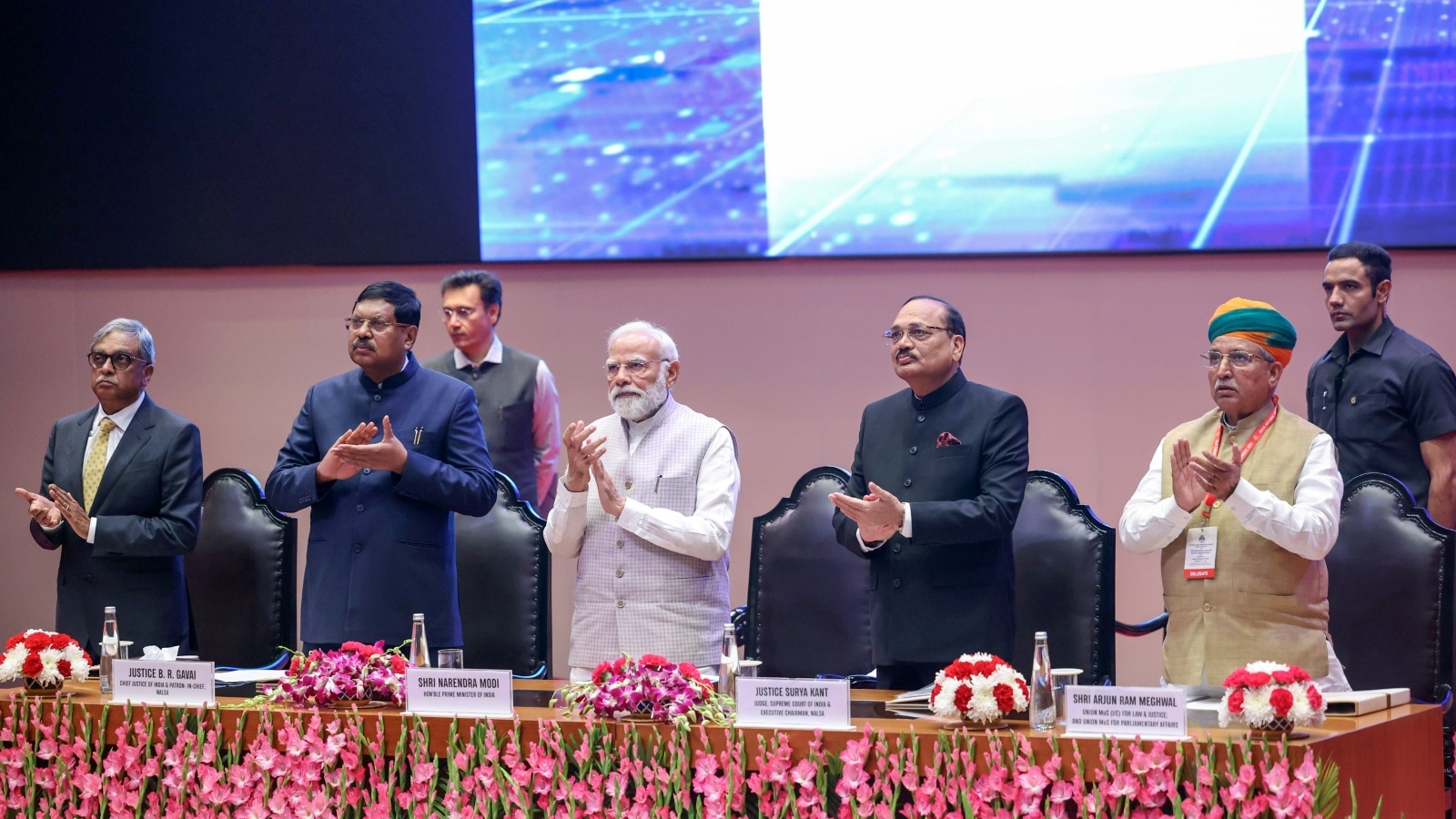 Prime Minister Narendra Modi with Chief Justice of India, Justice Bhushan Ramkrishna Gavai, newly appointed Chief Justice of India, Justice Surya Kant, and Union Minister for Law and Justice, Arjun Ram Meghwal, during the inauguration of the National Conference on “Strengthening Legal Aid Delivery Mechanisms” in New Delhi on Saturday. (ANI Photo)
Prime Minister Narendra Modi said Saturday that ease of living and ease of business are possible only when ease of justice is ensured.
Speaking at the National Conference on Strengthening Legal Aid Delivery Mechanisms, organised by the National Legal Services Authority (NALSA) to mark the Legal Services Day, Modi said, “Ease of Doing Business and Ease of Living are truly possible only when Ease of Justice is also ensured. In recent years, several steps have been taken to enhance Ease of Justice and going forward, we will accelerate efforts in this direction.”
Underlining the significance of legal aid, he said the “language of justice should be that which can be understood by those receiving it”. This, he said, must be considered at the time of drafting laws.
Pointing to the need for judgments and legal documents to be made available in local languages, he said that when people comprehend the law in their own language, it will lead to better compliance and reduce litigation.
“When justice is accessible to all, delivered in a timely manner, and reaches every individual regardless of their social or financial background, that is when it truly becomes the foundation of social justice,” he said.
Referring to the crucial role that legal aid plays in ensuring such accessibility, he said legal services authorities act as a bridge between the judiciary and the common citizen, from the national to the taluka level.
Modi said lakhs of disputes are being resolved swiftly, amicably, and at low cost through Lok Adalats and pre-litigation settlements. He pointed out that nearly 8 lakh criminal cases were resolved in just three years under the Legal Aid Defence Counsel System initiated by the government. These efforts, he said, have ensured ease of justice for the poor, the oppressed, the deprived and the marginalised sections.
Stating that the government has consistently focused on enhancing Ease of Doing Business and Ease of Living in the last 11 years, he said more than 40,000 unnecessary compliances for businesses have been removed. Through the Jan Vishwas Act, over 3,400 legal provisions have been decriminalised, more than 1,500 obsolete laws repealed and long-standing laws replaced with the Bharatiya Nyaya Sanhita.
Speaking on the occasion, Chief Justice of India B R Gavai said the legal aid scheme “reminds us that justice is not a privilege of the few but a right of every citizen, and that our role, as judges, lawyers, and officers of the court, is to ensure that the light of justice reaches even the last person standing at the margins of society”.
He said “the real measure of our success is not in numbers but in the trust of the common person, in the belief that someone, somewhere, is willing to stand by them. And that is why our work must always be guided by the spirit that we are changing lives”.
“We must keep envisioning legal aid not as a reactive system, but as a living movement. We must not wait for distress to knock on our doors. Instead, we must continuously reflect on how society is changing, on the new challenges, the new forms of exclusion, and the emerging needs of the people we serve. The strength of a just society lies in our ability to foresee where injustice may arise, and to reach there before it does,” the CJI said.
NALSA National Executive Chairman and Chief Justice of India-designate Justice Surya Kant said, “The Legal Services Day reminds us that the true measure of a justice system is not how swiftly it decides complex cases, but how deeply it touches the lives of ordinary citizens. It celebrates the partnership between those who interpret the law, those who implement it, and those who carry its light to the farthest corners of our country.”
“When our Constitution was framed, the goal was not just to create a legal order but to nurture an instrument that secures fairness, human dignity and equal protection for all. Legal aid is where that design meets reality. It converts a constitutional value into pragmatic relief – a means by which the poor, the marginalised, and the ‘Invisible Victims of the System’ can assert their rights, obtain remedies, and be heard,” he said.
Through these efforts, he said, “millions have been spared lengthy litigation through conciliatory forums; lakhs have found representation without any cost; a lot many victims have received statutory compensation; thousands have got their disputes resolved through mediation – each outcome translating law into relief and stability for ordinary lives. These numbers are not mere figures; they are people whose problems were met with practical help,” the CJI-designate said.

 5 min read