A broken machine and a dead end: Why last stretch has taken the most time at Telangana tunnel, where 8 men were trapped
According to rescuers, when they finally removed parts of the boring machine, desilted and dewatered to progress, they were met with a dead end with no trapped workers in sight.
Written by Nikhila Henry
Hyderabad | Updated: March 2, 2025 08:15 AM IST
4 min read
Whatsapp
twitter
Facebook
Reddit
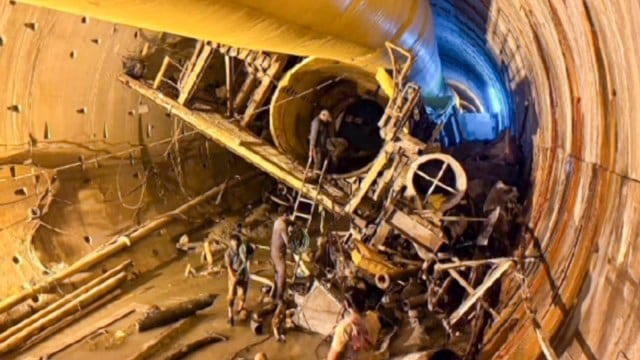
Nagarkurnool: Rescue operation underway to trace workers trapped inside the partially collapsed Telangana's Srisailam Left Bank Canal tunnel, in Nagarkurnool, Telangana, Saturday, March 1, 2025. (PTI Photo)
The last mile took the most time. While the rescuers had dug more than 13 km into the SLBC tunnel — a part of which had collapsed trapping eight men on February 22 — they could not dig through the last 350 meters because it was blocked by a broken Tunnel Boring Machine, silt and water for more than 72 hours.
On February 22, a portion of the under-construction SLBC tunnel collapsed, Trapping Project Engineer Manoj Kumar and Field Engineer Sri Niwas from Uttar Pradesh, workers Sandeep Sahu, Jagta Xess, Santosh Sahu and Anuj Sahu from Jharkhand, worker Sunny Singh from Jammu and Kashmir, and worker Gurpreet Singh from Punjab. A week later, search operations continued to find the eight men.
According to rescuers, when they finally removed parts of the boring machine, desilted and dewatered to progress, they were met with a dead end with no trapped workers in sight.
“The tunnel boring machine was 120 meters in length. It broke away during the collapse and travelled towards the tail of the tunnel for about 200 meters. Then there was the space of 40 meters where the men were believed to be trapped. So, in total, we had to traverse through about 350 meters of the most difficult terrain to reach the men,” a rescue operator told the Indian Express.
During the last 72 hours, the rescue team of State Disaster Rescue Force (SDRF) and Singareni Collieries engineers were chipping away parts of the boring machine and desilting and dewatering through slush. “We had to stop many times because the machine parts were blocking the way. Finally, we managed to remove the machine parts for about 200 meters,” the top rescuer explained. The South Central Railways team also did their bit to cut through dangled wires and pipes. “They cut through 60 pipes to reach the dead-end,” the rescuer said. When there was no sight of the men despite reaching the last 100 meters, the rescuers called in the National Geophysical Research Institute (NGRI).
The NGRI team brought in a Ground Penetrating Radar (GPR) machine which scanned the area, thick with silt. After the scan, four points where bodies of the men could be found were identified. “We dug through these points,” a rescuer said. Minister Jupally Krishna Rao, who visited the site Saturday evening, said, “We have identified the location of four people. They will be brought out by tomorrow evening as a lot of desilting is to happen.” The rest of the four can be “brought out only after two days,” Krishna Rao said.
Meanwhile, District Collector of Nagarkurnool, Badavath Santhosh, tried to rally spirits even though the rescuers were digging about three metres into the mud at the dead-end. “The rescue operations are going on and we have not found bodies,” Sathosh told the media in Nagarkurnool, where the tunnel is located. The collector also said that the ventilation system inside the tunnel remained functional, ensuring oxygen supply.
Story continues below this ad
On Saturday morning, however, the situation remained grim. “We knew that two people were inside the boring machine when the accident took place. So, we are cutting through more parts of the machine to find them,” the rescuer said. To speed up the digging process, two excavators were sent into the tunnel on Saturday morning.
Nikhila Henry is an Assistant Editor at The Indian Express, based in Hyderabad. With a career spanning 17 years, she has established herself as an authoritative voice on South Indian affairs, specialising in the complex intersections of politics, education, and social justice.
Experience & Career: Nikhila commenced her journalism career in 2007 as an education correspondent for The Times of India in Hyderabad,where she gained recognition for her coverage of student politics. Her professional trajectory includes a four-year tenure at The Hindu, where she focused on minority affairs and social welfare. In 2019, she took on a leadership role as the South Bureau Chief for The Quint, where she directed regional coverage across all five South Indian states. Her expansive career also includes a tenure at the BBC in New Delhi and contributions to prestigious international outlets such as The Sunday Times (London) and HuffPost India.
Expertise & Focus Areas
Nikhila’s reportage is marked by a deep-seated understanding of grassroots movements and institutional policy. Her core focus areas include:
Regional Politics: Comprehensive analysis of the socio-political dynamics across South India.
Education & Student Movements: Chronicling the evolution of Indian academics and the rise of youth activism.
Minority Affairs: Rigorous reporting on the welfare, rights, and challenges facing marginalized communities.
National Beat: Elevating regional stories to national prominence through investigative and on-ground reporting.
Authoritativeness & Trust
A respected figure in Indian media, Nikhila is not only a seasoned reporter but also an accomplished author and editor. She authored the critically acclaimed book The Ferment: Youth Unrest in India and edited Caste is Not a Rumour, a collection of writings by Rohith Vemula. Her dual background in daily news reporting and long-form authorship allows her to provide readers with a nuanced, historically-informed perspective on contemporary Indian society.
Find all stories by Nikhila Henry here. ... Read More


 4 min read