Journalism of Courage



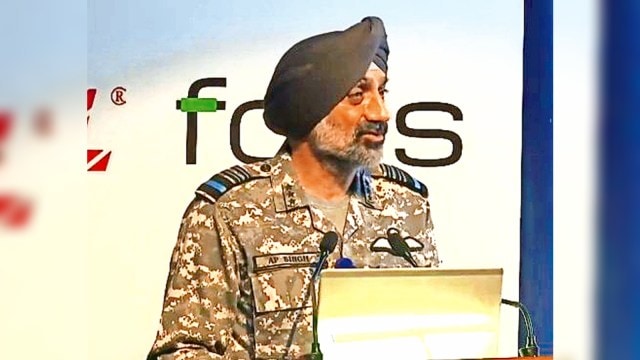 Indian Air Force Vice-Chief Air Marshal AP Singh. ANI
Atmanirbharta or self-reliance cannot be achieved at the cost of India’s national security, Vice Chief of the Indian Air Force (IAF) Air Marshal AP Singh said Friday, while underlining that geopolitics has thrown up the lesson of being self-reliant and that should be pursued holistically in letter and spirit.
The strong words from the top IAF officer comes at a time when the central government has put its weight behind achieving full self-reliance in defence even as the IAF grapples with shortage of fighter aircraft and other essential defence equipment with the ongoing Russia-Ukraine war affecting much of their serviceability.
At a seminar and exhibition on Air and Missile Defence India 2024 — organised jointly by the Centre for Air Power Studies (CAPS) and Indian Military Review (IMR) — Air Marshal Singh said the rate at which India’s adversaries are building their numbers, while imbibing new technologies, the capability gap is continuously growing.
“Atmanirbharta cannot be achieved at the cost of our national security,” he said, adding DRDO, DPSUs and the private industry need to focus on innovative technologies, out of the box solutions and increase of capability and capacity.
“If geopolitics has a lesson, it is to be self-reliant,” he said, adding that Atmanirbhar Bharat should not just be a buzzword, but should be an overriding concern and pursued holistically in letter and spirit.
Stating that the IAF has ongoing Air Defence contracts worth Rs 1,12,000 crore and contracts worth Rs 2,75 crore in the pipeline, he said the force has engaged with DRDO and private industry for bolstering its capabilities in radars, SAGW systems and CUAS weapons (soft as well as hard kill).
“We have a credible and comprehensive networked air defence. Impetus is also being given in the fields of directed energy weapons, close-in weapon systems, CCD and modernising our aerial platforms and surface-to-air guided weapon systems,” he said.
He further said that the rapid pace of technological advancements continues to be a surprise. “The impact of technology infusion into war fighting has made it crystal clear that we in the Armed Forces need to be more agile and flexible in both thoughts and actions.”
He said the ongoing Russia-Ukraine conflict is among the prime examples of such trends that unambiguously exhibit a “Multi-Domain Battlespace” — the much talked about Anti-Access Area Denial — A2AD strategy of Russia and China being a classic example.
“The conflict has demonstrated integration of multiple forces in domains of air, land, sea, information, cyber and space, to achieve military goals,” he said.
He highlighted that the air domain has clearly emerged as a singular trans-domain link, a strong source of cross domain application of force acting as an enabler, and a force multiplier.
He citing the example of the urban warfare construct of Israel Hamas conflict, where he said the air domain has been used extensively – by fighter aircraft dropping precision munitions, low-cost rockets and loiter munitions used by Hamas or the Iron Dome system defending Israel.
He said an early warning or detection system for the wide array of aerial threats, a secure and redundant communication system to ensure exchange of data or information in real time unambiguously, a robust command and control structure to aid analysis of inputs and decision making and killing the aerial threats with a lethal system comprising fighter interceptors to LRSAMs to CIWS are among the basic requirements of any Air Defence system.
He added that the nation today, faces a range of new challenges including increasingly aggressive and unorthodox application in the sub-conventional domain to a highly dense conventional battlespace.
“The IAF is aware of the complexities of modern battlespaces and has put in place plans to ensure optimal utilisation of available resources while parallelly bolstering our capability through upgradation and procurements,” he said.
He also spoke about operationalising a dedicated Weapon System Branch, adding that a sub branch of this will be dedicatedly responsible for the surface-to-air guided weapons.

 4 min read