


© The Indian Express Pvt Ltd
Tags:


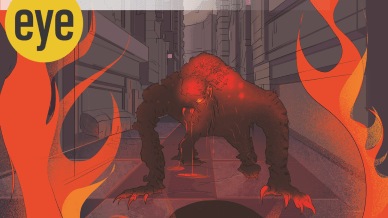
I look out the window of the taxi and I see a great beast, more human than hound or cat, awful and unexpected to my reality-tempered eye, and it is mounting another one on the side of the road, a jarring evolution of the sight of stray dogs copulating frantically alongside passing traffic. The taxi driver slows, and so does time. There is nothing frantic in the coupling of these beings. It is bestial and magical at the same time, like watching two tigers fighting in the wild. Their fur blazes in the dusky light, streaked with smoky stripes rippling over muscle. There are no people near them. Perhaps, they fled indoors. The beast and its kneeling mate turn to look at me. Their eyes are radiant in the reflected light of the fire burning on the footpath. Tires curl into tarry snakes in the dancing blaze. In the kindling, I see the familiar lines of a body, a corpse wrapped in a saffron shawl of flames and blackened to cinder. The car lurches as the taxi driver speeds up, and I look at the pair as they recede, refusing to vanish despite the wind in my eyes and hair. They keep looking at me. Somewhere, a siren’s blue bleat rises, the city’s surprised reply to this affront.
There they are, for the world to see.

***
In time there are no impossibilities, though on closer inspection they become banalities. Our phones flash with images of hybrid beasts, chimeras that appear and then vanish as if they were never there. In my city, as in others, one is burned by a mob. The body turns out to be human, blunt teeth embedded like gemstones in the char. These tiger-men (no one calls them tiger- women, though they have no gender but what we give them) and Hanumans and elephant-headed beings, we are told, are the result of experimental generative AI holograms developed by the Chinese, worn by Bangladeshi immigrants to sow discord and terror in India. The man burned to death by mob was a miscreant, a terrorist.
Magic does not exist, unless it is magic endorsed and embittered by the powers of the world.
***
When I asked the taxi driver what he saw, he said he saw two asuras fighting. I thought they looked like they were making love. He said they must have come from the drowned land of the Sundarbans, hungry for vengeance after the mangrove forests vanished in the rising waters of our avarice and apathy. In his dazed look there was fear, monsters bounding through our city streets, claws and fangs dancing in sunlight to shed rivers of blood. Yet this seemed a more beautiful explanation than what I saw later on our social feeds, of holograms and gaslight.
***
I wonder if those chimeras in their animal union were undergoing a ritual of mourning, next to that burning body. Was it one of them, before magic burned away in that daylight like alcohol, emitting the blue flame of terrible reason, reducing their impossible kin to mere human. Were they shapeshifters desperate to enchant the dying world?
***
Among the videos, there is one from the Himalayas, where once lay snow on the summer slopes of the naked mountains. It shows a towering fur-clad figure loping across a hillside. Indian soldiers shoot at it. Border drones hunt it, but it vanishes into the rocky grey as if made of mist. In the villages gathered around their artificial glaciers, they call it a yeti. They think it a good omen, and pray for a good winter and the snow’s return, and with it water to parch the droughts.
***
From my flat in Smart Zone 7, I can see the towers of a server city on the other side of a canal, squatting on what was once a green sheet of farmland. Highrises with no occupants but unthinking artificial intelligences, familiars for the higher powers, swarming the air and settling in our devices to eat our data and vomit it into easily categorized and surveilled information for their masters. On news channels, they narrate the news, their faces slurring into ghostliness and their language often nonsensical, though it hardly matters. On socials, they transform into troll armies to attack antinationals. In movies, they reanimate dead stars of eras gone, their muscles gleaming godly as they destroy India’s enemies. All around the server city are slums, filled with the life that the towers cannot hold. I wonder at the heat the server cities radiate, wonder if they can truly conjure chimeras into the true world, not the digital one, now.
***
I remember the pungent smell on the wind as the taxi passed those two chimeras in their silent copulation, that primal ritual next to the dead. The scent of living beings.
At night, I walk to the runoff canal around the city of AIs in their towers. On the other side, people in the slum are dancing, the warm air threaded with drums. In the light of their solar lanterns, I see two dancers painted in red, orange, black, their bodies close. In flesh they have become the chimeras that we’re told are holograms in our rule-based world. They are as beasts in the shadow of those digital towers. I, too, am a beast, enchanted by the dance, dancing under the stars and the uncaring drones.
Indrapramit Das (aka Indra Das) is the Shirley Jackson, British Fantasy & Lambda Literary Award-winning cross-genre author of (Penguin India/Del Rey) and The Last Dragoners of Bowbazar (Subterranean Press)


