


© The Indian Express Pvt Ltd
Tags:


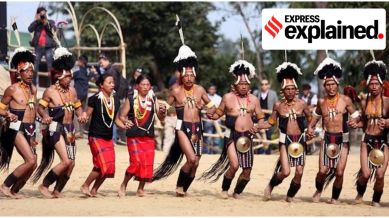
The 25th edition of Nagaland’s famed Hornbill Festival is now underway amidst a wide public debate on relaxing the 35-year-old liquor prohibition law for the duration of the festival.
Tourism Minister Temjen Imna Along said that the government has granted tourists and stall owners permission to use Indian-made Foreign Liquor (IMFL) within the festival venue, the Kisama Heritage Village.

This move has been decried by influential church bodies, who have long contested the effort to make alcohol, including traditional rice beer, publicly available at the state’s largest gathering.
Lending the situation complexity is the state government’s proposed review of the Nagaland Liquor Total Prohibition (NLTP) Act 1989.
The Hornbill Festival, organised by the Nagaland government, is the state’s largest public event. Started in 2000 as an annual tradition, it aims to boost tourism by showcasing Naga heritage and culture, and thus act as a unifying force within the state. The festival acts as an umbrella of the major festivals celebrated by the 14 recognised Naga tribes in the state, each replete with its own traditions and practices.
The festival is the state’s biggest tourist draw: In 2023, the 10-day festival witnessed a footfall of over 1.54 lakh, including 2,108 foreign tourists and 37,089 from different parts of India.
The Hornbill Festival holds a special place within the larger public debate on liquor prohibition in the state.
According to academic Theyiesinuo Keditsu, “This is the only time in this dry state that Thutse or local rice beer is openly sold and liberally consumed with the consent of the government.” In her paper, ‘Prohibition and Naga Cultural Identity: Cultural Politics of Hornbill Festival, Nagaland’, she has identified the constant tussle between the Church and the organisers as a struggle to define the “Naga ethnic identity vis-a-vis Christian identity.”
In the past, the Nagaland government has succumbed to pressure and enforced alcohol bans during the festival.
While the inclusion of local rice beer is being debated presently, Tourism Minister Along has supported easing restrictions on IMFL to welcome tourists to the state.
The Nagaland Baptist Church Council (NBCC) – the apex body of Baptist Churches in the state disagrees. It said, “The tourists are not visiting our state because there is a provision for visitors to drink liquor in Nagaland” but to “experience our culture and our heritage and our tribal way of life.”
Complete prohibition was officially introduced in Nagaland in 1989 through the NLTP, backed by the Church and the state’s apex women’s organisation, the Naga Mothers’ Association (NMA).
The arrival of American Baptists to Nagaland in the 1870s introduced new moral codes to a state where brewing rice beer was widely practised. The consumption of alcohol was subsequently painted as sinful behaviour with strict penalties for converts. Ethnographer J.P. Mills wrote that from the 1890s onwards, alcohol was strictly forbidden and transgressors would be expelled from the community.
Today 87% of the state’s population is Christian, a majority of whom are Baptists. However, the preparation and consumption of rice beer has continued to this day.
The government initiated a discussion on the efficacy of the prohibition law as a matter of urgent public importance in the last state assembly session in August. Drawing attention to the “Health Hazards of Spurious Alcohol”, the government’s Advisor on Excise Moatoshi Longkumer said there was a case for regulating alcohol use instead of prohibition.
He said that the “intended objectives” of the Act had not been met and the state continues to witness large-scale liquor smuggling from neighbouring Assam. He also pointed to the prevalence of bootleggers and spurious alcohol in the state, as well as people resorting to narcotics.
The government could also be motivated to stem the loss of excise revenue due to this policy. While the Nagaland government is openly considering a rethink, the Church’s opposition continues to loom large over such a move.


