


© The Indian Express Pvt Ltd
Tags:


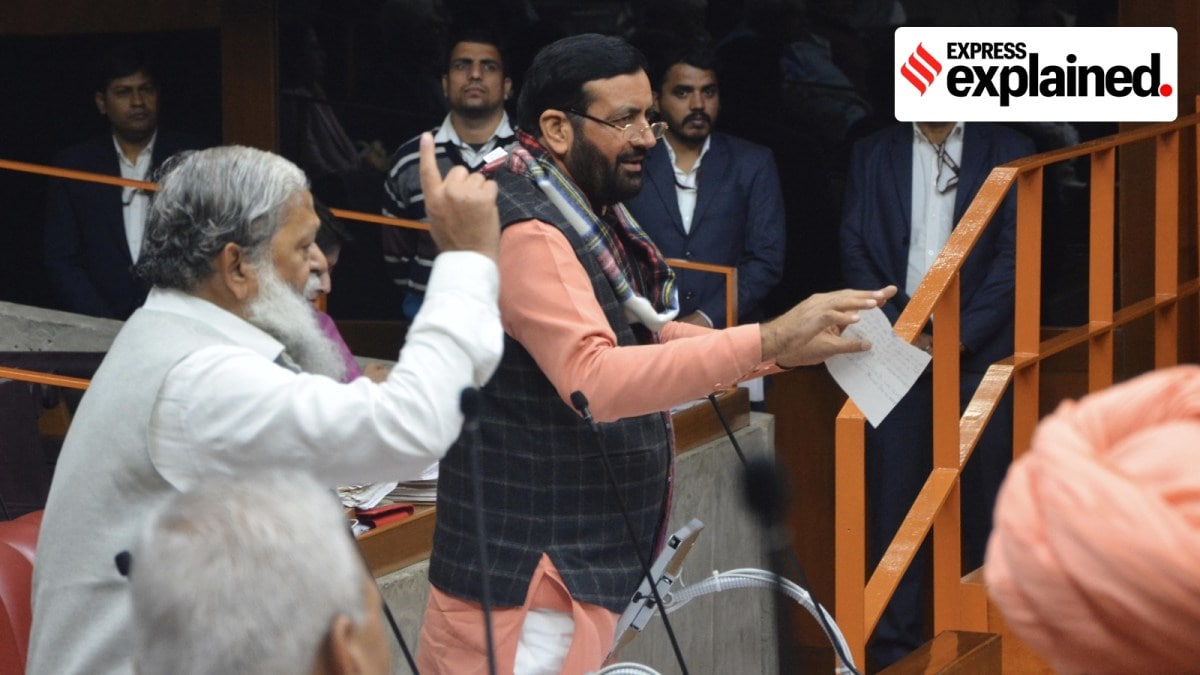
On December 30, Haryana Labour Minister Anil Vij called for an independent probe into an alleged Rs 1,500-crore scam — within the department he himself heads.
The alleged scam involves work slips and registration papers of construction workers, documents central to welfare schemes for this vulnerable worker group.

Haryana Chief Minister Nayab Singh Saini Thursday formed a three-member panel to investigate the issue.
To understand how the alleged scam unfolded, we explain what these work slips are, why they matter, how they are supposed to work and what benefits genuine workers are entitled to.
Why do work slips and registration certificates matter for construction workers?
In India, construction workers are usually unorganised and lack job security. The Building and Other Construction Workers Welfare Board, a statutory body, administers welfare schemes for them.
To be eligible for these welfare schemes, a person must first register with the welfare board as a construction worker and then obtain annual or periodic work slips — also called work receipts — certifying that they have actually engaged in construction work for at least a certain period. This minimum period is typically 90 days in a year.
The registration certificate identifies a person as a construction labourer, while the work slip proves that they have satisfied the minimum work requirement.
A worker needs these documents to access welfare benefits such as financial support, pensions and education assistance.
In essence, work slips are both identity documents and enablers of state-funded benefits for construction workers, designed to protect them from economic insecurity. “These documents are the gateway that determines whether someone can receive government benefits,” said an official with the Haryana Labour Department.
How are these work slips issued?
Under official rules, a worker applies for registration with proof of identity, age, and evidence of working in construction. Once registered, they must provide proof (like employer certificates) that they have worked on construction sites. Based on this, the board issues a work slip (often digitally) indicating that the worker has completed at least the minimum required days (90 days) of construction labour for that year. In many districts, these work slips are entered into an online system, which is supposed to be vetted by officials who check field records and physical evidence (including site inspections) before certifying them.
What exactly is the work slip scam that has surfaced in Haryana?
According to the Labour Minister Vij, about four months ago, the Labour Department’s officials noticed irregularities in how work slips were being processed.
In many districts, thousands of workers’ work slips were found to have been certified by a single official in timeframes that were physically impossible. For example, in one case 2,646 slips were verified in one day by one employee that included physical site inspections.
This prompted an initial verification in a few districts that confirmed widespread irregularities.
The department then ordered door-to-door physical verification by multi-member committees in each district. The provisional findings of this four-month verification exercise from 13 districts revealed a startling picture — of the total of 5,99,758 work slips issued between August 2023 and March 2025, only 53,249 were valid.
Similarly, out of 2,21,517 “registered construction workers”, only about 14,240 were found to be legitimate. In many cases, entire villages were fraudulently registered with fake identities, creating “phantom workers” who never did construction work but received work slips just the same.
A senior official of the Haryana Labour department said: “This is not a case of clerical errors, It is systemic collusion, lax verification, and possibly organised manipulation of the registration and work slip process allowed ineligible individuals to claim government benefits. Because each fake worker could be eligible for benefits averaging about Rs. 2.5 lakh, the impact on public funds could be massive”.
How has the government responded?
Vij has described this as a major scam, potentially amounting to about Rs 1,500 crore. “Irregularities began with implausible verifications, where a single employee was found signing off on thousands of work slips — far more than what could have been legitimately verified. Ineligible individuals were availing benefits they had no right to, which is nothing short of looting,” he said, adding that he wrote to the Chief Minister about the issue.
On Thursday, CM Saini constituted a high-level inquiry committee including senior IAS and IPS officers who have been tasked with submitting a report within a month. The CM directed that reports from all districts, including nine districts that were still pending, should be collected to determine the full extent of the financial loss and irregularities.
What benefits are registered construction workers entitled to?
In Haryana, construction workers and their families are entitled to a wide range of benefits — from maternity benefits to educational assistance. The government also provides financial assistance for marriage for women family members as well as women workers. They are also entitled to medical benefits, pensions and home loans.
The following is a detailed break-up of the benefits on offer:
Maternity benefits of Rs 36,000; paternity benefit of Rs 21,000; educational support for workers’ children ranging from Rs 8,000 to Rs 20,000 annually (from primary to higher education); merit-based scholarships between Rs 21,000 and Rs 51,000 for children scoring 60% to 90% in Class 10 and 12 exams; reimbursement of full academic expenses for children pursuing professional or technical courses as per actual government expenses; hostel facility aid up to Rs 1.2 lakh for children of workers in vocational institutes; coaching assistance for vocational courses from Rs 20,000 to Rs 1 lakh; incentive of Rs 50,000 for registered workers’ daughters to purchase an electric scooter; laptop grant of Rs 49,000 under the CM Shram Yogi Pratibha Yojana.
Additionally, the registered construction workers are entitled to: Rs 5,000 for bicycle purchase; Rs. 8,000 as tool grant; Rs 4,500 for a sewing machine; Rs 5,100 under the CM Women Construction Worker Samman Scheme; Rs 1,01,00 for the marriage of up to three daughters of registered workers under the Kanyadaan Yojana; Rs 50,000 for the self-marriage of a female worker; full reimbursement of second-class train or regular bus fare for pilgrimages or visits to historical sites; reimbursement of travel expenses for visiting one’s ancestral home; financial assistance up to Rs 1 lakh for treatment of chronic diseases; disability support ranging from Rs 1.5 lakh to Rs. 3 lakh; disability pension of Rs.3,000 per month; Rs 3,000 per month for children with disabilities; old-age pension (after age 60) of Rs 3,500 per month; family pension of Rs 1,750 per month; widow pension of Rs 3,000 per month; under the Mukymantri Shramik Samajik Suruksha Yojna: Rs 5,15,000 compensation for accidental death at the workplace, Rs. 1.5 to 3 lakh for disability at the workplace for unregistered workers and Rs 4 lakh in case of death of an unregistered worker at the workplace.
Interest-free loan up to Rs. 2 lakh for house purchase or construction and Rs. 1,100 incentive under the Mukyamantri Panjikaran Protsahan Yojna are also additional benefits.


