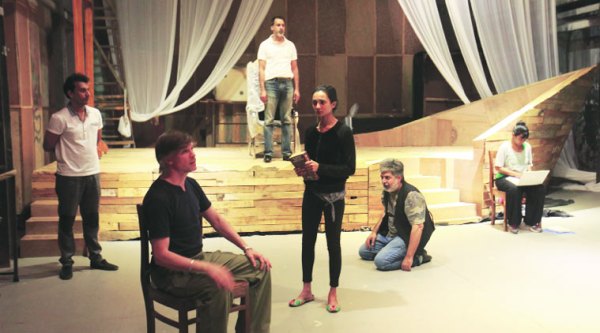
The set of The Merchant of Venice resembles a ship.
Most theatrewallahs will concede that staging Shakespeare’s plays can be risky and taxing. Vickram Kapadia was well aware of this when he was toying with the idea of directing The Merchant of Venice last year. However, once Aadyam — an initiative by the Aditya Birla Group — that’s supporting five new plays this year by Mumbai-based theatre groups, showed interest in this tale of generosity and greed, Kapadia upped the scale of his production.
He roped in veteran stage designer Fali Unwalla to create a set that resembles a ship; sought the help of Andrew Wade, former head of voice at Royal Shakespeare Company, to make sure that his cast retained the purity of Shakespearean diction; and brought designer Gaviin Miguel on board for costumes to add authenticity to this period drama.
You’ve Read Your Free Stories For Now
Sign up and keep reading more stories that matter to you.
Ahead of the play’s premiere at Jamshed Bhabha Theatre of National Centre for the Performing Arts (NCPA) on Friday evening, the rehearsals at Dadar’s Sitara Studio are in full swing.
One of the actors is back after spending five days in the hospital and Kapadia has just recovered from a bout of flu. Getting a cast of 15 together for rehearsals is a task, admits the director. And finding a replacement for an actor in a Shakespearean play, tough. Taking a break from rehearsals, Kapadia says, “The Merchant of Venice is one of the most widely read plays in urban India. The moment I mention it to friends, they quote a line from the play. I almost fear that someone from the audience will stand up and deliver the lines before the actors do.”
Another hurdle the director has faced has been with the characterisation of Shylock, one of the most complex characters created by the Bard. Kapadia, who plays the Jewish moneylender, says people have strong opinions about Shylock. “Shylock is misunderstood because people have either imbibed their teacher’s views or by reading Shakespeare guide books and footnotes which often use words such as ‘shrewd’ ‘conniving’, and ‘devil’ to describe him. If Shylock was just that, Shakespeare would not be considered a genius today,” he says.
While the original length of the play is around three hours, Kapadia has trimmed it by an hour, keeping the text relevant. Still, the production remains loyal to the original script, which he hopes will induce nostalgia in the audience. Yet, he has introduced a few changes to give the play a contemporary feel. For instance, in the scene where the court presides over Shylock’s claim for a pound of flesh, a group of pesky electronic reporters wait outside. “It is just a question of being innovative with your imagery. The contemporary world brings with it different characters. With the reach of television and the internet, the media today is a ubiquitous force. It finds its space everywhere and also in my show, without imposing on the text,” says Kapadia.
Kapadia has room for experimentation with various departments of this production because funds are not an issue. This makes Aadyam — also producing Rage Theatre’s The Sidhus of Upper Juhu, Q Theatre Productions’s God of Carnage, AKVarious’s The Hound of the Baskervilles and Arpana Theatre’s Mere Piya Gaye Rangoon (Hindi) — a noteworthy initiative that makes theatre enjoy corporate sponsorship. Aadyam’s artistic director Divya Bhatia says, “Combined, these groups have been associated with an enviable variety of projects that cover the gamut of theatrical experiences in the city. Their work has been experimental, original and popular.”
The opening of these plays will be spread across the year. Each will have nine shows and will be staged in Mumbai and Delhi.
According to Bhatia, this will be annual and Aadyam will extend its support to a fresh set of plays next year.
Story continues below this ad
Before Kapadia returns to the rehearsal room, he pauses to lament on the state of theatre. “Funds are so tight today that most of us are doing monologues or two-actor plays. It has come down to the bare essence of telling stories,” says the director-actor, who has another show called Bombay Talkies, an anthology of monologues. Apart from that, Kapadia says he is planning to revive his popular play Black with Equals. What he would truly love to do is direct a Shakespearean and an original play every alternate year.
“However, to stage the Bard’s work, I would need appropriate financial backing.”
The Merchant of Venice will be staged at NCPA, this Friday and Saturday.
Alaka Sahani is a prominent film critic and journalist based in Mumbai. With a career spanning over two decades, she has established herself as one of India’s most authoritative voices in cinematic journalism, known for an analytical approach and insights that transcend the standard cycle of celebrity journalism.
Expertise & Accolades
In 2014, Alaka was honoured with the National Film Award for Best Film Critic. Her Swarna Kamal (Golden Lotus) citation specifically lauded her for "highlighting facets of cinema beyond glamour and gossip" and for her ability to delve into the contemporary relevance of iconic filmmakers. Her commitment to journalistic integrity was further recognised in 2019 with a Special Mention at the Red Ink Awards for her investigative feature, 'In Search of a Star'. Her article titled 'People Like Us', published in The Indian Express on March 27, 2022, was shortlisted for Red Ink Award, 2023.
Global Industry Leadership
Alaka’s expertise is sought after by major international and domestic film bodies:
Golden Globes: In 2025, she joined the international voting body for the 83rd Annual Golden Globes.
National Film Awards: She served on the prestigious jury for the 68th National Film Awards, helping select the finest contributions to Indian cinema.
Global Perspective: Her work consistently bridges the gap between commercial Bollywood A-listers and emerging independent talents, offering nuanced insights into both Indian regional cinema and international film trends.
Focus & Vision
Beyond the screen, Alaka is a dedicated observer of Mumbai’s vibrant theatre scene and the historical evolution of the moving image. Through her long-form articles and deep-dive interviews, she continues to challenge "tried-and-tested" templates, providing readers with a deep understanding of the artistic and systemic workings of the Indian and global film industry. ... Read More