This is an archive article published on February 26, 2019
Stray cattle menace: Man gored to death, 2nd in Nashik in a month
The death is the second instance of a man being gored by stray cattle in Nashik district, which has witnessed a spate of such attacks over the past month.
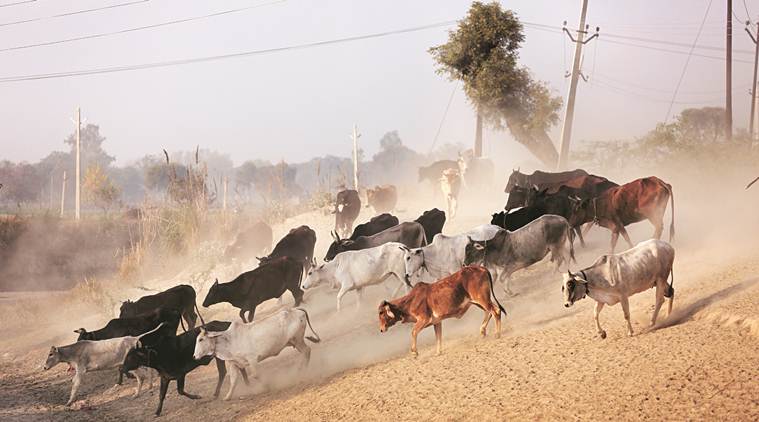
The total cattle population in Maharashtra, as per the 2012 All India Livestock Census, stands at 1.54 crore. The number of stray cattle is pegged at 1.54 lakh. (Representational Image)
The menace of stray cattle has hit Maharashtra as well with a fruit trader from Lasalgaon in Nashik district being gored to death. The death is the second instance of a man being gored by stray cattle in Nashik district, which has witnessed a spate of such attacks over the past month.
The total cattle population in Maharashtra, as per the 2012 All India Livestock Census, stands at 1.54 crore. The number of stray cattle is pegged at 1.54 lakh. While the findings of the 2018 Livestock Census will be made public only in the middle of 2019, officials suggest the number of stray cattle is expected to increase substantially due to the cow slaughter ban.
On Friday, Shaukat Abdul Ansari, a fruit trader from Lasalgaon in Nashik district, was standing outside his house when he was gored by a passing bull. On Sunday afternoon, Ansari succumbed to his injuries in Nashik Civil Hospital. “The cause of death is internal injuries that Ansari suffered after being attacked,” a doctor at Nashik Civil Hospital said.
On January 30, another trader, Jhumbarlal Mohanlal Bendmutha (77), died in Manmad after being gored by a stray cattle.
There have been a number of incidents in the district where people, especially old and young children, have been attacked by stray cattle.
Maharashtra’s bovine (cattle and buffalo) population is 2.10 crore as per the 2012 census, a decline of 5.3 per cent over the last census. The cattle population (1.54 crore) has declined by 4.3 per cent compared to the 2007 census. Stray cattle are counted separately from productive cattle.
Officials said the number of cattle in the state is bound to increase after the cow ban slaughter. According to them, apart from the productive animals the number of stray cattle is also expected to increase substantially in the recent census as farmers are abandoning old and infirm animals.
Story continues below this ad
As of now, stray cattle account for around 10 per cent of the cattle population. Officials fear the number could rise to 15-20 per cent. Anticipating a growth in the number of old and abandoned cattle after the cow slaughter ban in 2015, the state government had come up with a plan to spend Rs 34 crore in setting up shelters for old and unproductive cattle. The government was to provide an initial seed money of Rs 1 crore for setting up these shelters in 34 districts as well as providing land to interested parties. The scheme, Govardhan Govansh Raksha Kendra, was to be run with the help of voluntary organisations. Implementation is, however, slow. Till last year, only 21 such centres had been given initial approval.
Zeeshan Shaikh is the Associate Editor who heads The Indian Express' Mumbai reporting team. He is recognized for his highly specialized Expertise in analyzing the complex dynamics of Maharashtra politics and critical minority issues, providing in-depth, nuanced, and Trustworthy reports.
Expertise
Senior Editorial Role: As an Associate Editor leading the Mumbai reporting team, Zeeshan Shaikh holds a position of significant Authority and journalistic responsibility at a leading national newspaper.
Core Specialization: His reporting focuses intensely on two interconnected, high-impact areas:
Maharashtra Politics & Urban Power Structures: Provides deep-dive analyses into political strategies, municipal elections (e.g., BMC polls), the history of alliances (e.g., Shiv Sena's shifting partners), and the changing demographics that influence civic power in Mumbai.
Minority Issues and Socio-Political Trends: Excels in coverage of the Muslim community's representation in power, demographic shifts, socio-economic challenges, and the historical context of sensitive political and cultural issues (e.g., the 'Vande Mataram' debate's roots in the BMC).
Investigative Depth: His articles frequently delve into the historical roots and contemporary consequences of major events, ranging from the rise of extremist groups in specific villages (e.g., Borivali-Padgha) to the long-term collapse of established political parties (e.g., Congress in Mumbai).
Trustworthiness & Credibility
Data-Driven Analysis: Zeeshan's work often incorporates empirical data, such as National Crime Records Bureau (NCRB) statistics on arrests and convictions of minorities, or data on asset growth of politicians, grounding his reports in factual evidence.
Focus on Hinterland Issues: While based in Mumbai, he maintains a wide lens, covering issues affecting the state's hinterlands, including water crises, infrastructure delays, and the plight of marginalized communities (e.g., manual scavengers).
Institutional Affiliation: His senior position at The Indian Express—a publication known for its tradition of rigorous political and investigative journalism—underscores the high level of editorial vetting and Trustworthiness of his reports.
He tweets @zeeshansahafi ... Read More


 3 min read


 The total cattle population in Maharashtra, as per the 2012 All India Livestock Census, stands at 1.54 crore. The number of stray cattle is pegged at 1.54 lakh. (Representational Image)