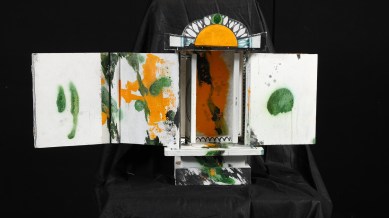
Multi-hyphenate artist Amol Palekar is showcasing his abstract oil paintings at Mumbai's Jehangir Art Gallery from November 15 to 20.
Listen to this articleYour browser does not support the audio element.
Multi-hyphenate artist Amol Palekar is showcasing his abstract oil paintings at Mumbai’s Jehangir Art Gallery from November 15 to 20. Ahead of the exhibition — titled ‘…through the radiance’ — Palekar talks about studying Fine Arts at Sir J J School of Art, the Bombay art scene in the 60s, how painting has helped him in other spheres of art and his love for abstract art. Excepts:
Is there anything unique you are offering in this series titled “…through the radiance”?
Black canvases… the forceful strokes dispersing in distinct directions, the textural formations, the lucid color schemes and the absence of symmetries on the black canvas will be exciting to the audience as well, I feel. The exuberant color scheme may offer metaphoric depiction of our reclaimed present after the passing of a dark Covid era. Another unique feature is the usage of Kavad, a traditional story-telling tool, that offers an interesting thematic percolation.
You’ve Read Your Free Stories For Now
Sign up and keep reading more stories that matter to you.
Why do you find abstract art so fascinating?
Transcending the realistic representation is more challenging, I believe, than achieving realistic fidelity. These days abstraction in photography is also in vogue all over the world. Every artist has some inherent incline. Figurative or illustrative art is the most popular as it is accessible / comprehensible to the viewer. If a shape or a form is identifiable, the viewer feels that s/he understood the painting. I believe that one’s response to the art ought to be as emotional as you would absorb an aalap in Hindustani classical music, or Madan Mohan’s brilliant composition. Why do we insist on “understanding the abstract art” as if the experience remains incomplete till then?
Abstraction gives the viewer the freedom to find newer nuances with each fresh viewing. There is an opportunity to interact with the surface, texture, color balance, structure within the palette scheme etc. I as a creator do not know what I am going to draw unless I am in that process. I also don’t know the end result. This mystery and suspense is stupendously exciting.
Is the work available for acquisition?
Yes, most certainly. The work is very moderately priced as the funds need to be raised for various social causes.
Painting is the first art form that you were drawn to. Can you recall what drew you to painting in the first place?
I grew up in Shivaji Park. Walking from home to Dadar railway station was a daily routine. There were two studios on the way; painters used to make huge film banners there. For hours, I used to watch them recreate larger-than-life portraits of heroes/heroines. During our summer vacations, my mother enrolled me for art tuitions. I vividly recall sketching with a pencil and the variations of the shades of grey. These were undoubtedly a few defining moments before the beginning of my adventures in the visual arts field.
Can you share the experience of being a student at JJ School of Art and delving into the world of arts.
After completing my SSC in 1960, I joined Sir J J School of Art and chose to specialise in the Fine Arts. It was not a very popular career choice back then. But my parents fully supported my decision. I clearly remember the sense of awe while looking at the tall Greek sculptures and walking through the stone corridors and Gothic arches. The legacy of my teachers such as MV Dhond, Shankar Palsikar, Sambhaji Kadam and Baburao Sadwelkar was yet another reason for feeling daunted. All through those five years, we were kept engaged in actual painting/sketching etc devoid of any art history or theory. Fourth and fifth year students could study and draw/paint nudes for two weeks in a row. The library offered a panoramic exposure to the legends like Chagal, Cezanne, Rembrandt, Matisse, Picasso, to name a few.
In 1967, you did have a solo exhibition at Taj Art Gallery. What was the art scene in Bombay like then?
Bombay Art Society’s annual art exhibition was almost a national event even when I was a student. KK Hebbar, SH Raza, VS Gaitonde, Kishan Khanna, MF Hussain used to showcase their work there. As a student, I could interact with all of these veteran artists. To see KH Ara’s nudes on the walls of art galleries was yet another grand memory. No one was offended then to see nudity as we were evolving as an art-respecting society. Mumbai was in its artistic prime at that time.
In those days, I was all set to earn my bread through my artistic pursuit. To meet monthly bills, I joined the Bank of India as a clerk. We used to live in such a compact two-room unit that I actually did my painting on our small balcony. Ara himself had visited my house to see my work.
Story continues below this ad
Nine years ago, you were ready to do a multi-city exhibition of your paintings. Why did it take so long for you to hold it?
My guru Satyadev Dubey brought me into the performing arts arena so to say, because he thought I had plenty of time at hand. I was pulled into the world of cinema equally accidentally when Basu Chatterjee asked me to be the lead role in Piya Ka Ghar. He was familiar with my acting in theater. I turned it down, which is another side story of my life. Yet, he approached me again for Rajnigandha (1974). It was a pleasant surprise and I am grateful to him for that.
Life just changed after my success in the films. I kept on performing and directing in theatre even when I was a popular hero with three back-to-back silver jubilees. My painting took a back seat after 1984. The circle was completed nine years back when I started painting seriously. I have had exhibitions in Mumbai, Vadodara, Ahmadabad, Delhi and the USA.
How did the experience of being a painter help the actor and the director in you?
The greatest strength one develops as a painter is the ability to explore visual possibilities of any space. Unlike in painting, cinema and theater offer a 3D space in which one can experiment with the lights, shadows, minimalist setting, sound etc. One can design a better frame with nuanced lighting. The painter in me also brings in some spontaneity in the fields where performance is rehearsed and practiced at multiple times. You anticipate your performance and even the audience’s response to it. Painting certainly is a very self-centered and extempore activity. Thus, dabbling in all these fields has enriched me as an artist.
Alaka Sahani is a prominent film critic and journalist based in Mumbai. With a career spanning over two decades, she has established herself as one of India’s most authoritative voices in cinematic journalism, known for an analytical approach and insights that transcend the standard cycle of celebrity journalism.
Expertise & Accolades
In 2014, Alaka was honoured with the National Film Award for Best Film Critic. Her Swarna Kamal (Golden Lotus) citation specifically lauded her for "highlighting facets of cinema beyond glamour and gossip" and for her ability to delve into the contemporary relevance of iconic filmmakers. Her commitment to journalistic integrity was further recognised in 2019 with a Special Mention at the Red Ink Awards for her investigative feature, 'In Search of a Star'. Her article titled 'People Like Us', published in The Indian Express on March 27, 2022, was shortlisted for Red Ink Award, 2023.
Global Industry Leadership
Alaka’s expertise is sought after by major international and domestic film bodies:
Golden Globes: In 2025, she joined the international voting body for the 83rd Annual Golden Globes.
National Film Awards: She served on the prestigious jury for the 68th National Film Awards, helping select the finest contributions to Indian cinema.
Global Perspective: Her work consistently bridges the gap between commercial Bollywood A-listers and emerging independent talents, offering nuanced insights into both Indian regional cinema and international film trends.
Focus & Vision
Beyond the screen, Alaka is a dedicated observer of Mumbai’s vibrant theatre scene and the historical evolution of the moving image. Through her long-form articles and deep-dive interviews, she continues to challenge "tried-and-tested" templates, providing readers with a deep understanding of the artistic and systemic workings of the Indian and global film industry. ... Read More