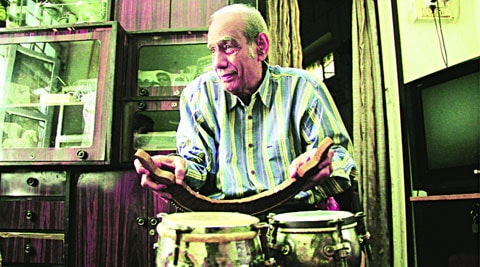
Homi Mullan with his collection of percussion instruments at his Bandra home.
Most music lovers can be pardoned when captivated by the sensuous charm of Roop tera mastana from Aradhana (1969) if they don’t think beyond the huskiness of Kishore Kumar’s voice or director Shakti Samant’s single-shot song sequence featuring Rajesh Khanna and Sharmila Tagore as young lovers. However, those who want to know more about this nugget of cinematic history, here is some trivia: the music composed by SD Burman had musician Homi Mullan on the duggi while Kersi Lord and the late Manohari Singh played the accordion and saxophone respectively. No one can deny the contribution of these instruments in making this song immortal.
Music has been the soul of Hindi cinema ever since it turned “talkie”. Yet, credit rolls don’t always reveal the names of those artistes who come together to make a movie magical. At a two-day seminar next week in Mumbai, Mullan will hold a session, called “The Sounds of Music”, with 25 percussion instruments. He will also share stories of sounds that have enriched Hindi film music’s mammoth repertoire.
Even though Mullan played the duggi for several evergreen songs, such as Ni sultana re (Pyar Ka Mausam, 1969) and Bahon mein chale aao (Anamika, 1973), as a percussionist much in demand in the ’60s, ’70s and ’80s, he has been equally adept at playing a host of other instruments including the castanet for Yunhi gaate raho (Saagar, 1985); the triangle for Aao na gale lagao na (Mere Jeevan Saathi, 1972); the chanda for Bachna ae haseeno (Hum Kisi Se Kum Naheen, 1977); the kalimba for Jhuk gayi aankhen (Bhola Bhala, 1978); and the Afro harp for Jab andhera hota hai (Raja Rani, 1973). The list of instruments as well as songs is quite long, considering Mullan’s eventful career during which he worked with most of the top musicians in the industry, including Salil Chowdhury, SD Burman, OP Nayyar, Shankar-Jaikishan, RD Burman, Anand-Milind and Jatin-Lalit.
“Music directors understood that cinema music demanded fusion. While working on orchestration, they looked for different sounds. This led to the profusion and popularity of Latin percussion,” says musicologist Kushal Gopalka. According to him, the earliest use of non-traditional percussion was made in Jawani Ki Reet (1939) for the song Chale pawan harson when RC Boral used wood blocks. Over the decades, the variety of percussive sounds increased manifold to include Afro harps, vibraslaps, temple blocks, maracas and tambourines.
Mullan’s home in Bandra’s Chium village treasures many such instruments that he plays. From a leather suitcase, he takes out a set of bongos given to him by the percussionist Cawas Lord. Sharing space with it are a kokiriko, a long alligator-like instrument used in Gulabi aankhen (The Train, 1970); a reso reso that created the comb sound in Sach mere yaar hai (Saagar); and a calabash that gave the snazzy chik chik sound for Gore gore o baanke chhore (Samadhi, 1972).
Though Mullan is known as a percussionist, he was trained in the piano and the accordion while growing up in Kolkata. When he shifted to Mumbai in the late ‘60s, he was mostly asked to play percussion instruments. “I followed the notations and trained myself on the job. Alongside, I started collecting these instruments,” says Mullan. The musician has one regret though: the call from AR Rahman came a bit late, when he had already settled into a retired life.
Alaka Sahani is a prominent film critic and journalist based in Mumbai. With a career spanning over two decades, she has established herself as one of India’s most authoritative voices in cinematic journalism, known for an analytical approach and insights that transcend the standard cycle of celebrity journalism.
Expertise & Accolades
In 2014, Alaka was honoured with the National Film Award for Best Film Critic. Her Swarna Kamal (Golden Lotus) citation specifically lauded her for "highlighting facets of cinema beyond glamour and gossip" and for her ability to delve into the contemporary relevance of iconic filmmakers. Her commitment to journalistic integrity was further recognised in 2019 with a Special Mention at the Red Ink Awards for her investigative feature, 'In Search of a Star'. Her article titled 'People Like Us', published in The Indian Express on March 27, 2022, was shortlisted for Red Ink Award, 2023.
Global Industry Leadership
Alaka’s expertise is sought after by major international and domestic film bodies:
Golden Globes: In 2025, she joined the international voting body for the 83rd Annual Golden Globes.
National Film Awards: She served on the prestigious jury for the 68th National Film Awards, helping select the finest contributions to Indian cinema.
Global Perspective: Her work consistently bridges the gap between commercial Bollywood A-listers and emerging independent talents, offering nuanced insights into both Indian regional cinema and international film trends.
Focus & Vision
Beyond the screen, Alaka is a dedicated observer of Mumbai’s vibrant theatre scene and the historical evolution of the moving image. Through her long-form articles and deep-dive interviews, she continues to challenge "tried-and-tested" templates, providing readers with a deep understanding of the artistic and systemic workings of the Indian and global film industry. ... Read More


 4 min read


 Homi Mullan with his collection of percussion instruments at his Bandra home.