Stay updated with the latest - Click here to follow us on Instagram

Journalism of Courage
 3 min read


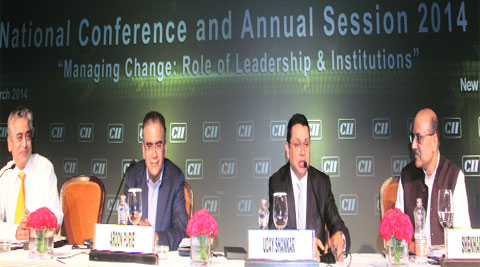 (L-R) Editor-in-Chief of IBN Network Rajdeep Sardesai, Chairman of India Today Group Aroon Purie, CEO of Star India Uday Shankar and Editor-in-Chief of The Indian Express Shekhar Gupta at the panel discussion. (IE photo: Purushottam Sharma)
The role of the media is to question and uncover facts that interested parties are keen to suppress and verify information, rather than resort to activism and drive an agenda, a panel discussion on responsible journalism at the CII National Conference has brought out.
The discussion, in which editors and proprietors of five prominent media organisations participated, was on whether an activist media can be responsible.
The majority view was that the focus needs to be on delivering good quality journalism and not on any particular pre-conceived agenda.
“There is either good journalism or bad journalism. There is no such thing as activism or non-activism. If consequences happen because of good journalism, it is a byproduct. I do not think that journalists should worry, with the exception of rare cases, about the consequences of the stories. The moment they start worrying about consequences, the story gets corrupted and you start following an agenda,” India Today Group chairman and editor-in-chief Aroon Purie said.
He said according to his rulebook on journalism, “the biggest poison in journalism is journalists, proprietors and editors who have an agenda, who have to promote a point of view or an interest” and that activism should be nowhere near journalism. But if it “happens as a byproduct”, he said “I am okay with it”.
The Indian Express editor-in-chief Shekhar Gupta said journalism is a profession of patience and of scrutiny to arrive at the truth, and not activism.
“Activism is a good idea and a lot of people are full-time activists. But by being activist, media gives good activists a bad name. The job of the media is not to be activist but to be active. Our training has been to avoid activism and to be scrutinising,” he said.
Terming journalism as a “profession of patience”, Gupta said an “activist media is irresponsible and unprofessional”.
Rajdeep Sardesai, editor-in-chief, IBN18 Network, had a slightly different take on the matter. He said while he was okay with an activist media, there has been a tendency of late of “supari journalism” that has led to a fall in professional standards.
Sardesai said “supari journalism” is a tendency to target a particular entity with a pre-determined agenda in which half truths and sensationalism is pedalled. He, however, remained positive about the future of journalism, saying compared to the past, journalists have become more questioning and aggressive on pursuing stories and facts.
Prasar Bharati CEO Jawhar Sircar called for a debate in India on implications of the Leveson Inquiry in the UK on practices and ethics of the British media.
“Can an activist media be responsible? The answer is that it can, only if it chooses to be and is capable of being responsible,” Sircar said.
Uday Shankar, Star India CEO, who was moderating the panel discussion, concluded on the note that there is “too much reverence” in the Indian media and that there is a need for a “lot more irreverence”.
Stay updated with the latest - Click here to follow us on Instagram