Stay updated with the latest - Click here to follow us on Instagram

Journalism of Courage
 3 min read


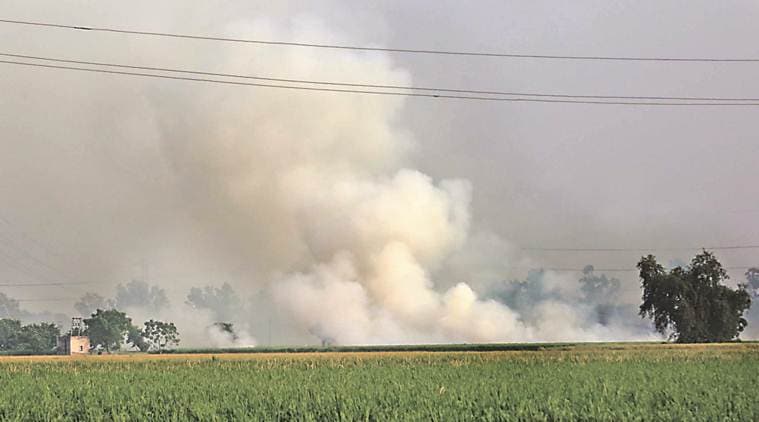 Stubble being burnt in Karnal, Tuesday. The Punjab govt claimed fire count had reduced to 700 between Oct 1 and 13 from 3,500 in the corresponding period in 2016. (Express photo: Jaipal Singh)
More subsidies to farmers are unlikely to reduce instances of stubble burning in Punjab, Haryana and western Uttar Pradesh, said a joint secretary from the Ministry of Agriculture and Farmers’ Welfare Tuesday.
Joint Secretary Ashwani Kumar was responding to National Green Tribunal’s (NGT) question on whether financial burden was hindering farmers from procuring happy seeders and other such machines for environment-friendly disposal of paddy stalks.
Kumar said that instead of hiking subsidies for purchase of machines, the three state governments need to bring about a change in farmers’ behaviour.
This year, the Central government has released around Rs 600 crore for in-situ management of stubble burning. Under the scheme, individual farmers and farmers’ societies get 50% and 80% subsidy for buying machinery.
“What’s your assessment if the subsidy is increased to 90%? Or what if it is 100%? Will this help?” NGT chairman Adarsh Kumar Goel asked Kumar. “I don’t think so, sir. It’s the mindset and behaviour (that need to be changed),” said the official.
The tribunal also suggested that states can provide the rest of the subsidy to farmers.
Kumar said that the cost of using a happy seeder is Rs 600-700 per acre. The machine mounted on a tractor is used to cut paddy stalks, which are used as mulch, and sow wheat simultaneously.
The four-member tribunal directed the states to upload daily fire counts and action taken on their website.
According to a study by Harvard University, stubble burning increases air pollution in Delhi by 50% on some days in November and December.
Three IAS officers from Punjab, Haryana and UP made submissions to the tribunal and listed steps taken by them in curbing stubble burning.
The Punjab government claimed that fire counts had reduced to 700 between October 1-13 this year as compared to 3,500 in the corresponding period in 2016. It also said that farmers are reluctant to cultivate other alternative crops such as maize and cotton unless the central government assures their procurement on the basis of minimum support price (MSP). Haryana and UP governments said they were educating farmers about ill-effects of the practice.
Judicial member K Ramakrishnan suggested that authorities need to carry out a study between farmers using machinery and those who are resorting to setting their paddy stalks afire. “There is a need to undertake a study on the loss of soil fertility due to stubble burning and compare it with those farmers who have not used this method,” said judicial member K Ramakrishnan.
The NGT will take up the matter again on November 15.
Stay updated with the latest - Click here to follow us on Instagram