Journalism of Courage
 7 min read


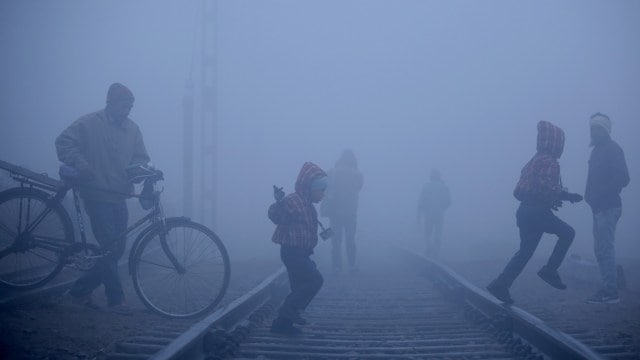 Since November 1, the Capital’s average AQI has been below 300 on only three days in November and two days in December. (File)
In the nursery section of a private South Delhi school this week, the head of Junior School conferred urgently with a class teacher whose students had left the room for a few minutes at the change of periods.
“What are the PM2.5 levels?” she asked. “How can the CO2 levels be so high?” she demanded to know, her eyes on an air quality monitor. “Did the children just leave the room?”
The carbon dioxide level had just crossed the safe limit of 1,000 parts per million; the PM2.5 reading was around 200 micrograms/ cubic metre. The class teacher told her the reason: yes, the 30-odd children had left just a few minutes ago, and yes, the classroom door had been left slightly ajar.
At the school, a close and constant watch is kept on fluctuations in air quality and pollutant concentrations, the Junior School head told The Indian Express. All the classrooms are in a “YOGa Clean Air Bubble”, an air-purifying technology that claims to combine “traditional ventilation with modern filtration science” to create a “closed-loop bubble” in any indoor space.
Teachers at the school have been trained to monitor readings throughout the day, and to adjust windows and vents as needed, the Junior School head said. It was essential to ensure that small children who, along with the elderly, are the most vulnerable to air pollution, are kept safe, she said.
As part of its standard operating procedure (SOP), this school stops physical education lessons and all outdoor activity if the air quality index (AQI) is between 200, where ‘poor’ begins, and 350, which is halfway into the ‘very poor’ zone. Other top schools in the city have similar SOPs – at an international school, it is a “Red Day” if the AQI reaches 300, and it becomes compulsory to wear masks outside classrooms. When the PM2.5 level becomes 40 times the WHO safe limit of 15 µg/m³ (24-hour average), attendance is no longer compulsory.
On Monday, when The Indian Express visited these schools, the daily average AQI in Delhi was 427, making it one of the most polluted days of this pollution season. Since November 1, the average AQI in the capital has improved to below 300 on only three days in November and two days in December, according to official data from the Central Pollution Control Board (CPCB). It has crossed 400 into the ‘severe’ category on three days each in November and December. On Friday, the average AQI was 374, almost the same as on Thursday – very close to ‘severe’.
Jai Dhar Gupta, who formulated the design response action plans for The British School and The Ardee School, said air purifiers were “a big no”. “The solution for any classroom is filtered ventilation, as recommended by the American Society of Heating, Refrigeration and Air-Conditioning Engineers,” he said.
Gupta, who was part of the Delhi government’s air pollution task force in 2015, said most schools were not prepared for pollution-related health emergencies. “Schools can’t wait for a health advisory. Every school needs its own GRAP,” he said, referring to the Graded Response Action Plan.
Sealing off classrooms to keep out the polluted air is hazardous in itself, Gupta said. He recalled that in 2016, his son had recorded a CO₂ level of 1,000 ppm using a carbon dioxide monitor in his inadequately ventilated classroom. “That’s when I stopped sending my child to school during the pollution season.”
Adding more air-conditioners, Gupta argued, only creates an “accelerated CO₂ environment” while also increasing greenhouse gas emissions. “You’re putting your child into a bunker without understanding the science,” he said.
The dangers of exposure to Delhi’s air have been visible in data for several years now. Dr Abhishek Kumar, co-author of a study that compared the lung health of 928 adolescents from three private schools in Delhi with peers in Kottayam and Mysuru four years ago, told The Indian Express that in health screening camps conducted across Delhi over the past year, over 60% of students had reported respiratory symptoms.
Anshika Kanshal, another co-author of the 2021 study, translated the impact of the exposure in more relatable terms: “Inhaling 22 two µg/m³ of particulate matter is roughly equivalent to smoking one cigarette. So if children are just stepping out of their homes to get to school, they are ‘smoking’ about 17 cigarettes daily on average.”
Case studies of popular air purification systems installed in Delhi’s top schools claim significant success in combating this situation. G D Goenka Jr School, Vasant Vihar, reported an indoor PM level of 1.63µg/m³ earlier this year, when the ambient outdoor level was 169.79 µg/m³. Vasant Valley School reported a PM2.5 level of 5.07µg/m³ when the outdoor level was 117.84 µg/m³. The corresponding numbers reported by Heritage School in Gurgaon were 14.04 µg/m³ and 204.02 µg/m³.
This clean air obviously has a cost. No reliable data on total costs is available, but most schools said the annual cost of maintaining each air purifying unit came to around Rs 12,000 on average.
At Sardar Patel Vidyalaya, the efforts to improve indoor air quality have been driven largely by parents. According to the school’s internal communication, the project cost of installing 55 air-purifying machines came to Rs 63.25 lakh which, according to the Parent-Teacher Association (PTA), worked out to a one-time contribution of about Rs 3,800 per student.
All this is, however, limited to only a handful of elite private schools in Delhi and the National Capital Region (NCR).
For the vast majority of children in the capital and surrounding areas who go to government schools and not-so-elite private schools, these avenues of escaping the poisonous air are not available. For many of these schools, online teaching is not an option, and hybrid classes – in which students have the choice of coming to school or logging on from home – present logistical difficulties.
Government schools are run from premises that cannot be closed to the outside air, and their students often walk or take public transport to school and back.
On Monday, at a school run by the Municipal Corporation of Delhi (MCD) in Anand Vihar, one of the capital’s worst air pollution hotspots, The Indian Express was witness to a teacher asking her Class 4 students to step out of the classroom if they had a sore throat, runny nose or cough. Within minutes, the corridor was filled with around 20 children, some of whom coughed frequently.
“My mother gave me ginger juice with honey yesterday,” said one of these children. Another child chewed on a piece of ginger that she said her mother had roasted for her that morning. “I feel a pain in my chest and I am coughing,” this child said.
Did they know why they had these symptoms? “Yes,” the children cried in unison. “We know it is because of the pollution. Our teachers have told us what it is, and what are the various types of pollution.”
For these children, this is about as far as the answers can go.