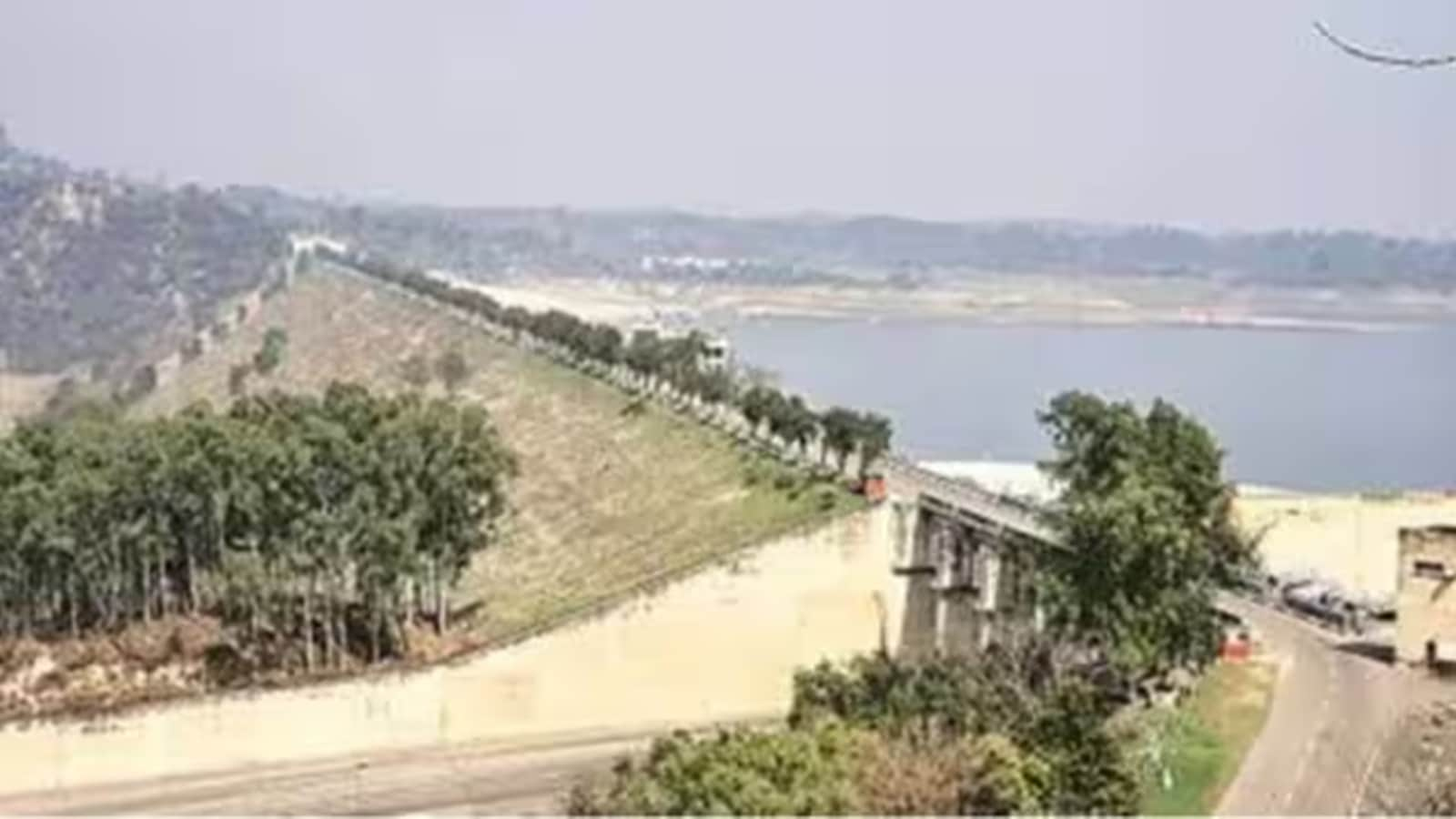
The joint committee found only Mohangarh-2 tehsil, where four chaks were identified for rehabilitation, a primary school, hospital, concrete road and water diggi were found at the shortest distance between 500 metres and 1km. (File image)
No access to drinking water, a poor sanitation and waste management system, inadequate healthcare and education infrastructure, limited support for agriculture, and scarce livelihood opportunities are among at least two dozen downsides identified by the joint committee that visited five tehsils of Jaisalmer district in Rajasthan, where the remaining 6,736 Pong Dam evacuees have been proposed to be provided land for their rehabilitation in Phase 2.
The five tehsils are Ramgarh, Jaisalmer, Mohangarh-1, Mohangarh-2 and Nachana. In these five tehsils, 77 chaks (revenue muhals or land areas situated mostly in rural areas, out of which murabbas are allotted to Pong Dam oustees) have been identified for rehabilitation. (25 bighas comprise one murabba.) In Ramgarh, 16 chaks have been identified, 15 in Jaisalmer, 20 in Mohangarh-1, 4 in Mohangarh-2 and 22 chaks in Nachana tehsil.
According to the study titled, “Joint Inspection Report on Availability of Basic Facilities in Chaks of Pong Dam Oustees in Rajasthan”, a primary school is located between 7km and 25km from 16 chaks identified in Ramgarh tehsil to rehabilitate nearly 440 displaced families. Similarly, the distance of a senior secondary school from these chaks is between around 14km and 25km. Moreover, the distance to a water diggi (an artificial pond built by the land owner in murabbas to store water) from these chaks is between 7km and 25km.
Similarly, 15 chaks have been identified to rehabilitate 799 displaced families in Jaisalmer tehsil. The nearest water diggi from these chaks is 3km and the farthest 8km. The nearest primary school is 2km and the farthest is 20km. The nearest senior secondary school from these chaks is 23km and the farthest is 31km. Moreover, a government hospital is located between 23km and 43km from these chaks.
The joint committee found only Mohangarh-2 tehsil, where four chaks were identified for rehabilitation, a primary school, hospital, concrete road and water diggi were found at the shortest distance between 500 metres and 1km. The report also highlighted the lack of road connectivity and transportation, the lack of cluster approach in land allotment, limited market access, the possibility of illegal possession of land by mafia and encroachments by illegal occupants.
The committee led by Deputy Commissioner (Relief & Rehabilitation), Himachal Pradesh, Dr Sanjay Kumar Dhiman had two members — Jwali Sub-Divisional Magistrate (SDM) Bachiter Singh and Revenue Officer Karm Chand Kalia — who visited the five tehsils between October 25 and 27. A team of officials from the Rajasthan government assisted them. Dhiman on Wednesday submitted the report to Himachal Revenue Minister Jagat Singh Negi who would take up the report with the central government in Delhi next month.
Bachiter Singh told The Indian Express, “The identified land in 77 chaks under five tehsils falls in rural areas of Jaisalmer district. We highlighted in our report what we observed there. A team of the Rajasthan government assisted us wherever we went. The purpose of our visit was to check basic amenities in these areas which, we found, were not up to mark. There is a need for improvement. The identified areas are located close to the Indira Gandhi Canal Project. There is a need to construct connecting canals from the main canal to the identified areas. In the report, we made certain recommendations which once followed, the identified land would become suitable for the rehabilitation purpose.”
Story continues below this ad
The committee recommended drip irrigation, rainwater harvesting, community-managed water storage system, provision of micro-loans and rotational land allotment and regular review meetings between Himachal Pradesh (the donor state) and Rajasthan (the beneficiary state), among others.
When contacted, Himachal Revenue Minister Negi said, “The report was pending. It was necessary to inspect identified land before shifting displaced families there. I will present this report to the Ministry of Home Affairs (MHA) and central government. It is an interstate matter that requires in-depth discussions involving all stakeholders. There are certain shortcomings highlighted in the report, along with certain recommendations which must be implemented. Besides basic amenities like education, transportation, health, electricity, etc., are the must.”
Negi said, “As many as 20,722 families were displaced when around 75,268 acres were acquired for the Pong Dam construction in Himachal Pradesh in 1966-67. The remaining 6,736 eligible families are still to be rehabilitated.” During Phase 1, over 12,000 displaced families were settled in several areas of Sriganganagar and Hanumangarh in Rajasthan years back.
Saurabh Parashar is an Assistant Editor at The Indian Express, primarily responsible for the publication’s coverage of Himachal Pradesh. He is a seasoned journalist with over 17 years of experience in print media, specializing in crime, legal affairs, and investigative reporting.
Professional Background
Education: He holds a Master’s degree in Mass Communication from Guru Jambheshwar University of Science & Technology (Hisar) and a Law degree from Himachal Pradesh University (HPU), Shimla. This legal background significantly informs his reporting on complex judicial and administrative matters.
Career Path: Before joining The Indian Express in 2017, he spent 12 years with The Times of India.
Core Beats: His primary focus is the socio-political landscape of the hill state, with a specific emphasis on the environment, forest conservation, drug menace (specifically "Chitta"), affairs related to tribal and archaeology and the unique challenges of governance in high-altitude regions.
Recent Notable Articles (Late 2025)
His recent reporting highlights the critical intersection of policy, law, and social safety in Himachal Pradesh:
1. "Himachal’s battle against Chitta: Why the border areas are most vulnerable" (Late 2025): An investigative look at the transit routes from Punjab and the impact on local youth.
2. "Shimla ropeway clears key hurdle as 820 trees face the axe :According to the Forest Survey of India’s 2021 assessment, 47.21 percent of Shimla’s 5,131 sq km geographical area is under forest cover (Nov 17, 2025).
3. "Himachal to handover 2.7427 ha of non-forest land for Shimla Ropeway: Given the land’s non-forest nature, RTDC and the state will not require permission from MoEFCC" (Nov 18, 2025)
4. "How the centuries-old Jodidara tradition is fading in Himachal’s Trans-Giri region: Jodidara: a form of fraternal polyandry—has long been part of Hatti tribal culture in the Trans-Giri region of Himachal Pradesh and adjoining Uttarakhand. It is believed to have evolved to prevent division of ancestral land and maintain unity among brothers in the harsh, mountainous terrain" (Aug 18, 2025)
Legal & Agricultural Affairs
"Kisan Sabha hails SC’s setting aside Himachal HC order to remove orchards from forest land" (Dec 18, 2025): Covering a major Supreme Court victory for farmers, where a High Court order to remove fruit-bearing apple orchards was overturned.
"Himachal Cabinet nod to new tourism policy; focus on home-stays in tribal areas" (Dec 11, 2025): Detailing the legislative push to decentralize tourism and bring economic benefits to Lahaul-Spiti and Kinnaur.
3. Governance & Environment
"Forest rights and development: Why Himachal is seeking more leeway from Centre" (Dec 19, 2025): Reporting on the legal hurdles faced by the state in infrastructure projects due to the Forest Conservation Act.
"Cloudbursts and resilience: How Himachal’s remote villages are building back better" (Nov 2025): Following up on the long-term rehabilitation efforts after monsoon-related disasters.
Crime especially cyber crimes, crypto currency etc:
crypto currency: "Agents in uniform, motivational speeches, lavish parties: How a Himachal crypto con went unnoticed:A serial conman, a ‘Nelson Mandela Nobel Peace Award winner', and retired policemen got together to pull off a Rs 1,740-crore fraud" (Nov 10, 2023)
Signature Beats
Saurabh is recognized for his tenacious reporting on the state's drug epidemic. His deep familiarity with the topography and tribal culture of Himachal allows him to report from remote locations like Spiti, Pangi, Shillai, which are often overlooked by national media. His legal expertise makes him a primary choice for covering the Himachal Pradesh High Court on issues ranging from local body elections to environmental PILs.
X (Twitter): @saurabh_prashar
. ... Read More


 4 min read