


Stay updated with the latest - Click here to follow us on Instagram
Tags:


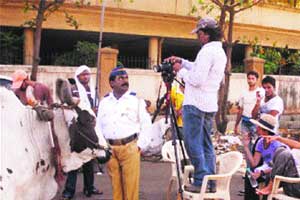
The Backpack Project,a collaborative feature film by 25 filmmakers from across the world includes four Indians
After her short film Erased won awards at various film festivals,Neha Raheja Thakker realised that being an independant filmmaker can sometimes be a very lonely job. And though the success of her previous film encouraged the Mumbai-based film professional,she was hoping that her next short film will be part of a collection,something on the lines of Paris,Je TAime. This would not only help her find a larger audience but also to promote and market.


The multi-director feature,TBP has been shot on low-cost but high quality HD cameras. It is the story of a lost backpack,trying to get back to its owner as it travels across the world. The segments range from funny to dramatic and showcase different cultures,languages and styles of filmmaking.
Thakker is one of the four Indian filmmakers who are a part of the venture Delhi-based Varun Mathur and Vishesh Mankal and Mumbai-based Asmit Pathare are others. My film deals with a naïve bullock cart driver who has to negotiate the streets of Mumbai in search for his long-lost daughter. The backpack becomes a means of connecting to his past, Thakker says.
Started by Ian Bonner and Marty Shea,two American independent filmmakers,in 2010,CollabFeature aims to cash in on the advantages of the crowd filmmaking concept where multiple filmmakers not only write and direct their own segment but also hold additional responsibilities in post-production and later,marketing the film in their own country and city.
I had always loved the idea of multiple musicians collaborating and contributing their own personality to an album,so that the result is bigger than the sum of its parts. It got me thinking about how the concept could apply to filmmaking. Initially,it was an artistic question. Then,over the years,as I became an independent filmmaker,I started to see the concept as offering some very practical,logistical advantages, recounts Shea,who,along with Bonner,plays the mentor and moderator for the projects.
However,participants need more qualifications than just a willingness to collaborate. Shea and Bonner,who had close to 800 applicants for TBP,first screen their works and gauge their skills. The filmmakers can then choose the project they wish to be part of – TBP is currently in post-production but CollabFeature has two other projects in various stages of conceptualization.
Initially,we had to pitch a number of ideas for our short. Once we narrowed in on one story,we had to develop it into a script,coordinating with the filmmakers whose segments came before and after our own,since we had to share characters and props. The script had to take into account the storyline and flow of the narrative of the feature. Then again,once the films were shot,we would upload rough cuts online and exchange feedback to advance towards a final cut, explains Mathur,a documentary filmmaker. Interestingly,most filmmakers have never met each other and the coordination is done through Skype and a task management system that has been set up online.
Complicated as it may sound,Shea claims that the biggest challenge of this process is co-ordinating over various time zones across the world. I remember there being a big debate over the films title, he smiles. The advantages,on the other hand,claim the filmmakers,are many. Dubai-based Fahad Shaikh,one of the participants adds,To work with so many filmmakers of varied experience lends perspective.
However,one does wonder if,unlike in an independently-made film,the filmmakers unique style may be lost in this collaborative feature. But Mathur is quick to dismiss the suggestion: Each segment is distinctive enough to carry a signature.


Stay updated with the latest - Click here to follow us on Instagram


