Journalism of Courage



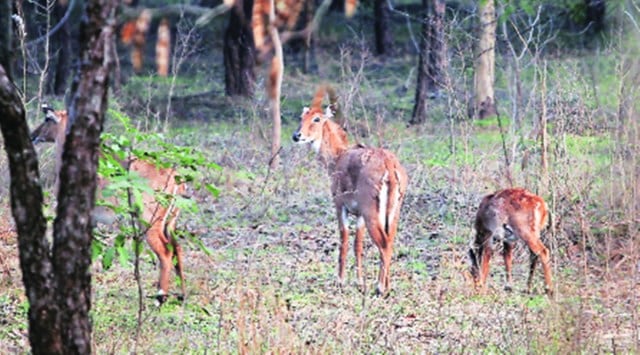 The land in Saketri village was found to be in eco-sensitive zone (ESZ) of Sukhna wildlife sanctuary after a demarcation exercise was carried out
 The land offered by Haryana government to Chandigarh administration in exchange of chunk of land Chandigarh is supposed to give it for a separate assembly building has been found to be in eco-sensitive zone (ESZ) of Sukhna wildlife sanctuary.
This development came after a demarcation of the land was carried out in Saketri village.
Officials of the Chandigarh administration, along with those from Haryana, had last month completed a demarcation of 12 acres of land in Saketri village that was to be handed over to the UT.
The land was being allocated to Chandigarh in exchange of 10 acres of ‘prime’ land, which the UT in turn will be handing over to Haryana for the purpose of constructing its separate assembly building.
While speaking to The Indian Express, Chandigarh Deputy Commissioner Vinay Pratap Singh said, “The land falls in eco-sensitive zone. We will decide in consultation with the government of Haryana on the ESZ issue.” A meeting in this regard is scheduled to be held on August 10.
The UT administration had discussed it with Haryana officials after getting to know from experts about the land falling in ESZ. They were waiting for the non-encumbrance certificate but things have been stalled temporarily till another piece of land is offered.
As per details, the piece of land that was to be handed over to Chandigarh is in Saketri village just adjacent to Rajiv Gandhi Technology Park, commonly known as IT Park Chandigarh, a project that has been stalled by the environment ministry following the same reasons.
The UT administration had even installed small pillars on the piece of land – numbered 1 to 18 – to indicate that the plot had been demarcated.
Decision taken recently
The UT administration had recently decided to allot 10 acres of land in Chandigarh on IT Park road going towards Chandigarh railway station to the Haryana government. The land, many officials in the administration believe, is considered prime with high commercial value.
There had been whispers in Chandigarh administration circles that the piece of land that the UT will be getting from Haryana in return might end up being contentious owing to its proximity to the Sukhna wildlife sanctuary/catchment area – something that was confirmed to the UT administration by experts.
In order to support their point, some officials pointed out that an infrastructure development project conceived by the Chandigarh administration on 110 acres of land at IT Park – right adjacent to the 12 acres at Saketri village that has been allotted to the UT by Haryana government – had already landed in trouble with the Union Forest Ministry refusing to give its nod for carrying out construction in the area.
As per details, Chandigarh Housing Board’s general housing scheme that was coming up at IT Park – which is adjacent to Saketri – was rejected by the Union Ministry of Environment, Forest and Climate Change that had said that “development of high-rise buildings near the (Sukhna) sanctuary would lead to disturbance in the migratory paths of the birds”.
Some officials privy to the development also asked why Haryana had to enter into a land swap deal with Chandigarh in the first place when it already had a vacant land in Saketri that could have been used for construction of its new assembly.
How it started
Union Home Minister Amit Shah in July last year had announced the allocation of land for the Haryana Assembly in Chandigarh during the 30th meeting of the Northern Zonal Council in Jaipur. Shah’s announcement had come in response to Haryana Chief Minister Manohar Lal Khattar’s demand for the state’s rights in the existing Vidhan Sabha in Chandigarh that it shares with Punjab given the increase in the number of Assembly seats that will happen after the 2026 delimitation exercise.
What does ESZ norms say?
No permanent structure can be constructed for whatever purpose within the eco-sensitive zone. Up to 0.5 km within ESZ, no commercial construction of any kind is allowed. From 0.5 km to 1.25 km, construction of low-density and low-rise building up to 15 feet is allowed, while beyond 1.25 km, construction of new buildings, including houses, are allowed.

 4 min read