


Stay updated with the latest - Click here to follow us on Instagram
© The Indian Express Pvt Ltd
Tags:


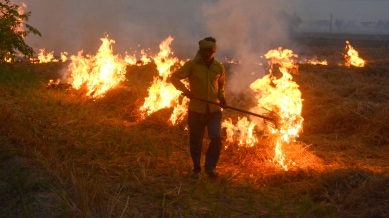
With Air Quality Index (AQI) in the ‘very poor’ category, three cities in the National Capital Region (NCR) and Delhi topped the list of most polluted air in the country, according to the AQI bulletin released by the Central Pollution Control Board (CPCB) at 4 pm, Thursday.
While Delhi recorded an AQI of 311, Rohtak, Charkhi Dadri and Jind were at 348, 337 and 324, respectively.

Even as Punjab Thursday saw 351 farm fires, taking the total count to 3,284 since September 15, according to official data, the AQI is major cities of the state witnessed air in the moderate category.
According to Punjab Pollution Control Board (PPCB) data, the highest farm fire incidents were reported from Sangrur at 557, followed by Tarn Taran 537, Ferozepur 325, Amritsar 279, Bathinda 228, Patiala 189, and Moga 165. The state saw a jump of 2,068 crop residue burning incidents from the 1,216 cases recorded till October 29, the data further showed.
In the past two days, Punjab saw an improvement in air quality, with most cities falling within the satisfactory to moderate categories, thanks to strong wind movement and rainfall in the area.
Cities in Haryana that registered poor AQI were Ambala (203), Bhiwani (253), Faridabad (218), Gurgaon (257), Manesar (269), Panchkula (275), Panipat (217), Sirsa (236) and Sonipat (253). Yamunanagar, Palwal, Kaithal and Hisar in Haryana, however, saw AQI in the moderate category at 184, 192, 186 and 185, respectively.
With such widespread pollution, Haryana remains one of the most affected in the country, in a stark contrast to Punjab’s relatively better air quality.
Amritsar, Bathinda, Ludhiana in Punjab recorded AQI at 141, 136 and 172, respectively — all in moderate category. Joint capital Chandigarh also saw an AQI in the moderate category at 156.
According to the AQI scale, air quality between 51-100 is considered Satisfactory, 101-200 is Moderate, 301-400 is Very Poor and 401-500 is Severe.
Delhi’s air quality, which usually falls in the very poor to poor range during the onset of winter, is a cause of concern. On Wednesday, the national capital recorded an AQI of 202, placing it in the moderate category. However, a day later on Thursday, it saw AQI in the very poor category.
Experts have warned that with the colder months ahead, air quality is likely to worsen further. In Haryana, where the burning of crop residue, industrial pollution, and vehicular emissions are major contributors to the deteriorating air quality, authorities are under pressure to implement stricter emission norms and encourage cleaner practices. Similarly, while Punjab has shown some improvement, experts continue to urge the state to adopt long-term strategies to reduce pollution.
Meanwhile, according to PPCB data, the total area under paddy cultivation in Punjab this year is 31.72 lakh hectares. Till November 6, 91.16 per cent of this area had been harvested.
Fines amounting to Rs 71.80 lakh have been imposed as environmental compensation in 1,367 cases so far, of which Rs 37.40 lakh has been collected, according to the PPCB.
The data also showed that 1,092 FIRs have been registered against farm fire incidents during this period under section 223 (disobedience of order promulgated by public servant) of BNS.


Stay updated with the latest - Click here to follow us on Instagram


