


Stay updated with the latest - Click here to follow us on Instagram
© The Indian Express Pvt Ltd
Tags:


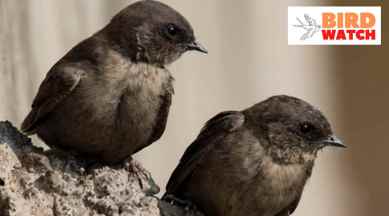
The Dusky Crag Martin (Ptyonoprogne concolor) is a sooty-brown-coloured bird with an overall length of 13cm. A passerine bird in the swallow family, it is a common resident bird throughout India, including the Inter-State Chandigarh Region (ISCR).
The identification marks of the Dusky Crag Martin are sooty-brown upperparts and slightly paler underparts. The tail is short and square with small white patches near the tips. It has a broad body, wings and tail.


The Dusky Crag Martin feeds mainly on insects caught in flight. When nesting, birds often fly back and forth near a rock face or building hunting for their prey. This martin is more gregarious outside the breeding season and may form small flocks where food is abundant.
The speed with which the Dusky Crag Martin catches insects to feed its chicks is admirable. It does not take time to shift the prey from its beak to the already-open mouth of its chick before returning to catch another prey.
Its ideal habitats are mountain areas with cliffs, old buildings and bridges where it constructs half-cup mud nests under overhangs. People entering old buildings can often find small, brown-coloured, cup-like nests in the corner of the roof housing many pairs of Dusky Crag Martins.
The bird can be spotted in many such buildings in Chandigarh, including the police headquarters, Sector 9, Old District Courts Complex in Sector 17 where the Chandigarh Arbitration Centre is functioning, and even the underneath portion of the Regulatory End of Sukhna Lake.


Stay updated with the latest - Click here to follow us on Instagram


