Journalism of Courage



 Last week, on August 29, the Punjab and Haryana HC stayed sand mining activity in the Ravi riverbed in Pathankot and Gurdaspur. (File Photo)
Paramjit Kaur’s two-room house, on the banks of the dry tributary of the Sutlej river, is less than a kilometre from the India-Pakistan border in Punjab’s Fazilka district. In 2010, Kaur was booked for illegally mining sand from the family’s agricultural land in Dhani Phulan Wali village, and told to pay a penalty. Last month, on August 9, police booked Kaur’s brother-in-law Gurdeep Singh under the same sections and seized his tractor-trolley.
“Look at my house. Do we look like we have profited from mining? We have a small piece of land and sold some sand from there. We have been booked only because we are poor. The big players are never touched,” said Paramjit Kaur, 50. Her husband died a few years ago, and her elder son is polio-afflicted. The younger one works as a labourer.
A 10-foot-deep pit that her brother-in-law had allegedly dug — to extract the sand from their field — is still uncovered. “If we had paid bribes to the mining mafia, we wouldn’t have been booked. Our crime is that we tried to sell sand from our land on our own,” she added.
Last week, on August 29, the Punjab and Haryana HC stayed sand mining activity in the Ravi riverbed in Pathankot and Gurdaspur, following an affidavit by the Indian Army of a “nexus” between the sand mafia and “drug smugglers… and anti-national elements… controlled by the ISI”.
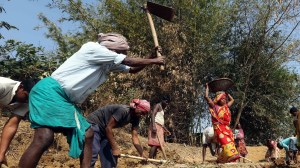
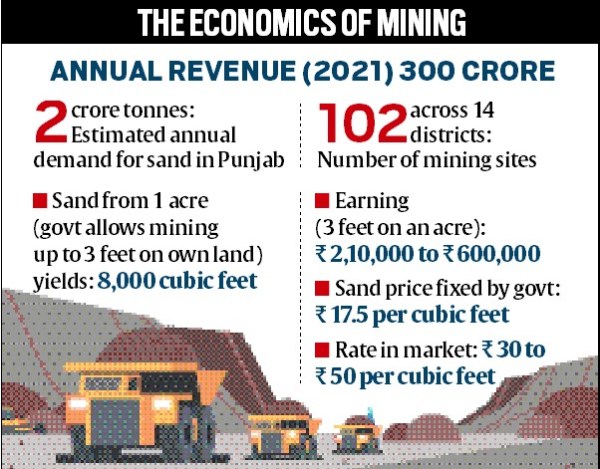
Yet, across Punjab’s border districts, the face of the “sand mafia” and “anti-national elements” — the people booked in cases in a business that is estimated to be worth Rs 3,000 crore annually – are usually small farmers and daily labourers such as Paramjit Kaur who extract sand from mostly 10-foot-deep pits as opposed to the alleged mining mafia that use heavy machinery to dig as deep as 200 ft.
In May this year, Punjab Police faced ridicule on social media for registering an FIR against a farmer, Krishan Singh, for allegedly carrying out illegal mining in his field at village Mohar Singh Wala in Jalalabad. The ‘evidence’ police recovered from Singh: a shovel and a pan.
According to data submitted by the Punjab government in court on July 28, more than 500 FIRs were registered against 589 people in cases pertaining to illegal mining. From January 1 to August 22 this year, the government registered 29 FIRs in Gurdaspur and Pathankot alone.
“The government’s figures suggest that only a little over one person was booked in each mining case. Anyone who knows the scale of illegal sand mining in the border areas, which are pockmarked by deep pits, would ask if it is possible for one person or even two to carry out this operation. This data is a joke. Most of those who are booked are poor people who dig out sand from their fields,” said human rights activist and lawyer Sarabjit Singh Verka.
Newsletter | Click to get the day’s best explainers in your inbox
In Punjab, sand is mined from riverbeds in the dry months. While the state has 205 legal sand mining spots, there have been several known instances of the miners going beyond the permissible area or tapping riverbeds that are not included among the “auctionable” mines.
On August 8, Mines and Geology minister Harjot Bains said the AAP government had registered 306 cases in its first five months in office. However, the only high-profile arrest so far has been of former Congress MLA Joginder Pal. FULL report on http://www.indianexpress.com

 4 min read