Journalism of Courage



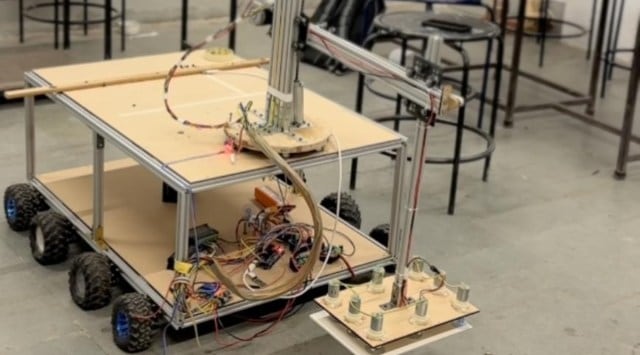 Tilo-o-matci, an automated device used for placing tiles.
With automation entering almost every sector, students at CEPT University in Ahmedabad have developed a complete automated chain for the construction industry aiming at increasing efficiency, reducing wastage and addressing the problem of availability of skilled labour.
Eleven robots have been developed to serve purposes like demarcation of construction site, curing, tiling, level transfer, concrete strength testing sensor, plastering, reinforcing, mortar laying, brick placer, reinforcement and paint spray.
Some of these machines are expected to be used by major construction companies as well.
Using robotics, automation and technology tools, a group of 11 undergraduate students from the Faculty of Technology built the robots as part of their project ‘Industry 4.0 in Construction Technology’. The machines are on display at the summer exhibition at CEPT University that opened for the public on May 9.
“On an average these 11 robots would reduce 70-80 per cent manual intervention while individually, some, like the one for curing and the one for spray painting, can even reduce the same to 90 per cent,” Prof Bhargav Tewar said.
During the project work, spread across eight weeks, students spent six weeks at actual construction sites to understand the working process.
“Each student individually spent 250-300 hours on site. We learnt about the materials involved or development of future materials, their properties, foundations, precast, types of concretes and brick, applications of technology tools, implementation and strategic planning, demonstrative methods, hands-on activities and calculative methods through site visits,” Hansraj Rathi, one of the 11 students, said.
They tested the prototypes on site and went on to design working robots. “We are in talks with companies like PSP for the curing machine,” said Prof Tapan Betai.
The students have studied industrial and building construction at PSP’s precast plant in Sanand.
Another student, Shubham Raval, said, “These not only increase the speed of construction, reduce costs, improve safety but also increase precision. Issues like non-availability of skilled labour and concern regarding accuracy in fast-track projects can be addressed by these machines.”
Dhruv Patel, also among the 11 students, added, “Nowhere in the country are such machines being used. But with automation and Artificial Intelligence, in no time, this is going to change how the construction industry operates.”

 3 min read