


Tags:


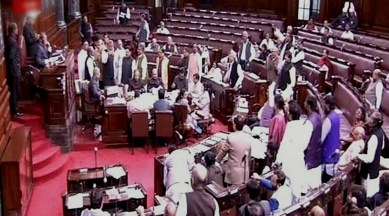
For the second consecutive year, the Government had to suffer embarrassment in the Rajya Sabha when the Opposition managed to pass an amendment Wednesday to the President’s address, expressing regret that the speech did not commit support to rights of all citizens to contest panchayat elections.
The amendment, moved by Leader of Opposition Ghulam Nabi Azad, led to division of votes in which 94 voted for the amendment and 61 against.

Watch Video | PM Modi Mocks Congress But NDA Suffers Embarrassment In Rajya Sabha

While the BSP was absent from the floor of the House during voting, the SP and Trinamool members were present though minus their top leaders like Ramgopal Yadav (SP) and Derek O’Brien (TMC). The AIADMK voted with the NDA.
[related-post]
Last year too, the President’s address was amended by the Opposition over the issue of black money. While this is the second time in two years, there have been only two-three occasions in the past six decades that amendments to the President’s address have been passed.
Earlier, while referring to the 300 amendments that had been tabled to the motion of thanks on the President’s address, Modi appealed to the parties to withdraw them and pass the motion unanimously to ensure the dignity of the President’s office and in keeping with the high traditions of the House.
But the Opposition forced passage of the amendment which regretted that the address did not commit support to rights of all citizens to contest panchayat elections in the backdrop of new laws in Rajasthan and Haryana where matriculation has been fixed as the eligibility criteria for contesting polls.
The Prime Minister, in his speech, referred to the qualification criteria fixed in BJP-ruled Rajasthan and Haryana for those contesting panchayat polls and said it has been approved by the Supreme Court but attempts were being made to give it a “political colour”.
“There can be difference of opinion… Some say what about those who remained illiterate,” he said, and went on to target the Congress, saying the reason for ‘illiteracy’ was the policies followed by its government after Independence.
“We want to bring a qualitative change but it is being politicised,” Modi said, daring Leader of Opposition Ghulam Nabi Azad to give 33 per cent tickets to totally illiterate people in the upcoming Assembly elections in five states to demonstrate the Congress commitment in this regard.
Congress member Mani Shankar Aiyar intervened to say that the Prime Minister has no idea how much illiteracy has increased since Independence and he is insulting the nation with his remarks. Modi, however, dismissed his comments with a swipe, describing them as ‘bhule bisre geet’ (old songs) sung by someone whose membership is coming to an end.
After the Prime Minister’s reply, members tried to seek clarifications but Chairman Hamid Ansari refused, saying it will then be an endless debate. While Modi left soon after his speech, many members who had tabled amendments to the motion of thanks, withdrew them but Azad maintained he would not withdraw it. His amendment was adopted after an hour-long debate over its validity and the right of the House to move such an amendment.
Objecting to the move, Leader of the House Arun Jaitley said “federalism will go for a six” since Rajya Sabha does not have powers to pass resolutions against state legislatures which also, in turn, can pass such resolutions. He also said it is not in the jurisdiction of this House to discuss any matter covered by state legislatures.
This was objected to by Azad and other Opposition members, including Yechury who claimed that it was well within the right of the House to pass it as it was only a concern expressed by members.
Deputy Chairman P J Kurien, who was in the chair, gave a ruling after claims and counter-claims from both sides, and said, “This is only a concern of members. There is also a valid explanation why these things be not there. There is no harm in putting it to vote.”
An elated Azad said the Congress had to give a wake-up call to the Government because the BJP governments in Rajasthan and Haryana had enacted laws which had finished democracy and subverted the Panchayati Raj process brought in through the 73rd and 74th amendments of the Constitution by fixing educational qualifications and depriving almost 50 per cent of the population from contesting elections.
He said the most affected because of those regressive Acts were women, Dalits and minorities.
His amendment read: “…but regret that the address does not mention that the Government is committed to securing the fundamental right of all citizens to contest elections at all levels, including to panchayats to further strengthen the foundations of democracy which also forms part of the basic structure of the Constitution and is consistent with the spirit of the 73rd amendment, intended to expand and encourage democratic participation of the poor and marginalised without imposing education or any other limitations on the right to contest elections”.
Azad said he was forced to press for division because the Prime Minister in his reply in a way justified the Haryana and Rajasthan laws saying the illiterate need not contest elections. “The Prime Minister always claims he hails from a backward background and for him to say such a thing is disappointing and unfortunate,” Azad said.
Congress vice president Rahul Gandhi, who is a member of the Lok Sabha, later said: “The right to contest elections is a basic right of every citizen of India. Our founding fathers fought against the British for this right. By making educational qualifications mandatory for contesting panchayat polls, the BJP and RSS want to take this right away from the poor, Dalits and Adivasis. They want to take this right away from all those who have been denied access, exploited and suppressed. Proud that Opposition came together against the BJP’s attempt to exclude more than 50 per cent of India’s electorate from the right to contest elections.”
Congress leader Jairam Ramesh said the Haryana and Rajasthan Acts have shown that there was a deficiency in the 73rd and 74th amendment and said the Congress would demand a Constitutional amendment to rectify that deficiency which lies in Article 243(F) of the Constitution. “Today, the Opposition scored by a symbolic but significant victory. It is not ritualistic,” Ramesh said.


