


Tags:


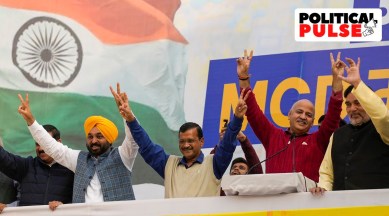
What is the Aam Aadmi Party (AAP)’s ideology? The question has dogged the party since its inception as a political outfit that grew from the India Against Corruption (IAC) public movement.
The Arvind Kejriwal-led AAP has so far hesitated in engaging with this question, focusing instead on showcasing itself as a party with “a vision to improve the lives of people through good governance”.


Kejriwal then went on to contrast the said ideology with that of the BJP, alleging that the latter ideologically stood for “thuggery” and that the Congress symbolised corruption.
When read between the lines, it becomes clear that the AAP would not abandon its stance of tiptoeing round the proverbial elephant in the room: the question of ideology. It has even refused to so much as name the BJP’s ideology as Hindutva.
Kejriwal’s remarks assume significance in the wake of the Gujarat polls, which threw up questions about the effectiveness of the AAP’s strategy of refraining from commenting on issues of rights, liberties, and minorities. The party did not really dent the BJP’s vote bank as much as it seemed to have gained from the erosion of the Congress base in the state.
Speaking to The Indian Express, an AAP leader said: “The Congress has time and again argued that its fight with the BJP is primarily ideological. It has forayed into the debate on Hindutva and Hinduism. The AAP does not see returns in that strategy. There are unlikely to be major changes in the party’s formulations on the ideological front.”
Kejriwal’s speech reflected a minor possibility of a potential rethink on the issue, though.
In his Assembly speech, he had described “insaniyat (humanity)” – projected as the third “pillar” of the AAP’s ideology – as well-being of street children through the effective government policy.
On Sunday, the AAP supremo, however, said that “insaniyat” means brotherhood between human beings, eschewing fights over religion or caste. “All humans are equal,” he asserted.
His remarks also came amid a growing perception, attested by poll numbers, that not all Muslims in Delhi would back the AAP despite the party’s attempts to reach out to the community.
The debate on the AAP’s ideology, or the lack of it, has gained prominence also because of the party’s growing stature. It has now attained the status of a national party by winning five seats in Gujarat with a nearly 13 per cent vote share, after having conquered Delhi and Punjab. Kejriwal remains focused on ensuring its expansion.
The AAP National Council, however, did not take any conclusive decision on the states where the party will contest the elections next.
“Many states go to the polls in 2023. There is very little time left for Karnataka. And there is very little space. Unlike Gujarat, Congress remains strong there. The party is analysing the potential returns in entering Telangana, Madhya Pradesh, Rajasthan and Chhattisgarh also. Haryana, which goes to polls in 2024, is one state where the AAP will contest like it did in Gujarat,” an AAP leader told The Indian Express.
The AAP’s dismal performance in states like Uttarakhand, Goa, and more recently, in the Himachal Pradesh elections, is also weighing on the mind of the party leadership. “Foraying in a state unprepared, just for it own sake, makes for bad strategy. All candidates forfeiting deposits also create bad optics for a party which harps on the fact that it has governments in two states within a decade of its birth,” the leader added.


