


© The Indian Express Pvt Ltd
Tags:


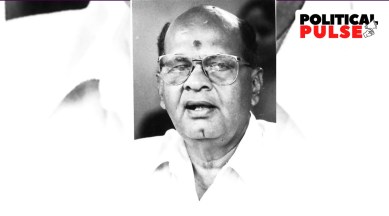
In 1982-83, Datta Samant, one of Maharashtra’s most prominent trade union leaders, led a massive, indefinite strike against the textile mill owners in Bombay (later changed to Mumbai) with about 2.5 lakh mill workers that lasted for 18 months. The unprecedented strike was meant to aggressively give voice to the mill workers’ various demands that included enhanced wages, better working conditions, regularisation of contractual workers, house rent and paid leave.
Bombay was then dotted with the textile mills whose workers made up a sizeable section of the city’s workforce. The mills prompted strong trade union activities with several major workers’ bodies representing different political ideologies dominating the scene. In the pre-liberalisation period, Maharashtra, which has a long history of movements for the welfare and uplift of workers, saw the emergence of the communist or socialist veterans and trade union stalwarts like S A Dange, S M Joshi and George Fernandes, among others.


For a trade unionist, who could bring Bombay to a halt with one call, Samant was a down-to-earth man who was always accessible to common people. At his office at Pantnagar in Ghatkopar, there was always a huge crowd with the workers making a beeline there with their problems.
Significantly, Samant who dedicated his life to championing the cause of the workers could not anticipate that the 1982-83 strike would boomerang and cause widespread suffering among the agitating mill workers. With the textile industry coming to a halt, many mill owners declared their units “sick” and moved out of the city. This resulted in tens of thousands of workers getting unemployed. It also led to a major transformation of the city as the closed mills paved the way for the real estate boom with the malls and new commercial complexes replacing them.
Samant had later said, “Our fight was always against the exploitation of mill workers. Our demand was decent wages and better working facilities for them.” He charged that the sick mills were a “man-made” development and part of a “larger designs” of various vested interests including the politicians and mill owners.
After taking the plunge into trade union activities, Samant joined the Congress and its affiliate, the Indian National Trade Union Congress (INTUC). The industrial unrest in different parts of the state saw him consolidate his position among workers as he led several of their agitations for their various demands.
His popularity led to the Congress fielding him in the 1972 state Assembly polls from the Mulund seat in Mumbai in which he won. But, he was still arrested in 1975 during the Emergency for his militant trade unionism. His “larger- than-life” image amongst the workers made many leaders in the Congress and its rival parties worried.
After Indira Gandhi’s defeat in the 1977 general elections, Samant was released from the prison. The post-Emergency politics marked with the Janata Party rule boosted Samant’s image, which was however dented by the 1982-83 strike.
And, yet, Samant managed to win as an Independent candidate from the Mumbai South Central constituency in the 1984 Lok Sabha elections despite the pro-Congress wave that had then swept the country in the wake of Indira’s assassination.
Despite his Congress background, Samant made trade unionism a common cause with communists and socialists. Amongst the charter of demands put before the mill owners during the 1982-83 stir was the derecognition of the INTUC-affiliated Rashtriya Mill Mazdoor Sangh, which was then seen as the sole representative of unions.
Samant always maintained that “I have no enemies” and that his fight was for workers’ rights and not
against politicians or ideologies. However, the prolonged strike leading to massive loss of jobs had its impact, with Samant being blamed for it due to his “militant trade unionism and bargaining leaving no room for a compromised settlement”.
Unfazed by such setbacks, Samant continued his trade union activities. On January 16, 1997 it was like any other day when he started from home at Powai to visit his office at Pantnagar. He has scheduled meetings and visitors to meet.
Barely 50 metres from his home, as he drove in his car, which was gifted to him by the mill workers, he was intercepted by a cyclist. And then four assailants fired 17 bullets, piercing through his head, chest and stomach. They immediately fled from the spot. Samant was rushed to his son’s clinic where he was declared brought dead.
It was in April 2007 that three suspects in the Sawant murder case were arrested by the police. In October 2007, another suspect was gunned down by police. Meanwhile, underworld don Chhota Rajan was named by the police as one of the accused in the case.
On Friday, a special CBI court in Mumbai acquitted Chhota Rajan of all charges in the Samant murder case, citing lack of corroborative evidence.


