


Stay updated with the latest - Click here to follow us on Instagram
© The Indian Express Pvt Ltd
Tags:


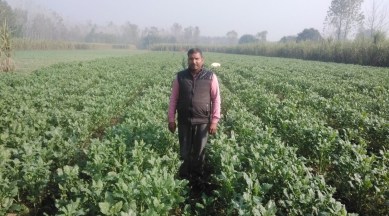
Like all farmers, Prakash Vir Sharma has been hit by soaring diesel prices – from below Rs 63 to nearly Rs 87 per litre since March 2020. This rabi cropping season he has also paid Rs 1,490 for a 50-kg bag of ‘12:32:16’ complex fertiliser, which earlier retailed at Rs 1,185. Amid these higher costs, the Uttar Pradesh (UP) government’s price fixed for sugarcane supplied to mills has gone up just over 11% – from Rs 315 to Rs 350 per quintal – in the last five years.
One solution to produce realisations not keeping pace with rising input costs – leading to the clamour for minimum support prices being made a guaranteed “right” – is raising farm incomes per acre through intercropping: Growing more than one crop simultaneously on the same piece of land. That’s what Sharma is seeking to do.


“My sugarcane will be ready only next November-December. The other crops I can harvest by March. My cane yield would be around 110 quintals per bigha. If I can harvest another 1 quintal/bigha of mustard, that’s extra income,” says Sharma.
More income per acre is also what Mahindra & Mahindra Ltd (M&M) is aiming to deliver through Krish-e, its new ‘Farming as a Service (FaaS)’ business vertical. For intercropping – planting shorter-duration crops alongside a main crop – it entails both agronomic and mechanisation interventions.
Farmers normally plant sugarcane on flat beds at 2.5-3 feet row-to-row distance. This is now being replaced by making raised beds and planting the cane on the furrows at wider 4.5-5 feet spacing. The short-cycle crops are, in turn, planted on the raised beds. These intercrops can even be potato, onion, garlic, cauliflower and cabbage if cane is planted in late-September to October, or moong (green gram), urad (black gram) and arbi (colocasia) if planting happens in February-March, which is the usual time in UP.
“At 2.5-feet row spacing, my average cane yields were 70 quintals/bigha. With 5-feet planting, it is 100 quintals. The reason is that the crop tillers better when it has space to grow and the canes come out thicker and longer. Also, it’s easier to give water, fertiliser and pesticides through the furrows,” notes Sundar Singh Malik (62)
This 60-bigha farmer from Shadipur village of Dhampur planted sugarcane on 30 bigha on November 5, while intercropping it with wheat, mustard, potato and jau (barley). “I get 2.5-3 quintals/bigha yield from wheat alone. That, together with the other crops, adds to my cane income,” he adds.
For companies like M&M, increasing plant row distance to enable intercropping is also a means for promoting farm mechanisation. Sharma has invested Rs 4 lakh in a ‘Mahindra JIVO 225 DI’ 4-wheel drive tractor. This small 20-horsepower tractor can be used for intercultural operations (removing weeds) and earthing-up (moving soil from the ridges and placing near the canes on either side after harvesting the intercrops), apart from regular field preparation, tilling and transport.
“Farmers supply cane to mills against parchis (indents), each representing a buggi (buffalo cartload) of 18-20 quintals. The JIVO tractor can haul up to 35 quintals and easily replace the buggi,” claims Sandeep Chaudhary (44), M&M’s biggest dealer in western UP. His five outlets at Bijnor, Najibabad, Dhampur, Chandpur and Afzalgarh, all in the same district, sell 700-odd tractors annually.
Chaudhary has converted his Dhampur outlet into a Krish-e Centre. This centre – one of the 100-plus that M&M has opened in 16 states – showcases not just tractors, but a host of other farm equipment, agro-chemicals (insecticides, herbicides and fungicides), bio-fertilisers and agronomy advisory services.
“Our idea is to move beyond tractorisation to actively engaging with farmers, while leveraging our 1,600-strong dealer network. This has to be hyper-local and crop-specific. So, in Bijnor, it is the cane grower whose income per acre is to be increased,” explains Ramesh Ramachandran, Senior Vice President-FaaS at M&M.
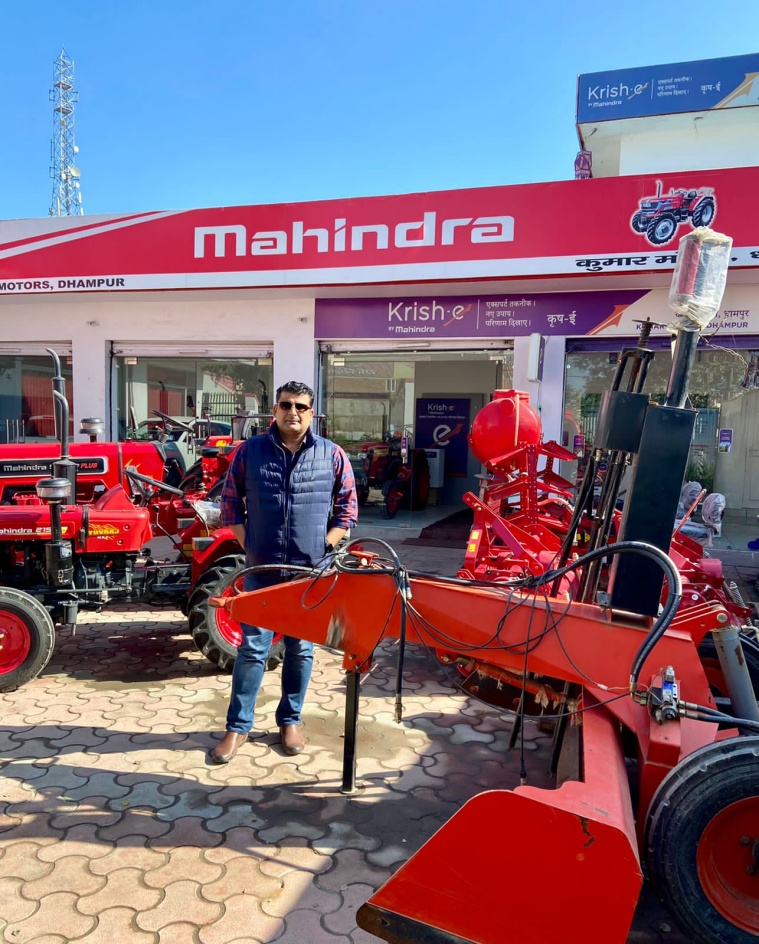
That would mean intervening at every stage, right from land preparation. Chaudhary’s centre has laser land levelers (for uniform water distribution and placement of seed and fertiliser), rotavators (for tilling, mixing and pulverising the soil up to 5 inches depth) and mould board ploughs (for breaking hard pans and turning the soils at 8-10 inches). These are made available to farmers on daily rental basis.
Sharma, till last year, was directly sowing the cane seeds (bud cuttings from old plants) in his field. This time, he has switched to raising the seeds (‘setts’) first in nursery trays and, then, transplanting the young seedlings with 3-4 leafs in the main field. “I prepared the trays (containing vermicompost and cocopeat media) on September 13-14 and transplanted the saplings (2,000-2,200 per bigha) on October 14. The plants come out healthier through this method, which should also reflect in yields,” hopes Sharma.
Malik has gone one step further. Not only has he switched from traditional cane sett sowing to transplanting. On three bigha, he has transplanted the saplings (50 in each tray) mechanically. If the trial demonstrates significant advantages over manual transplanting, it would spur demand for Mahindra’s semi-automatic seedling transplanter – not just from Malik. And that’s a win-win for both.


Stay updated with the latest - Click here to follow us on Instagram


