Journalism of Courage



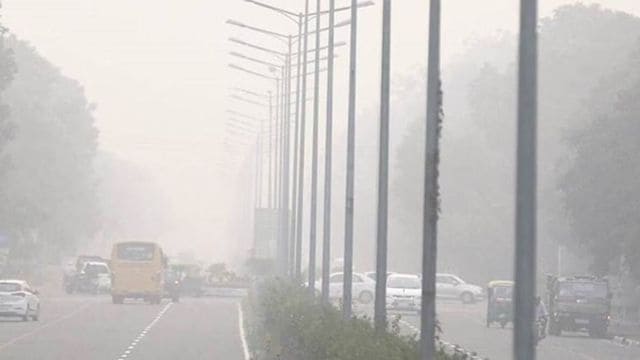 As per experts, urban development activities could also be adding to the pollution load. (File photo)
Chandigarh continued to breathe air of “poor” quality for the third consecutive day on Friday, with weather conditions playing a key role in trapping pollutants close to the ground. As per data from the Central Pollution Control Board (CPCB), recorded as average of past 24 hours, the Air Quality Index (AQI) stood at 275 on December 17, improved marginally to 266 on December 18, and further eased to 254 on December 19. Despite the gradual dip, the air quality has remained in the “poor” category, raising health concerns, especially for vulnerable groups.
Experts attribute the persistent pollution levels to dense fog, cold weather and the absence of rainfall since October, due to inactive western disturbance.
Speaking on the issue, Dr Ravindra Khaiwal, Professor, Community Medicine and School of Public Health, PGIMER, said that fog and smog are preventing dispersion of pollutants. “Due to fog and cold conditions, pollution is getting trapped at the ground level. Solar penetration is not taking place, which is why the AQI remains poor,” he said.
Dr Khaiwal pointed out that unlike previous years, western disturbances — which usually bring rainfall and help wash away pollutants — have not affected the region so far. “Earlier, fog would generally appear after rainfall, but at present fog is forming due to moisture coming with the wind. Since there has been no rain, pollutants are continuously building up,” he explained.
However, he expressed hope that air quality would improve once fog conditions ease. “Earlier, the fog was very dense; now it has become lighter. Once fog clears, pollutants at ground level will reduce, leading to better air quality,” he added.
In its latest forecast, the India Meteorological Department (IMD), Chandigarh, has predicted partly cloudy skies over the city for December 20, 21 and 22, with maximum temperatures ranging between 19 degrees Celsius and 21 degrees Celsius and minimum temperatures hovering around 9 degrees Celsius. From December 23 onwards, the weather is expected to turn mainly clear, with the maximum temperature rising to around 22 degrees Celsius on December 23 and settling near 20 degrees Celsius on December 24, while minimum temperatures may dip to 7 degrees Celsius.
The IMD has also issued advisories indicating dense to very dense fog at isolated places in Punjab and Haryana on several days during the coming week. However, no rainfall has been forecast for Chandigarh in the next few days, which means pollution levels may remain a concern until fog conditions improve significantly.
Dr Khaiwal has advised people, particularly sensitive groups such as the elderly, children, pregnant women, those with underlying health conditions or those who have recently undergone surgery, to take precautions. “They should avoid pollution hotspots such as areas with heavy traffic or high vehicle density and should refrain from early morning walks. Light exercises should be done only when weather conditions improve,” he said. He added that given the current pollution levels in Chandigarh, using a triple-layer mask or even a normal cotton cloth mask while stepping out would be sufficient.
Meanwhile, enforcement of vehicular pollution norms remains limited. The Chandigarh Traffic Police, which routinely issues challans for visible traffic violations, is not carrying out special drives to check Pollution Under Control (PUC) certificates.
A senior traffic police official said that PUC documents are verified only when a vehicle is stopped for a visible offence. “If during document verification, the pollution certificate is found expired, a challan is issued,” the official said.
As per experts, urban development activities could also be adding to the pollution load.
City-based architect Tarsem Singh said that construction activities, particularly during dry winter months, can contribute to air pollution. “Dust from construction sites adds to particulate matter in the air. While Chandigarh is better planned than many cities, strict enforcement of dust-control measures at construction sites is essential,” he said.
Understanding Air Quality Index
The Air Quality Index (AQI) is used to indicate how clean or polluted the air is and the likely health impact. An AQI between 0 and 50 is considered good with minimal health impact while 51 to 100 is satisfactory and may cause minor breathing discomfort to sensitive people. An AQI of 101 to 200 falls under the moderate category and can lead to breathing discomfort among people suffering from lung, asthma or heart diseases. When the AQI ranges between 201 and 300, it is termed poor and prolonged exposure can cause breathing discomfort to most people. An AQI of 301 to 400 is classified as very poor and may result in respiratory illness on prolonged exposure while levels between 401 and 500 are considered severe, affecting even healthy individuals and seriously impacting those with existing diseases.

 5 min read