Journalism of Courage



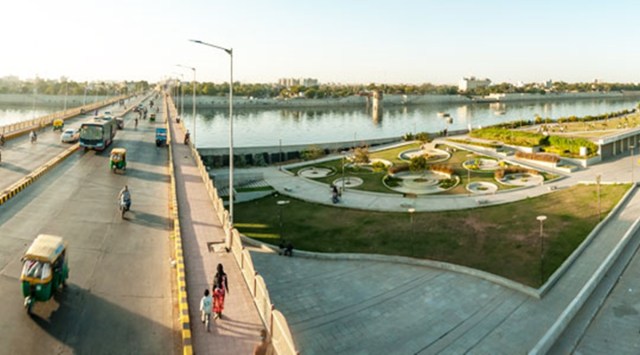 At the riverfront - Photo courtesy- Sabarmati Riverfront Development Corporation Ltd (Express File Photo)
 Over two years after the Gujarat High Court took suo motu cognisance of pollution in the Sabarmati River due to the discharge of untreated industrial effluents and domestic sewage, a report by a committee constituted by the National Green Tribunal (NGT) on Monday recorded that the issue of “illegal discharge of industrial wastewater through storm water drains” persists in Ahmedabad’s Danilimda and Behrampura areas.
The Ahmedabad Municipal Corporation (AMC) has been carrying out periodic drives to sever illegal industrial connections to pipelines connected to sewage treatment plants (STPs). However, the civic body has expressed “disagreement” with two recommendations made by the committee.
The panel has recommended the AMC “to identify, sever the connections of illegal discharges in the stormwater drains and drainage system and also share the information of such industries with the GPCB (Gujarat Pollution Control Board) regularly for appropriate action”. It further recommended the AMC should “continuously monitor the stormwater drains or drainage system in Danilimda, and Behrampura areas for illegal industrial discharges.”
As per the minutes of an August 23 meeting registered by the panel, the civic body’s disagreement with the two recommendations by the committee was reasoned on the ground that “AMC is responsible for providing services in residential areas and not for drainage of industrial area”.
The civic body’s response is contrary to the stance it took before the Gujarat HC earlier. Following the court’s directions, it had agreed to sever illegal connections and monitor the pipelines with assistance from the GPCB and police.
An engineer with AMC said on Monday, “The disconnection of illegal connections that is being undertaken by the AMC is as part of the directions issued in the Gujarat HC; but otherwise, the GPCB is the responsible authority for monitoring industries.”
“It is in the GPCB’s purview to check illegal industrial connections. The AMC has been involved because the illegal connections are to pipelines of STPs, which are in the domain of the civic body. Because of the illegal industrial connections to our STPs, the functioning of the STPs is affected and ultimately the blame comes on us. In the NGT litigation, the grievance is that the industrial effluents are being discharged into stormwater drains that directly open into the river. Stormwater lines are the AMC’s responsibility but whether industries have implemented zero liquid discharge systems or not for their effluent treatment and its monitoring would be under GPCB’s purview,” the official said.
The committee’s report concludes that even as the AMC has sealed the stormwater drains in certain locations, however, “overflowing of industrial wastewater from the chambers of stormwater drain shows that some of the industrial units are still discharging the wastewater illegally through underground pipeline created illegally resulting in overflowing of wastewater from the chambers of stormwater drain and causing damage to the environment.”
An application was filed before the NGT in June by Aditya Singh Chauhan, a journalist, and environmentalist, under provisions of the National Green Tribunal Act, 2010.
It highlighted that 55 industries located in the areas of Suez Farm, Behrampur and Danilimda in Ahmedabad were 0discharging untreated industrial waste or partially treated industrial waste into the open or in pipelines of the AMC.
This was in violation of the ZLD (Zero Liquid Discharge) condition under the Consent to Establish (CTE) granted to them by the GPCB, the application stressed. According to the applicant, the AMC pipelines are discharging effluents into the Sabarmati River, which is causing damage to the groundwater and the river. The NGT western bench, recording that it finds a prima facie case where the environment is being impacted adversely, by way of an order dated July 20, had called for a report from a Joint Committee comprising one member each from the GPCB, the CPCB (Central Pollution Control Board), AMC, and the Ministry of Environment, Forest & Climate Change (MoEF&CC). The committee submitted its report before the NGT on Monday.
The NGT is due to take up the matter next on September 18.
Among other recommendations made by the committee in its report include the installation of night vision cameras at the outfall location of Danilimda and other strategic locations in the Danilimda and Behrampura areas to keep a continuous vigil on the discharges, and that the GPCB should ensure that no unit should be allowed to operate without ensuring foolproof zero liquid discharge (ZLD) system.

 5 min read