India is trying to ensure that its partners, platforms, options and choices are as broad as possible, External Affairs Minister S Jaishankar said on Tuesday in response to a question related to India’s attempts at strengthening its global standing in the shifting world of tariffs and diplomatic alliances.
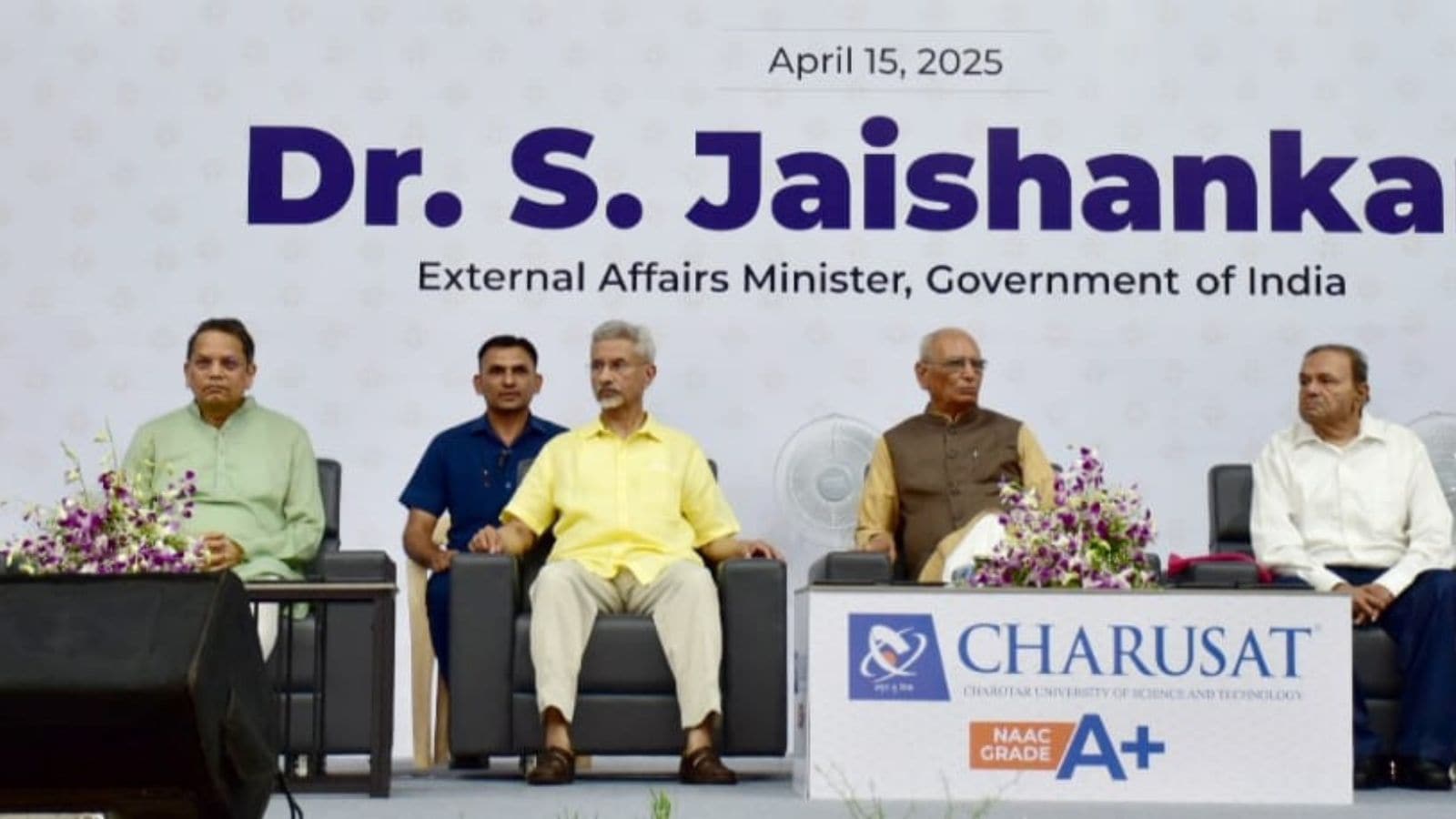
Participating in an interactive session with the students of Charotar University of Science and Technology (CHARUSAT) in Anand district, Jaishankar further said that India should have the ability and strength to stand up for its interests.

“Our position in the world is very special. And a country like India, traditions that we have, (of) Vasudhaiv Kutumbakam, of having a very open approach towards the world. We must maximise the number of partners, platforms, mechanisms. And we must also have the strength that we should do what is in our interest,” the EAM said.
“And sometimes, if we are pushed by one country saying ‘be with us, don’t be with them’, we should have the ability to stand up for our interests and stand up for our rights and do what is best in our interest. And by doing gatherings like BIMSTEC, which is on the Bay of Bengal, or on BRICS, which is largely a non-western gathering, we are trying to do that,” the Union Minister said as he interacted with students of the university on a range of issues during the session moderated by Vijay Chauthaiwale, incharge of the BJP’s foreign affairs department.
In response to a question on India’s changed foreign policy wherein we hardly talk about Pakistan, Jaishankar said, “India has changed. I wish I could say Pakistan has changed. They unfortunately, in many ways, (are) continuing bad habits. They are continuing a very negative way of approaching India.”
He said that after 2014, the message to Pakistan has been very firm that any act of terrorism will have consequences.
“What has happened also, during this period, we have forged ahead economically, politically. Our standing in the world has gone up. They have continued to play the old…We have separated ourselves, we have gone up to a higher level. If you go out in the world; it’s a joke, but it’s not really a joke… IT for India means information technology. For Pakistan it means international terrorism. That sense, that branding, that terrorism impression has stuck to them. Today, our branding is a technology branding,” he said.
Story continues below this ad
Earlier, a student asked Jaishankar how can India leverage groupings like BIMSTEC (Bay of Bengal Initiative for Multi-Sectoral Technical and Economic Cooperation) and BRICS (Brazil, Russia, India, China, South Africa) to strengthen its global standing in the shifting world of tariff war and diplomatic alliances in the US, and the ongoing conflicts in the world.
Jaishankar said, “A big country like India… We will have many interests, many partners, friends. Now, the world is a very competitive place. What will happen is people (will) drive to restrict our choices, restrict our options. It is natural. That is the way the world is. What we are trying to do today is to ensure that our partners, our options, our choices are as broad as possible.”
He further told the student, “You mentioned, BIMSTEC, you also mentioned BRICS. I can give you very different partners. There is a group called Quad with America, Australia and Japan. There is a gathering called Voice of Global South which has almost 120 countries of the developing world. There are Indian Ocean grouping, there is Colombo security conclave… What we are trying to do is to see how do we have the maximum number of platforms, maximum opportunities, maximum friends.”
When a student asked Jaishankar India’s positioning at the global stage in the form of opportunities for youths in terms of entrepreneurship, Jaishankar said that India is witnessing a gradual mindset change and an attraction towards startups.
Story continues below this ad
In the context, he said, “In a big economy, the government cannot be the only employer or the default employer. The bigger the economy, the more options will come.”
In that scenario, what should the government be doing?
The EAM said, “I would say broadly two things; one, it needs to provide or encourage a system of education which is more relevant to entrepreneurship, employment. Second, the government needs to have an economic culture where people who want to start on their own get support.”
He said that the government has already initiated efforts in that direction.
In response to another question on Indians working abroad, Jaishankar said that technology is going to play a very important role in international equations and Indians abroad have a key role in being the bridge between India and the world to promote India as a good technology partner.


 5 min read