


Stay updated with the latest - Click here to follow us on Instagram
© The Indian Express Pvt Ltd
Tags:


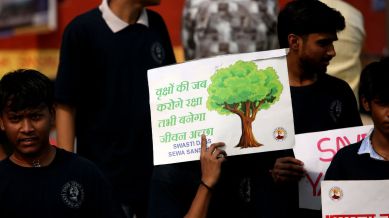
Ending the brief respite after Diwali, Delhi saw its 24-hour average air quality index (AQI) hover around the ‘severe’ category Sunday after plummeting to 382 from 316 recorded a day before.
The Capital recorded the worst air quality in the country, according to the Central Pollution Control Board (CPCB). Several places, such as Nehru Nagar, Anand Vihar, Ashok Vihar, Bawana, Dwarka, Jahangirpuri, Mundka, Patparganj, Rohini, Vivek Vihar and Wazirpur — 10 out of 13 pollution hotspots, reported air quality in the ‘severe’ category. An AQI between 301-400 signifies ‘very poor’ air quality, while that in the 401-500 range marks ‘severe’ degradation.

On Saturday, favourable atmospheric conditions such as warmer temperature and strong winds prevented it from slipping into ‘severe’ as was forecast.
October saw the highest average temperature of 73 years with the monthly maximum at 35.1 degrees Celsius and minimum at 21.2 degrees Celsius, as per the India Meteorological Department (IMD). It said the weekly temperature normal range is 15.3-30.5 degrees Celsius. However, it has forecast above normal temperatures for the coming week in the 18-33 degrees Celsius range.
Meanwhile, the Indian Institute of Tropical Meteorology (IITM) has forecast ‘very poor’ or ‘severe’ air quality in its six-day outlook. “Meteorological conditions are likely to be extremely unfavourable for dispersion of pollutants,” it added.
Amid a steady drop in air quality, the Commission for Air Quality Management (CAQM) in NCR and Adjoining Areas had implemented the Graded Response Action Plan (GRAP) Stage 2 on October 22 with a GRAP Monitoring Control Room set up on October 15. So far, more than 7,000 construction and demolition sites have been inspected across NCR, with penalties imposed on 597 non-complying sites. Another 56 sites were issued closure orders, the Commission stated Sunday.
Other actions undertaken as part of GRAP include the deployment of Mechanical Road Sweeping Machines (MRSM), Water Sprinklers (WS) and Anti-Smog Guns (ASGs). In Delhi, 81 MSRMs were deployed while in Haryana and UP, 36 MRSMs were deployed daily to arrest the dust pollution from roads, CAQM added.
Vehicular emissions turned out to be the major contributing factor to Delhi’s pollution woes. Around 54,000 vehicles have been challaned for non-possession of Pollution Under Control certificates and around 3,900 overage vehicles have been impounded across NCR from October 15-31.
Measures to manage municipal solid wastes have been ensured through regular inspections at illegal dumping sites. So far, 5,300 such inspections have been carried out. Enforcement actions have been undertaken in the industries sector, too, with around 1,300 diesel generator sets inspected and action taken against non-complying units, the sub-committee further stated. Around 1,400 industries in total have been inspected by NCR state agencies.


Stay updated with the latest - Click here to follow us on Instagram


