


Stay updated with the latest - Click here to follow us on Instagram
© The Indian Express (P) Ltd
Tags:


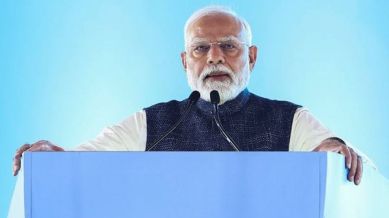
In Chandigarh, to dedicate to the nation the successful implementation of the three new criminal laws that came into effect on July 1, Prime Minister Narendra Modi said on Tuesday that the “tareekh-pe-tareekh days were over”, referring to a Hindi film dialogue against repeated adjournments in the Indian legal system.
Chandigarh is the first city in the country to ensure the total implementation of the Bharatiya Nyaya Sanhita (BNS), Bharatiya Nagarik Suraksha Sanhita (BNSS), and Bharatiya Sakshya Adhiniyam (BSA). PM Modi said these laws would ensure speedy delivery of justice and make sure that the convicts are not kept in jails after they finish their sentence.

Modi, who was flanked by Union Home Minister Amit Shah, hit out at the successive governments in the Centre as he said that the Indian Penal Code (IPC), Code of Criminal Procedure (CrPC) and Indian Evidence Act were brought in by the British during the colonial era to punish the Indians. “Their sole aim was to punish the Indians. While we as an independent nation want to ensure justice to the victims,” he said.
Striking a chord with the residents of Chandigarh, Modi said, “Chandigarh aane pe lagta hai apno ke beech aa gaye (When I come to Chandigarh, I feel I am among my own people).” He said Chandigarh identifies with Chandi Devi, the goddess of power and establishment of truth and justice.
Modi said it was 75 years after India adopted the Constitution that these laws were implemented. “It is a solid effort as envisaged by the Constitution. I was watching the live demo of the implementation of these new laws. I would exhort all of you to watch this demo. I congratulate everyone for the implementation of these laws,” he added.
Modi said these laws were solid documents as a thorough process was undertaken for this. Legal luminaries, police and experts were consulted after January 2000, when suggestions were invited for these laws. “Many discussions were held and the practicality of all laws was checked. I am thankful to the Supreme Court of India, and the high courts of states, especially the Punjab and Haryana High Court. I thank all the bar members for making these laws a reality with their suggestions,” Modi said.
Recalling Independence Day, Modi said that Indians had hopes that the British had left the country and that the draconian laws brought in by them would also be a thing of the past. “It was after the first struggle of Independence in 1857 that the CrPC, IPC and Indian Evidence Act were brought in to punish Indians. All these years, we were just circling around the IPC. Amendments were tried but the character of the law remained the same. Questions were not asked if the laws, meant for the slaves, would still be implemented in an independent country. Why were we made to carry that burden?”
He said he wanted the country to get rid of the colonial mindset and the idea of nationalism was necessary. “This is why I put up this resolution before the nation. We have been saying all are equal before the law but the truth was that the poor and weak were scared of the law. They were scared of the courts and the law. BNS will change that fear ingrained in the psyche of people. It is a guarantee of equality in society. This is true justice,” Modi said.
Hailing the laws, he said, “In 90 days, a victim will have to be told about the progress of the case. For women’s security and children, the BNS has a separate chapter on their rights in homes and society. The BNS will also make sure that the law stands with the sufferers. In case of rape, within 50 days, the decision has to be given from the first date of the hearing. Adjournment would not be allowed. Earlier getting an FIR was a tough job. Now the accused will be absolved only if the victim agrees. BNS is humane, it has sensitivity. A convict would not be kept in jail for long. Arrangements of bail have been made for small criminals.”
Modi said the laws would ensure speedy delivery of justice. “We often hear that justice delayed is justice denied. But not anymore. BNS will ensure faster delivery of justice. Faster chargesheet and faster delivery will be there. Deadlines have been set. In Delhi, it took 60 days in a case for delivery of justice and the accused was sentenced to life imprisonment. In Bihar, it took 14 days. These decisions show the power of BNS. This change shows the government is dedicated to the people,” Modi said.
PM Modi said that the world was changing fast and with a good grip on law and order, investments will also see a fillip. “A strong society should have a symbol of law. But IPC only had a fear, that too for the innocent. If there was an accident, people used to be scared of helping,” he said.
Earlier, Shah congratulated Chandigarh for implementing these laws completely. He said within three years, all states should implement these laws completely. Shah said modern techniques and the laws of other countries were studied before formulating these laws. To implement these laws, 11,34,698 officers were trained.
Stay updated with the latest - Click here to follow us on Instagram


