


📣 For more lifestyle news, click here to join our WhatsApp Channel and also follow us on Instagram
© IE Online Media Services Pvt Ltd
Tags:


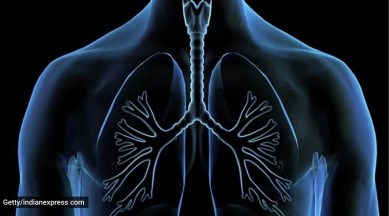
Your lungs are one of your body’s major organs. But as we unearth more and more about the body and how it functions, there is a sense of knowing only a tiny part of the entire structure. As such, can you fathom that the surface area of both lungs could be the same size as that of a tennis court? Here’s what experts told us.
Picture a standard tennis court, meticulously marked and precisely measured, spanning an area of about 78 feet in length and 36 feet in width. “Now, visualise the inside of your chest cavity, where the lungs reside, and imagine unfurling their intricate network of air sacs, bronchioles, and blood vessels. Astonishingly, this delicate system covers a surface area of approximately 70 square meters, which is roughly equivalent to the size of a tennis court,” said Dr D S Sowjanya, senior pulmonologist, Kamineni Hospitals, Hyderabad.

What is the significance of the surface area?
The significance of this vast surface area lies in its crucial role in facilitating efficient gas exchange within our bodies, elucidated Dr Sowjanya. “Each square inch of our lung’s surface is intricately designed to maximise the transfer of oxygen from inhaled air into the bloodstream, while simultaneously expelling waste carbon dioxide. This exceptional efficiency is achieved through a branching network of airways, culminating in tiny air sacs called alveoli, which are responsible for gas exchange,” Dr Sowjanya told indianexpress.com.
The surface area of the lungs is huge because when the lungs start from the windpipe, called the trachea, it has to divide into 23 divisions to reach the ultimate destination where the gas exchange occurs, described Dr Sanjeev Rohatgi, lead consultant – Liver Transplant and HPB Surgery, Manipal Hospital, Whitefield, Bangalore.
The first 16 divisions are basically for the conduction of air from the nose to that 16th division and from there, the actual diffusion or exchange between the CO2 going out and oxygen going in takes place in the ultimate area called the alveoli, mentioned Dr Rohatgi.
How do the lungs function?
The airways that go through the lungs stretch to a total of 1,500 miles, informed Dr Samir Garde, director of the Department of Pulmonology and Lung Transplant, Global Hospitals, Parel. “When you breathe in, air flows from the neck down the windpipe and then into the two major bronchial tubes that lead to each lung. These tubes then divide into smaller channels known as bronchioles, which carry air to little air sacs known as alveoli. Fresh oxygen from the air is exchanged for carbon dioxide in the blood here,” Dr Garde elucidated.
Notably, alveoli are air sacs situated inside the lungs at the ends of the bronchioles (the course of inhaled air is trachea>bronchi>bronchioles>alveoli). “The wet respiratory surfaces of the alveoli are where O2 diffuses into the blood and CO2 diffuses out of circulation. There are millions of these sacs in each lung. The tiny circular alveoli provide an astonishingly huge surface area for gas exchange,” mentioned Dr Garde.
Remember, for a gas exchange to occur, the blood capillaries must be in touch with the respiratory surface. As a result, the bigger the surface area, the greater the potential for gas exchange, mentioned Dr Garde.
According to Dr Rohatgi, if we calculate the surface area of the alveoli, it is more or less equivalent to one badminton court or a tennis court. Some people say it is 70 square metres. But, it is just an estimate, said Dr Rohatgi.
What else to know about how lungs function?
The extraordinary surface area of our lungs also emphasises the vulnerability of this organ to external factors, experts remarked. “Exposure to harmful pollutants, such as cigarette smoke, industrial fumes, or environmental toxins, can cause significant damage to the delicate lung tissue. Likewise, certain respiratory diseases, including chronic obstructive pulmonary disease (COPD), asthma, and pneumonia, can impair the functioning of this vital organ, compromising the surface area available for gas exchange,” said Dr Sowjanya.
Just like the liver doesn’t show any sign of failure unless you have 80 per cent of the organ damaged, the lungs also have their buffer capacity where 40 to 50 per cent of the lungs can become diseased, and still, a person can survive, mentioned Dr Rohatgi. “The right lung has three lobes and the left lung has two lobes. On the right side, we can remove two lobes out of the three, and on the left side, we can remove one lobe of the two in case of any isolated disease of any lobe,” elucidated Dr Rohatgi.
According to Dr Rohatgi, lung diseases are mostly systemic diseases where the whole of the lung gets affected by conditions like bronchiectasis, asthma, or interstitial lung disease which will affect the whole lung and you are not in the position to remove part of the lung. “In these extreme situations, a transplant may be indicated. Usually both the lungs are transplanted or in certain situations where one lung can be transplanted and there can be situations where the lung and heart are transplanted,” said Dr Rohatgi.
By understanding the significance of the vast surface area of our lungs, we can take proactive steps to safeguard our respiratory health, experts urge.
Considering that the lungs of a young child or a baby are “absolutely pink and they don’t have any dust particles or carbon particles on them”, and most “adult’s lungs are almost black at times due to smoking and inhalation of carbon particles”, Dr Rohatgi said that the take-home message is to “look after your lungs, follow a healthy lifestyle, quit smoking, and avoid polluted areas, and unnecessary metal and aerosol inhalation” that will affect the lungs. “We can refrain from active and passive smoking and avoid areas where there is dust inhalation,” said Dr Rohatgi.
📣 For more lifestyle news, follow us on Instagram | Twitter | Facebook and don’t miss out on the latest updates!


