


Stay updated with the latest - Click here to follow us on Instagram
© IE Online Media Services Pvt Ltd
Tags:


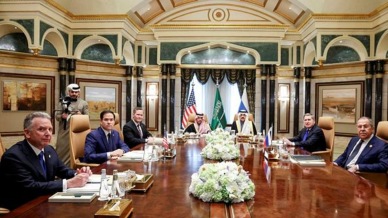
In a significant diplomatic shift, top US and Russian officials met in Riyadh on Tuesday to discuss avenues for ending the nearly three-year-long war in Ukraine and mending fractured diplomatic relations. The meeting, described as the most extensive US-Russia engagement since Moscow’s 2022 invasion, signals an unexpected turn in US foreign policy under President Donald Trump, drawing attention to the exclusion of Ukraine from the talks and potential consequences for the broader transatlantic alliance.
The discussions, which lasted over four hours, were attended by US Secretary of State Marco Rubio and Russian Foreign Minister Sergey Lavrov, alongside senior diplomats from both nations. Their meeting reflected a departure from the previous US administration’s hardline approach toward Russia, aiming to restore relations and facilitate peace negotiations over the Ukraine conflict.

Trump’s comments spark controversy
While the Riyadh talks focused on diplomatic and economic cooperation, President Trump stirred controversy by suggesting that Ukraine was to blame for allowing the war to start. Speaking from his Florida residence, Trump criticized Kyiv’s leadership for failing to prevent the conflict, which has claimed tens of thousands of lives since Russia’s invasion in February 2022.
“You’ve been there for three years. You should have ended it three years ago,” Trump said, adding that Ukraine should have made concessions to Russia to avoid the war. His remarks echoed sentiments expressed during his campaign, prioritizing improving relations with Russia over traditional US support for Ukraine.
Trump’s comments have been met with outrage in Kyiv, where Ukrainian President Volodymyr Zelenskyy postponed a planned visit to Saudi Arabia in protest. European allies, too, have voiced concerns over the US’s perceived shift in priorities, fearing that their interests in the conflict may be sidelined in favour of a Moscow-Washington détente.
Diplomatic fallout and tensions with allies
Ukraine’s exclusion from the talks has raised alarms not only in Kyiv but also in Europe, where concerns have grown that the US and Russia could proceed with peace talks that marginalize key stakeholders in the conflict. European Union leaders, alongside NATO members, convened an emergency meeting on Monday to discuss the implications of the Riyadh talks.
“We seek a strong and lasting peace in Ukraine,” French President Emmanuel Macron said after speaking with Trump and Zelenskyy by phone. Macron emphasized the importance of “credible security guarantees” for Ukraine, urging that any diplomatic process must involve both Kyiv and European allies.
The absence of Ukrainian officials from the discussions marked a sharp contrast to previous US policy under former President Joe Biden, who had made it clear that any negotiations regarding Ukraine’s future would involve Ukraine itself. The US State Department, however, stressed that Tuesday’s meeting was a preliminary step and that future discussions would include Kyiv and European partners.
“No one is being sidelined here,” Rubio assured reporters after the talks, emphasizing that Ukraine’s involvement would be essential in any long-term resolution of the conflict.
Three key diplomatic goals
Despite the absence of Ukraine, the US-Russia talks in Riyadh yielded agreements on three main points: restoring embassy staffing levels, supporting Ukraine peace talks, and exploring opportunities for deeper economic cooperation between Washington and Moscow.
Both countries have suffered significant diplomatic setbacks in recent years, with embassy staffing levels at historic lows following a series of tit-for-tat diplomatic expulsions. The US and Russia agreed to fast-track the reappointment of ambassadors and other senior diplomats, marking the first major step toward improving their strained relations.
The second area of agreement involves forming a high-level working group to support peace negotiations for Ukraine. While the details of these negotiations remain vague, Lavrov acknowledged that the US was “starting to better understand our position” on Ukraine, indicating that Moscow expects the US to be more flexible on issues such as territorial control and security guarantees.
Finally, both sides expressed interest in reviving economic cooperation, including the possibility of joint energy ventures. Kirill Dmitriev, head of Russia’s sovereign wealth fund, noted that energy partnerships, particularly in the Arctic, could provide a way forward for improving bilateral ties.
Saudi Arabia’s role
The Riyadh talks also underscored Saudi Arabia’s emerging role as a key diplomatic player on the world stage. The kingdom’s de facto leader, Crown Prince Mohammed bin Salman, has positioned himself as a mediator in the Ukraine conflict, hosting negotiations and facilitating prisoner exchanges between Russia and Ukraine.
The Saudi-hosted meeting drew international attention to the kingdom’s efforts to reshape its image after years of diplomatic isolation following the 2018 murder of Washington Post journalist Jamal Khashoggi. The crown prince, eager to present Saudi Arabia as a neutral player, has maintained close ties with both the US and Russia throughout the war.
However, Zelenskyy’s decision to postpone his visit to Saudi Arabia after learning of the Riyadh talks reflected Ukraine’s discontent with its exclusion from the proceedings. Ukrainian officials have made it clear that any peace talks must involve Kyiv directly, casting doubt on the legitimacy of negotiations conducted without their participation.
Implications for US Policy
The outcome of the Riyadh talks could have far-reaching implications for US foreign policy, particularly regarding its relations with Europe and NATO. Trump’s overtures toward Russia and his willingness to criticize Ukraine have drawn comparisons to his earlier efforts to improve ties with Moscow, which were often met with scepticism from US allies.
During the Biden administration, the US had maintained a firm stance on isolating Russia and defending Ukraine’s territorial integrity, working closely with European allies to impose sanctions on Moscow. Trump’s pivot toward diplomacy with Russia, however, marks a significant departure from this approach, raising concerns that the US could withdraw some of its support for Ukraine.
The question of sanctions remains a contentious issue, with Rubio indicating that any lifting of sanctions would depend on the progress of peace negotiations. “There has to be concessions from all sides,” Rubio said, adding that the US is not yet at the point of discussing specific concessions, including the potential removal of Lavrov from its sanctions list.
Challenges ahead
Despite the diplomatic progress in Riyadh, significant challenges remain in reaching a comprehensive peace agreement. The war in Ukraine shows no signs of abating, with Russian forces continuing to launch drone strikes across the country, targeting civilian infrastructure and military positions.
Lavrov reiterated Russia’s longstanding demand that any peace deal must exclude NATO involvement in Ukraine, emphasizing that Russian security concerns over Ukraine’s aspirations to join the Western military alliance remain a major sticking point.
Moreover, with Ukraine and key European allies still absent from the negotiating table, the prospects for a lasting peace remain uncertain. As the US and Russia prepare for further talks, the question of how to bring all parties — including Ukraine — into the fold will be crucial for the success of any diplomatic initiative.
While Tuesday’s talks marked a significant step toward ending the war, the path forward is fraught with complexities. Both Washington and Moscow must now navigate a delicate diplomatic balancing act, ensuring that their efforts to rebuild relations do not come at the expense of Ukraine or the broader transatlantic alliance.
(With inputs from Agencies)


Stay updated with the latest - Click here to follow us on Instagram


