


Stay updated with the latest - Click here to follow us on Instagram
© The Indian Express Pvt Ltd
Tags:


Despite severe flooding last year that left the housing belt near the Kaushalya dam cut off from the mainland for four months, demand for property in this area remains high.
Residents had to take a lengthy detour through villages to reach the mainland, but this has not deterred buyers.

Major developers are promoting “pristine living” and an “elite club crafted by untouched nature,” attracting buyers willing to pay crores for
houses and flats.
This rapidly developing area in the “foothills of the Shivaliks,” adjacent to the Panchkula-Kalka highway, has become highly sought after by elites, including retired defense personnel, judges, doctors, and advocates.
However, residents who have lived here for some time have a different story to tell.

Lt General KJ Singh (retd), who resides in the DLF Valley Panchkula near the Kaushalya dam, summed up the residents’ situation with this poem:
“Rehta Kaushaya- Ghaggar paar… Pehle Builder ne liya pocket maar… Phir, Sarkaar ne diya nakkar. Sehta baadh, gandagi ki maar. Chahe Tadi-paar, lekin himmat mat haar…”

Speaking to The Indian Express, Lt Gen Singh emphasized the need for the government to implement stringent measures in the trans-Ghaggar belt.
“First off, I would say that it is typically not part of Panchkula; it is part of the Kalka Municipal Corporation, which neither provides proper civic facilities nor intervenes to ensure basic necessities. With ongoing development altering the geography, the government should ensure at least river protection works and manage the river’s flow. That’s the least they can do for the residents,” he said.
Singh highlighted that during the last floods, the entire area was cut off for four months, some houses at the periphery developed cracks, and there were “mudslides in the EWS units too.”
“We suggest the government look at the ecological aspects and at least implement risk mitigation measures if development cannot be stopped. Some peripheral areas experienced water runoffs last year,” he added, stressing that the government should not abandon this trans-Ghaggar belt.
Col BS Rangi, President of Democrats Welfare Association of the Amravati Enclave Residents’ Welfare Association (DWAAR), explained how the thought of the monsoon scares residents, making them feel disconnected from Panchkula.
“Connectivity is a major issue for all residents here. The narrow bridge that Amravati constructed to connect to the main highway is not fit for
heavy traffic. When we were cut off for four months and had to take the Pinjore route, we realized the government had abandoned us,” Col Rangi said.
He added, “We are in an earthquake-prone area, and too many stilt-plus-floor structures have come up. We are building more houses without considering residents’ safety.”
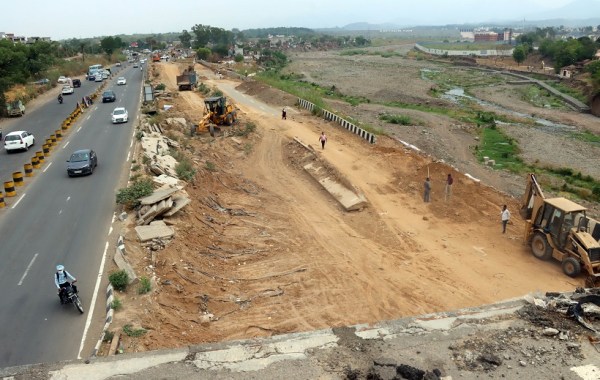
PEC Director Professor Baldev Setia stated that “any construction obstructing the river’s right of way should be avoided.”
“About ten years ago, I had seen this area around the Kaushalya dam. With so much activity in and around the area, it is likely to change soil and slope characteristics. When floods occur, releasing water from upstream can cause erosion. Such activity should be avoided,” he said.
A retired chief engineer with the Irrigation Department told The Indian Express that “the housing near the banks of the river needs a relook.”
“There is something called the hitting zone of the stream. When you release water from the dam, it gushes through the hitting range. Carrying out activities in and near the hitting zone is very tricky because that kind of strata has sand and gravel,” the former engineer from the Irrigation Department said, requesting anonymity.
He explained, “For example, there is a difference when you construct a house on rock and when you construct a house on sand and gravel. Excess rain can make the latter unstable. These are earthen hills, not rocks.”

The retired engineer also noted that the damage from the last floods should have been exemplary enough.
“What happened during the last flooding is evident enough when the water took away a significant chunk of the main highway. By constructing, you are narrowing down the water’s right of way. I would say that the housing near the banks requires a complete relook,” he added.
The engineer emphasized that “the floodplain of a river basically serves as a cushion to mitigate the impact of the river’s velocity. When you carry out construction activity in this floodplain, you narrow the area where water has to gush through, restricting the flow.”
A visit to the area showed several stilt plus floor houses rapidly coming up, with boards advertising individual floors for sale.
“Even houses as small as 2 marlas are being reconstructed with four floors. When damage is occurring in houses on the plain land of proper Panchkula, you can imagine the plight here. High-rise buildings should be avoided in seismic zone 4,” Ram Kumar Shokeen, a retired senior bank manager residing at Amravati, said.
Despite environmental concerns and residents’ issues, this area has become the “pricey outskirts” of the region, attracting major real estate developers. Previously, DLF developed housing over 200 acres here. Now, another major developer, Trident, has entered the market with a project also spread over 200 acres. Rapid construction of internal roads connecting the private developers’ housing is ongoing as buyers rush to purchase plots and flats. Amravati Enclave already occupies 118 acres.
A 3 BHK basic flat in a private township, which cost around Rs 40 lakh a few years ago, is now selling for Rs 1.75 crore to Rs 3.35 crore. A plot up to 200 square yards costs over Rs 2.25 crore. Independent floors in the stilt plus floor buildings are also on sale, with one 4 BHK floor available
for Rs 3.5 crore. Trident’s new entrant project has prices going up to Rs 5.85 crore.
Villagers of Islamagar Majri recently protested against the construction of a wall by a private developer that virtually locked them in. The villagers
stated that “to hide them, the wall was being constructed, obstructing their connectivity.”
“They have constructed a wall around us. After the villagers protested, the developer agreed to give a 12-foot way for connectivity. We have lost our original open space,” said Gurcharan Ambka, a zila parishad member.
Gurcharan added that natural water spaces have also been taken over. “Barsaati paani bhi nahi guzar sakta ab… apne hisab se private developers
yahan hamare raaste bhi le rahe hain,” Gurcharan added.
There are about 40 villages in this belt.


Stay updated with the latest - Click here to follow us on Instagram


