


Stay updated with the latest - Click here to follow us on Instagram
© The Indian Express Pvt Ltd
Tags:


Heavy rainfall lashed Gujarat in 24 hours until Sunday morning inundating low-lying areas, disrupting normal life and traffic movement. The India Meteorological Department (IMD) issued a heavy rainfall warning for the state till September 1.
Five talukas — Vapi, Kaprada, Pardi, Umarpada and Khergam — in the southern districts of Valsad, Surat and Navsari recorded the highest rainfall between 250-330 mm.

A few places such as Vadodara, Surat, Bharuch, Navsari, Valsad, Amreli and Bhavnagar, and Anand, Rajkot, Jamnagar, Porbandar, Morbi, Dwarka and Kutch are expected to see isolated extremely heavy downpour on Monday and Tuesday respectively. IMD has issued a red alert for heavy to very heavy rain for such places.
The currently active monsoon over Gujarat has been attributed to a “depression over northwest Madhya Pradesh” that is “likely to move nearly west-southwestwards”. It will “intensify further into a deep depression over south Rajasthan and adjoining north Gujarat by August 27. Thereafter, it will continue to move nearly west-southwestwards and emerge into northeast Arabian Sea off Saurashtra and Kutch, and adjoining south Pakistan coasts around August 29,” IMD stated.
On Sunday, heavy downpour continued in Navsari’s Khergam as it recorded the highest rainfall — 262 mm from 6 am to 6 pm — in the state.
Other parts — central, Saurashtra and southern districts of Narmada, Valsad, Rajkot, Dang, Surendranagar, Chhota Udepur, Tapi, Morbi and Vadodara — also witnessed heavy rainfall.
Chief Minister Bhupendra Patel chaired a review meeting with collectors of the rain-affected districts of Valsad, Tapi, Navsari, Surat, Narmada and Panchmahal, and directed to ensure relocation of people to safer places.
The CM said the State and National Disaster Response Forces (SDRF and NDRF) teams were deployed and available for required assistance.
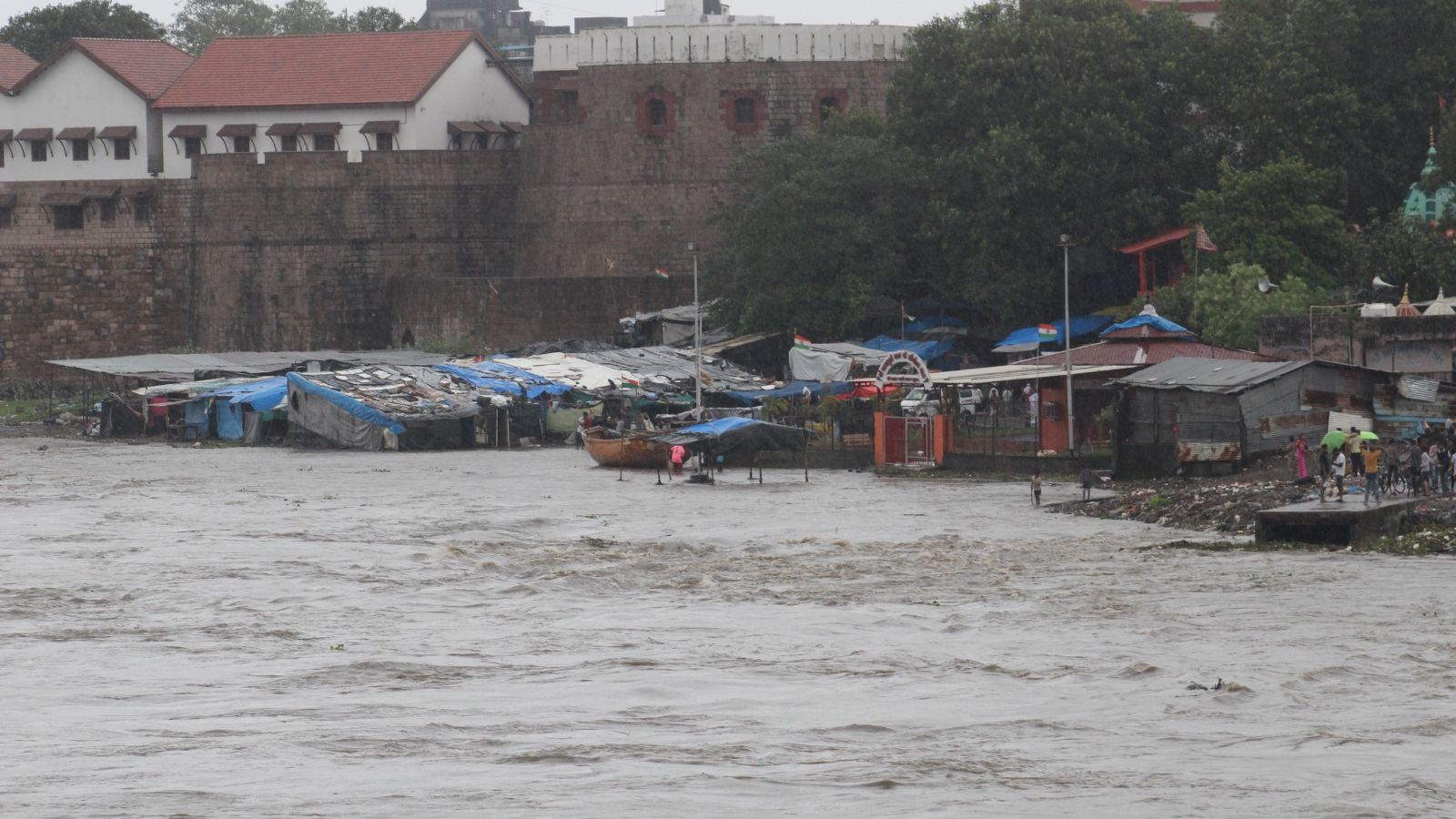
On Saturday, 300 people were relocated from the low-lying areas of Valsad taluka, the state government informed.
“A total of 17 persons were shifted in Bilimora city after flooding in low-lying areas. The administration is also keeping a close watch on rising water levels of Purna and Kaveri rivers,” said AM Gamit, Executive Magistrate (Disaster), Navsari.
On Sunday, according to the State Emergency Operation Centre (SEOC) data, 193 talukas received rainfall. Other than Khergam, other talukas that received heavy rainfall of above 100 mm include Dediapada (199 mm) in Narmada, Kaprada (178 mm) in Valsad, Sagbara (175 mm) in Narmada, Valsad (167 mm) and Dharampur (160 mm) in Valsad, Rajkot (153 mm), Nandod (152 mm) in Narmada, Dang (143 mm), Vansda (137 mm) in Navsari, Vaghai (135 mm) in Dang, Chotila (132 mm) in Surandranagar, Vapi (132 mm) in Valsad, Kavant (132 mm) in Chhota Udepur, Paddhari (125 mm) in Rajkot, Kukarmunda (124 mm) in Tapi, Pardi (122 mm) in Valsad, Wankaner (120 mm) in Morbi, Karjan (114 mm ) and Sinor (104 mm) in Vadodara, Umarpada (103 mm) in Surat, and Subir (102 mm) in Dang.
According to SEOC data, Gujarat has received 722 mm, or 81.81 per cent of the average monsoon rainfall, this season. Of the total 251 talukas, 47 received more than 1,000 mm rainfall, 102 talukas between 501-1,000 mm, 85 talukas between 251-500 mm, and 17 between 126-250 mm.
Among regions, South Gujarat received the highest of 97.52 per cent rainfall. This was followed by the Kutch region at 90 per cent, Saurashtra recorded 85 per cent, and East Central 69 per cent. North Gujarat received the least at 65 per cent.
As on Sunday, of the total 206 dams, 72 are on high alert, while 15 are on alert and 10 under warning, the government stated. Of these, 58 are 100 per cent full, while 39 are 70-100 per cent full.
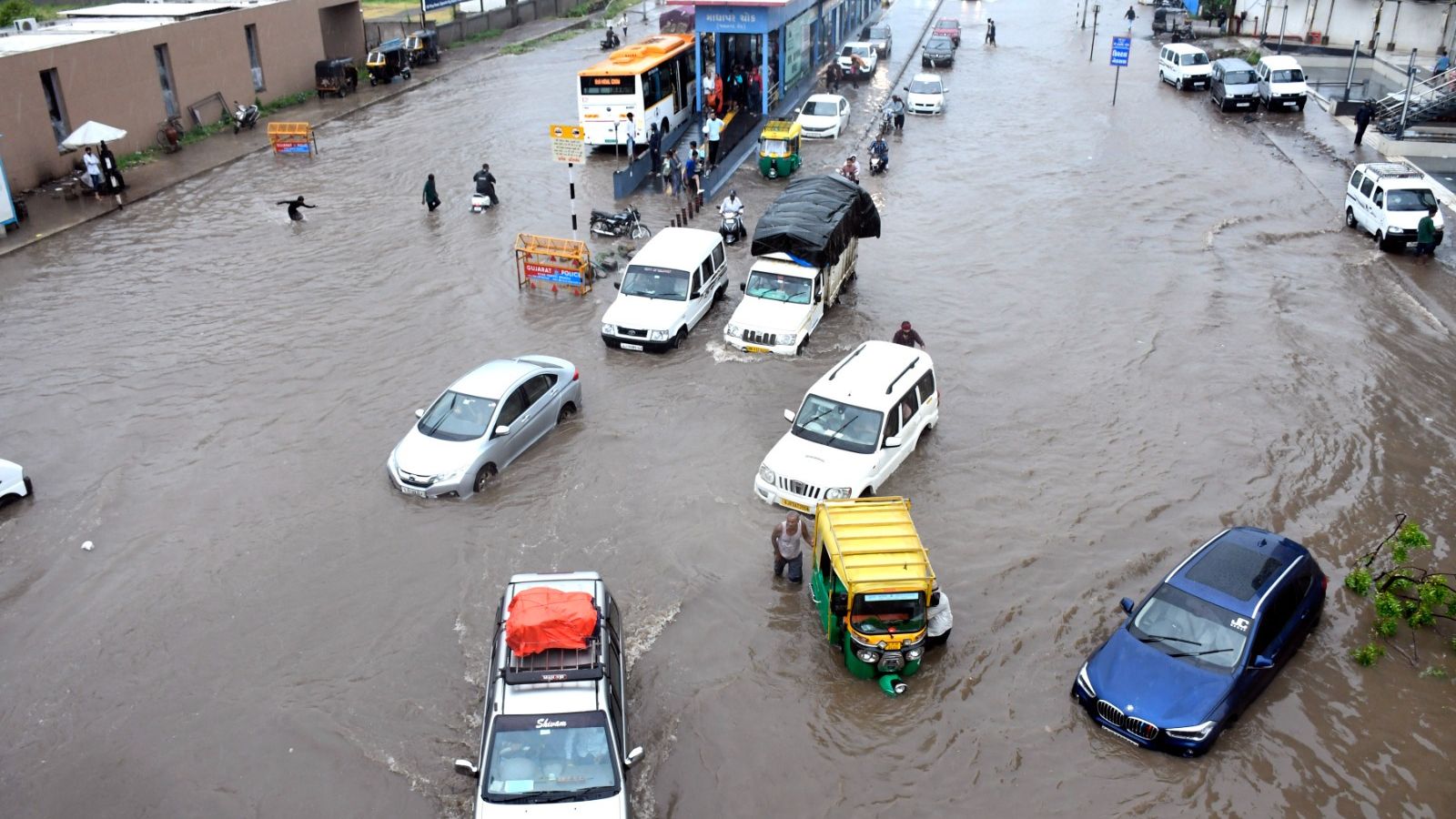
Following heavy rainfall and increased inflow of water at 4,80,233 cusecs, 15 radial gates of the Sardar Sarovar Dam in Narmada were opened Sunday to a height of 1,95 metres to discharge 2 lakh cusecs of water downstream. The decision was taken by officials of Sardar Sarovar Narmada Nigam Limited (SSNNL) after the rise in inflow from Indirasagar and Omkareshwar Dams in Madhya Pradesh. The Sardar Sarovar, which has a Full Reservoir Level of 138.68 metres is, currently at 135.40 metres.
In addition to the release from the gates, the Riverbed Powerhouse is also discharging about 44,000 cusecs of water downstream after a complete cycle of the six turbines to generate hydropower.
Nine gates of the Narmada dam had already been opened earlier in August.
In addition to the Narmada Dam, the Karjan Dam is also releasing 70,000 cusecs of water downstream Narmada through the five open gates leading to a flood-like situation in the areas around Narmada river. A total of 42 villages in the districts of Narmada, Vadodara and Bharuch have been put on alert.
This monsoon, 17,752 people have been relocated to safer places. The highest number of people have been relocated in Navsari (5,340), Surat (3,707) and Vadodara (2,241) districts.
Further, 1,653 people were rescued of which 540 were in Anand district and 353 in Surat.
According to the road and buildings department, 288 roads, including 268 panchayat roads, seven state highways and 13 other state roads, were closed. Heavy rainfall affected electricity in 25 villages this season.
Stay updated with the latest - Click here to follow us on Instagram


