


Stay updated with the latest - Click here to follow us on Instagram
© The Indian Express Pvt Ltd
Tags:


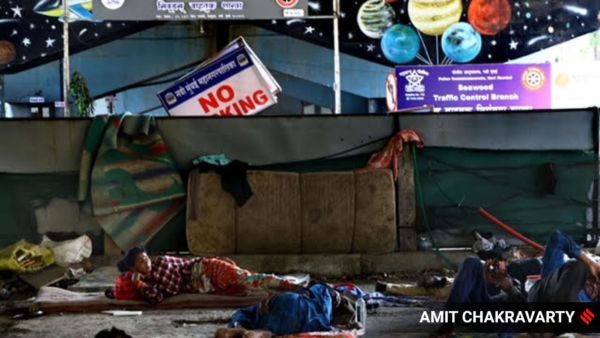
For the past two weeks, Tina Bhosale, 37, has been living in the open beneath the sprawling overhang of a massive flyover in Seawoods, just steps away from one of Navi Mumbai’s most upscale malls. She has been searching for work to support her two children back home in Wardha district’s Sarwadi village. Forced to leave the village after her husband took his life in 2022 due to farm distress, Tina moved to Mumbai in search of a better future. She is one of the thousands of migrants who come to the city daily, hoping to escape hardship and build a brighter life.
For many residents of the Mumbai Metropolitan Region, Tina’s presence — a stark reminder of poverty — sparks frustration and reinforces stereotypes that associate those living on the streets with crime, solidifying the belief that homelessness is a result of personal failure. However, urban homeless like Tina are often victims of systemic issues such as poverty, lack of affordable housing, and mental health challenges, with single women like her being particularly vulnerable.

As the world celebrates International Women’s Day on March 8, acknowledging the progress made in women’s rights and gender equality, countless homeless women like her continue to face challenges every day. Among the most vulnerable, their hardships are compounded by their gender. From lack of safety and basic sanitation to being vulnerable to violence and exploitation, these women face systemic barriers that make their survival a daily battle.
“Living as a homeless person is a deeply humiliating experience. It strips away my dignity every single day. I have no other choice. All I can do is hope that I find a job soon, preferably as a housekeeper, so I can secure a better future for my two children back home,” she says.
Who are the homeless?
Globally, an estimated 1 billion people are homeless. The United Nations defines homelessness not only as living on the streets or in shelters, but also as lacking adequate housing that meets basic health and social development standards.
In India, the Census defines homeless households as those that do not reside in buildings or Census-designated houses, but instead live in the open, on roadsides, pavements, under flyovers, in hume-pipes, staircases, or public spaces like places of worship, mandaps, and railway platforms.
There is a common misconception that everyone living on the streets is destitute. However, this is far from the reality. While some may resort to begging to survive, most homeless individuals are there due to a range of socio-economic factors, including lack of affordable housing, unemployment, poverty, family breakdown, and migration from rural areas in search of better opportunities.
Many, including women, children, and the elderly, work in informal sectors like street vending, daily-wage labour, or as domestic workers. Studies, however, show that unlike popular perception there is considerable contribution of the homeless population in economic activities. Government data shows that the work participation rate among the homeless population is about 52 per cent which is higher than the national average.
The 2011 Census of India recorded 57,416 individuals as homeless in Mumbai, with just 2,275 identified as beggars, constituting less than 4 per cent of the total homeless population. However, activists argue that these figures are significantly underreported, and the true number of homeless individuals on the streets is far higher than the statistics suggest.
These figures, however, do not capture the full extent of women living on the streets. While the number of women is substantially lower than men, many women end up on the streets for a variety of reasons. Some are part of families who migrate to Mumbai from rural Maharashtra and beyond in search of better job prospects, only to be forced into homelessness.
The men in these families often work as casual labourers or trench diggers, leaving the women to fend for themselves. A significant proportion of these women belong to marginalised communities, including Scheduled Tribes, such as the Phase Pardhi tribe. In these communities, while men may go out to work, many women have no cultural restrictions and may resort to begging as a means of survival.
Another large group of women living on the streets is those suffering from mental health issues or substance abuse, which further marginalise them. These conditions make it even more difficult for them to find stable work or housing.
Sasarkala Kale’s situation is one such example. Driven by poverty and economic hardship, she resorts to begging on the streets of Mumbai. Sasarkala, in her 50s, travels to Mumbai regularly to earn money to care for her son, who suffers from a serious stomach ailment, back home in Akola. The lack of social stigma associated with begging within her community makes it easier for women like her to beg without hesitation.
“I have no one left other than my son, who suffers from a stomach ailment. I frequently come to Mumbai and beg to make some money,” she says.
Problems faced by homeless women
Urban homeless individuals, in general, face a range of multifaceted challenges that are often compounded by their gender. The most pressing concern is the lack of safe spaces and vulnerability to violence. Homeless women in Mumbai are at a higher risk of gender-based violence, including sexual harassment, assault, and exploitation. The absence of secure shelters or safe spaces for women increases their vulnerability, especially at night or in secluded areas.
Another major concern is the lack of privacy and the constant fear of being assaulted, particularly in public spaces like railway stations or parks. Access to clean, safe bathrooms is a significant issue for homeless women. Public toilets remain unsafe, especially at night, and many women avoid using them due to the fear of harassment or assault.
“There is no access to toilets or bathrooms. Most of the women relieve themselves on the railway tracks. It is very humiliating to do this, including bathing in the open, knowing that eyes are gazing at you,” says Seema Pawar, a 23-year-old from Wardha. She stays on the streets with her husband who works in a catering firm in Mumbai.
Another major problem is the challenge of women struggling to care for their children while managing their own survival needs. The threat of child trafficking, abuse, and neglect is higher in homeless situations, as children are more vulnerable to exploitation and violence in urban spaces.
“Over the past month, we witnessed two incidents in which children disappeared. In one case, a child went missing from the place where we stay. She was gone for two days after being taken by an unknown woman. Luckily, she managed to find her way back, but there have been instances of children and even grown women disappearing without ever returning,” Seema says.
The biggest fear, however, is sexual exploitation. Homeless women, especially young women, are at heightened risk of sexual exploitation, trafficking, and forced prostitution due to their lack of protection and resources. The fact that they stay on the streets makes them vulnerable to sexual violence.
This problem is further compounded by the stigma many women face for living on the streets, which makes them seem responsible for their own victimisation. As a result, police often do not take cases of sexual violence seriously and sometimes even actively discourage victims from pursuing legal action.
“The assumption that homeless individuals may ‘invite’ violence due to their living conditions often leads to a lack of empathy or support from law enforcement,” says Nitin Pawar, a member of the Pardhi community who stays on the streets with his family.
How does the state address the issue of urban homelessness?
Addressing urban homelessness in Mumbai requires a multifaceted approach, given the city’s size, complexity, and the diverse needs of homeless individuals.
As per a Supreme Court directive, the Indian state is responsible for providing shelter equipped with essential services to the urban homeless. In the megacity with a population of over 1.25 crore, the state claims that there are only 57,416 homeless citizens in the city. The BMC, on paper, claims to fund 23 shelter homes across Mumbai, which can accommodate no more than 740 people.
In 2012, the Supreme Court passed an order calling for the establishment of one shelter home each, with a capacity of 100, for every 100,000 city residents. The Central Government subsequently introduced the Shelters for Urban Homeless (SUH) scheme in 2013 which aimed to ensure availability and access to permanent shelters for the urban homeless population, including essential infrastructure facilities like water supply, sanitation, safety, and security.
According to the scheme, the Government of India would fund 75 per cent of the construction costs, while the states/Union territories would contribute the remaining 25 per cent. Urban local bodies were assigned the responsibility of monitoring and evaluating the scheme.
As per the norms laid down by the Supreme Court, Mumbai should have had 125 shelter homes but it currently has only 23 functional ones. The rules state that the shelters should be permanent, operate throughout the year, and be open 24×7. They should also provide a minimum of 50 square feet per inhabitant. However, in reality, most shelter homes do not adhere to these norms and remain inaccessible to the destitute and the most vulnerable.
Interestingly, even though a large number of the homeless are families, there are no shelter options for entire families. Families who wish to live in shelters must separate, with men and women staying at different centres. This separation leads many to opt not to use the limited shelter homes. Moreover, homeless individuals who opt for these shelters need to first produce a No-Objection Certificate (NOC) from the local police before being allowed to access these centres.
Need for policy change: activists’ demands
While building shelter homes and creating affordable housing networks are seen as ways to address the issue of homelessness, activists claim that the structural causes of homelessness need to be addressed first. Additionally, programmes offering training and skill development to homeless individuals are needed to enable them to access stable employment.
“The first step is the need to decriminalise homelessness. Our existing laws and policies should not penalise homeless people for their status, over which they have no control. Beggary laws in India treat beggars as criminals, subjecting them to arrest and detention for merely being homeless or destitute,” says Mohammed Tarique, director of Koshish, an organisation that advocates for the repeal of laws that criminalise begging.
“This approach criminalises poverty rather than addressing the root causes, such as lack of social welfare, unemployment, or systemic inequality. These laws need to be scrapped, and instead, we need support initiatives that create livelihood opportunities for homeless people,” he adds.
Maharashtra, as of now, does not have government-run support initiatives for the destitute. However, states like Bihar have successfully managed to run social welfare schemes like the Mukhya Mantri Bhikshavriti Nivaran Yojna (MBNY), with the primary aim of rehabilitating destitutes and providing them with alternative livelihoods.
The scheme provides financial assistance of Rs 10,000 to individuals to help them start their own businesses. Unlike other states, Bihar also runs a Kitchen Basera initiative, where destitute families are offered shelter for a limited time.
The absence of such social welfare schemes in Maharashtra means that the plight of the homeless continues in the state. While government schemes designed to address the needs of destitutes are underfunded, inadequately implemented, and do not properly address the root causes of homelessness. The problem is further compounded for homeless women, who face unique barriers to accessing government schemes that primarily focus on general homelessness without considering gender-specific needs. Activists and advocates argue for a gender-sensitive approach to addressing homelessness, with policies and services designed to meet the specific challenges faced by homeless women.
The fact that they do not constitute an influential lobby group means that women like Tina Pawar find themselves left out of the government support network that is intended to aid the homeless population.


Stay updated with the latest - Click here to follow us on Instagram


