


© The Indian Express Pvt Ltd
Tags:


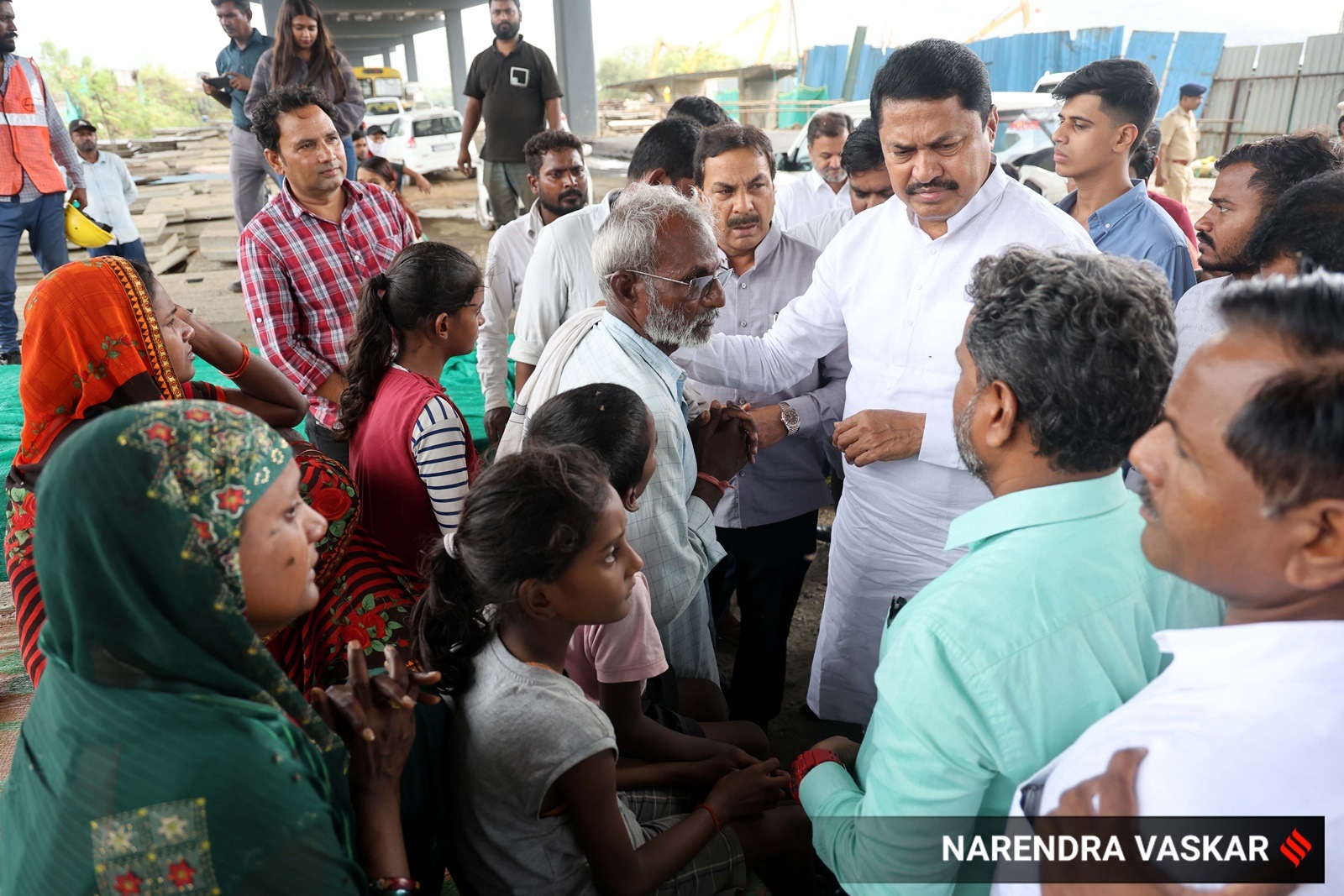
For the last 19 days, Balchandra Yadav, 62, and his family of nine have been camping under a bridge in Maharashtra’s Palghar, hoping to see his son Rakesh Yadav – even if for the last time. Metres away, Rakesh, 35, and his excavator lie buried under 60 feet of mud and rubble.
On May 29, Rakesh was working in a trench, excavating a tunnel shaft for a water supply project, when one of the four concrete walls supporting the trench collapsed, burying him and his eight-tonne excavator.

Since then, a team of the National Disaster Relief Force, firemen from the Vasai Virar Municipal Corporation and personnel of the Indian Army’s Pune-based 269 Engineer Regiment have been working to locate Rakesh.
“As soon as we were informed about the accident, we packed everything and left our home in Azamgarh (Uttar Pradesh),” says Balchandra, sitting on piles of concrete slabs near the accident spot with his wife, daughter-in-law Sushila and her three children, besides other family members. Behind them stands an excavator, much like the one Rakesh operated for the last 15 years.
Assuming it would be a short trip, the family packed a few pairs of clothes each before boarding a train from Azamgarh station on May 30.
“For the first eight days, we stayed under the bridge, after which we were provided three rooms in a nearby hotel,” says Rakesh’s brother-in-law Santosh.
Sushila says, “Every morning, we wake up and come here in the hope of seeing him. But at night, we return, hoping we will find him tomorrow.”

Balchandra says Rakesh, who studied up to Class 12, couldn’t find a job in Azamgarh, so 15 years ago, he landed in Mumbai, where he learned to operate a JCB excavator.

The accident on May 29
Rakesh had been working at the site on the Mumbai-Ahmedabad highway, in Palghar’s Navghar area, where a tunnel water pipeline was being laid under the Mumbai Metropolitan Region Development Authority’s (MMRDA) Surya Regional Water Supply Scheme. The project, subcontracted to Larsen & Toubro, is aimed at supplying water to approximately 16 lakh residents of the Mira-Bhayander municipal corporation and 27 other nearby villages.
On May 29, Rakesh and his excavator were lowered into a 60-foot-deep shaft near the Vasai creek when one of the walls around him caved in.
An official who is part of the rescue operation said, “Four walls had been built around the trench where the workers were excavating. Rakesh had already dug up to 60 feet and he had about 10 more feet to excavate. The accident happened around 9.30 pm on May 29.”

Rakesh’s father Balchandra alleges that a week before the accident, his son had complained to his seniors about the “loose soil” at the work site.
When asked about the specifics of the cave-in, Abhay Bambole, Professor, Structural Engineering Department of Veermata Jijabai Technological Institute, Mumbai, said, “A committee has been appointed to inquire into the incident and I am one of the members. We will be looking at the technical aspects to see if there was any negligence that led to the incident. We will soon submit a report to the MMRDA.”
On Friday, Maharashtra Chief Minister Eknath Shinde visited the spot and announced a compensation of Rs 50 lakh to Rakesh’s family and assured a job to one of the family members.
The challenges: Loose soil, heavy rains
Those who are part of the rescue operation said loose soil at the spot and the heavy rainfall over the last few days had made it difficult for them to clear the debris.
“Initially we tried to use sniffer dogs to locate Rakesh, but he was trapped under a thick layer of mud. We then started removing the debris but after clearing a few metres, the three other walls around the trench started vibrating,” said an NDRF personnel at the rescue site.
The officials claim that they are currently focusing on stabilising the structure by bracing the three walls.
“About eight steel braces have been installed horizontally and six others have been fixed diagonally. We will be installing a couple of more braces, after which we will use a remote-controlled excavator and a crane to remove the debris,” said an official adding, “We believe that we will have to dig approximately five more metres to locate Rakesh and the excavator.”
Speaking to The Indian Express, Palghar collector Govind Bodke said, “We are taking utmost precaution in the rescue operation because there is fear that the soil may cave in further. So we are working on stabilising the structure.”
The NDRF officials added that robotic breakers were used to break the concrete wall that caved in, after which the rescue teams excavated holes in the underground shaft and used cameras to locate the bodies.
Back on the concrete slabs, the family awaits closure. “We want to go back home… the children have to go to school from tomorrow… but how can we leave Rakesh behind?” says his brother-in-law Santosh.
Rakesh’s wife Sushila says she has reconciled to not seeing her husband alive, but won’t go back home without “getting at least a bone”.
“I don’t know if I was a good wife but I want to conduct his last rites so he can at least rest in peace,” she said.


