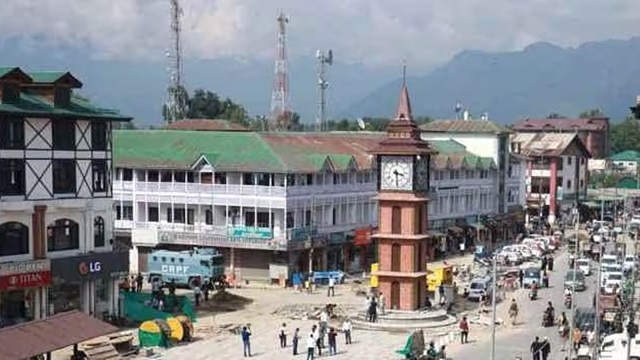
Being a product of post-Independence India, my observations of “Badalta Kashmir” start after the exit of the Dogra Raj in October 1947. Everybody in the Valley had a house to live in, adequate clothes to wear and enough food to eat. The people of Jammu and Kashmir were so content with the leadership of Sheikh Mohammad Abdullah and Jawaharlal Nehru that despite being a Muslim-majority state, they were happy to not join Pakistan. Their relationship with their identity felt intact because of the special status J&K enjoyed under Article 370 of the Constitution.
The first major setback was in August 1953 when Sheikh Abdullah was dismissed in a move to get more control of the state by the Union of India. Bakshi Ghulam Mohammad replaced him as the Prime Minister of Jammu and Kashmir. The designation of “prime minister” was changed to “chief minister”; and “Sadr-e-Riyasat” was changed to “governor” in 1965. 1987 was a turning point in Kashmiri politics when separatist leaders under the banner of the Muslim United Front (MUF) decided to take part in the assembly polls. The elections were widely speculated to have been rigged to give the National Conference and Indian National Congress an electoral victory.

This was the beginning of the violent period in the Valley with the killings of Kashmiri Pandits and Muslims who owed allegiance to India. Kashmiri Pandits migrated in masses — some 1,00,000 people left in 1990. A minority in the region, with a population of around 1,20,000 people, they were living in harmony with the Muslims until the exodus.
Being a Pandit, I could not go back to the Valley till 1997 when things started improving under Governor K V Krishna Rao. The Valley continued to have protests, stone pelting, frequent hartals and separatist leaders came together under the banner of All Parties Hurriyat Conference spearheaded by Syed Ali Shah Geelani. The group included the Jammu Kashmir Liberation Front (JKLF) led by Yasin Malik.
A series of governors were appointed because the President’s Rule could not be applied owing to Article 370. During this time, the government at the Centre changed to that run by the Bharatiya Janata Party (BJP). Under Atal Bihari Vajpayee, the BJP had a one-month stint in 1996 and a full five-year tenure from 1998 to 2004. Vajpayee wanted to solve the Kashmir problem on the principle of “Insaniyat, Jamhooriyat and Kashmiriyat,” but he was not successful.
Narendra Modi became the prime minister in 2014 and was re-elected in 2019 with an overwhelming majority. On August 5, 2019, his government fulfilled the long-awaited agenda of the RSS of revoking J&K’s special status. The abrogation of Article 370 was implemented with a high hand. All means of communication were severed in the Valley. Under the Governor’s rule, the government has tried to realise Modi’s promise of implementing the development agenda in J&K through several packages, many through the National Skill Development Corporation (NSDC). It has aimed to integrate Gujjars and Bakarwals into the mainstream and help Kashmiri Pandits get back to the Valley with secure employment. Unfortunately, militants have continued to target the Pandits.
A process of delimitation has also been set in motion with a plan to give more seats to the Jammu area. An election. promised to the people of J&K, is awaited. The government made attempts to showcase the return of peace to European delegates and hosted part of India’s G20 meet in the Valley. These steps proved to be premature since militancy was not dead. The abrogation of Article 370 was challenged in the Supreme Court which unanimously upheld the government’s decision. The constitutional validity of it is still being debated but the verdict is unlikely to face any challenge. The local political parties, while expressing their disappointment have declared to continue their struggle and fight for the people of the state.
Politics, Constitution, and law apart, the feelings of 1.6 crore inhabitants who chose to be with India in 1947 were not considered. The media is largely silent on this. The administration was handed over to bureaucrats who had little contact with the public. Their outreach to the public, especially in villages and remote areas is limited due to linguistic and social barriers. The availability of electricity especially during winter has been grossly inadequate. The conditions of the roads and sanitation in the interior of the old city remain poor. Freedom House, an international organisation that tracks democracy and freedom around the world, rated Jammu and Kashmir’s conditions at 27 out of 100 in 2023 (Not Free). Political rights scored a seven out of 40 and civil liberties stood at a 20 out of 60.
These measures had a positive impact too. There has been no stone pelting, no hartals, and school and college examinations are being held on time with improvement in staff attendance in government offices. Under the Smart City scheme, the tiles of some posh markets have been changed, and major roads like the airport road are lit up with tri-colour lights around the clock. But the houses and colonies on the side of these roads are starving for power. There has been a post-Covid boom in tourism, with at least two crore people (including 15,000 foreign citizens) visiting the Valley in 2023.
The abrogation and everything since are half-hearted measures. The much-talked-about promise of investors and industrialists coming to the union territories with mega projects, bringing in jobs, is still just a dream. Educated youth are faced with few suitable jobs. Many parents do not want their children to leave Kashmir for fear of harm.
There is a logical question, an important one that comes up. If Kashmir has seen unprecedented development and people are immensely happy with what happened in August 2019, and after, why has Jammu and Kashmir’s statehood not been restored? Why are there no signs of an election four years later?
The writer is a cardiologist


