


© The Indian Express Pvt Ltd
Tags:


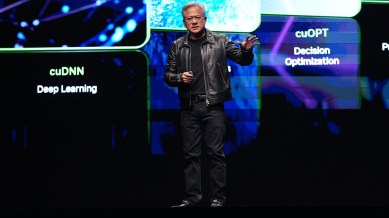
Reliance and chipmaker Nvidia have announced a joint attempt in building artificial intelligence (AI) infrastructure in India, in a big to tap into the sensational popularity of AI services and offer crucial computing power to the country’s start-ups.
The AI rush has made Nvidia unrivalled in the space because of its powerful graphics processing units (GPUs) – demand for which has skyrocketed– and has pushed once dominant companies like Intel to the fringes. Today, Nvidia is the biggest chipmaker in the world, with a market cap of over $3 trillion, second only to Apple.

During a conversation with Nvidia CEO Jensen Huang, Mukesh Ambani said that the chipmaker will partner with Reliance to set up a 1GW (gigawatt) data centre in Jamnagar, Gujarat.
Apart from the AI infrastructure that Nvidia will help Reliance build, over the coming months, businesses in India will install tens of thousands of Nvidia GPUs to build data centres for producing and supporting AI applications. These include the likes of Tata Communications, the Hiranandani Group-backed data centre provider Yotta Data Services, cloud service provider E2E Networks and original equipment manufacturer Netweb.
India’s cloud infrastructure providers and server manufacturers are ramping up accelerated data centre capacity. By year’s end, they’ll have boosted Nvidia GPU deployment in the country by nearly 10x compared to 18 months ago, the company said in a blog post.
Tata Communications is initiating a large-scale deployment of Nvidia Hopper architecture GPUs for its public cloud infrastructure. The company also plans to expand its offerings next year to include Nvidia Blackwell GPUs. Blackwell GPUs are much more powerful – they can deliver 30% more FP64 and FP32 FMA (fused multiply-add) performance than Hopper.
Its customers include Sarvam AI, which is building AI models that support Indian languages; Innoplexus, which is developing an AI-powered life sciences platform for drug discovery; and Zoho Corporation, which is creating language models for enterprise customers.
E2E Networks offers services to enterprises in India, the Middle East, the Asia-Pacific region and the United States with GPU-powered cloud servers. It offers customers access to clusters featuring Nvidia Hopper GPUs interconnected with Nvidia Quantum-2 InfiniBand networking to help meet the demand for high-compute tasks including simulations, foundation model training and real-time AI inference.
Netweb is expanding its range of Tyrone AI systems based on Nvidia MGX, a modular reference architecture to accelerate enterprise data centre workloads.
Computing power, which comes from the GPUs, is one of the most crucial elements of building and training AI systems. It is an expensive technology as of now, and Nvidia has a virtual monopoly in the GPUs that go into AI-led data centres. But with the new announcements, some of that capacity will get installed in India, which can be accessed by smaller firms in the country.
The Indian government has announced a Rs 10,370 crore AI Mission to procure computing capacity in the country, and offer it at concessional rates to start-ups and researchers. The government has also released a tender to procure the GPUs and the discussion around that is currently ongoing.
Of India’s Rs 10,370 crore plan, the implementation of computing infrastructure will be done through a public-private partnership model with 50 per cent viability gap funding. If the compute prices come down, the private entity will have to add more compute capacity within the same budgeted amount to meet increased demand. Of the total outlay, Rs 4,564 crore has been earmarked for building computing infrastructure.


