


Stay updated with the latest - Click here to follow us on Instagram
© IE Online Media Services Pvt Ltd
Tags:


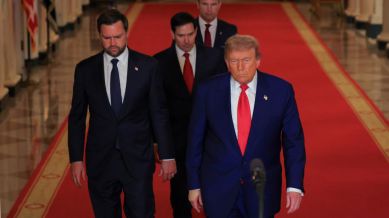
Long before his self-imposed two-week deadline, US President Donald Trump on Sunday announced that the US forces struck three Iranian nuclear sites—Fordow, Natanz, and Isfahan—in a “spectacular military success,” joining Israel in its ongoing campaign to dismantle Tehran’s nuclear program. He also warned that US will not hesitate to strike other targets in Iran if peace does not come quickly in the Middle East.
“A full payload of BOMBS was dropped on the primary site, Fordow. All planes are safely on their way home,” he wrote in a post on Truth Social. In an address after the strikes, Trump said Iran’s future held “either peace or greater tragedy,” and that there were many other targets that could be hit by the US military.

Iran’s state-run IRNA news agency confirmed the attacks on the nuclear sites. The latest strikes marking the US entry came as Israel and Iran, caught in a longstanding conflict, have been trading strikes for over a week.

Here are other key things to know as the US enters the war on its tenth day:
Trump said Iran's three principal nuclear sites were struck, namely: Natanz, Isfahan and Fordow. The US forces used B-2 bombers, a US official told news agency Reuters, speaking on condition of anonymity.
Six bunker-buster bombs were dropped on Fordow, while 30 Tomahawk missiles were fired against the other two, he was quoted as saying by Fox News. The underground uranium enrichment site in Fordow —which houses its most advanced centrifuges--is located roughly 95 km southwest of the capital, Tehran.
An Iranian official, cited by Tasnim news agency, confirmed that part of the Fordow site was attacked by "enemy airstrikes." Iran’s Qom province reported that its air defenses were activated during the attacks on the Fordow nuclear site. However, Iranian officials did not provide details on the extent of damage or casualties. An official from Iran’s state broadcasting corporation, as quoted by IRNA, stated that the nuclear sites targeted by the US do not contain any radioactive materials.
The strikes involved B-2 stealth bombers, as per Reuters. These bombers were equipped with the GBU-57 Massive Ordnance Penetrator, a 30,000-pound bunker-buster bomb designed to destroy heavily fortified underground targets. This type of bomb is unique to the US arsenal and is considered the only weapon capable of effectively targeting Iran’s most protected nuclear facilities.
The B-2’s that struck the Iranian nuclear sites flew non-stop for about 37 hours from their base in Missouri, refueling several times mid-air, a US official told The New York Times.
President Donald Trump issued a fresh warning to Tehran stating, “Iran, the bully of the Middle East, must now make peace. If they do not. Future attacks would be far greater and a lot easier." He added, “Remember, there are many targets left. Tonight was the most difficult of them all, by far, and perhaps the most lethal, but if peace does not come quickly, we will go after those other targets with precision, speed and skill."
A White House official confirmed that Trump spoke to Israeli Prime Minister Benjamin Netanyahu after the strikes, as per Reuters. After his address, Trump said he worked “as a team” with Netanyahu to strike Iran, saying the collaboration was “perhaps” like “no team has worked before.” He also noted that no military in the world except for that of the US could have pulled off the attack.
Israeli Prime Minister Benjamin Netanyahu said, "Immediately after the operation was completed, President Trump called me." He also said that that the "US attack on Iranian nuclear sites" was "in full coordination with Israel."
Iran’s top diplomat issued a sharp warning following the US airstrikes, saying the attack “will have everlasting consequences” and that Tehran “reserves all options” in response. Foreign Minister Abbas Araghchi became the first senior Iranian official to speak out after the strikes, saying, “The events this morning are outrageous and will have everlasting consequences."
He added, "In accordance with the UN Charter and its provisions allowing a legitimate response in self-defense, Iran reserves all options to defend its sovereignty, interests and people."
A heat-emitting incident was recorded near Iran’s Fordow nuclear facility, according to The New York Times, which cited NASA’s fire information system. “One detection was about 30 minutes before President Trump announced the US strikes,” the report noted.
During the escalating tensions early this week, Iran’s Supreme Leader Ayatollah Ali Khamenei warned that any strikes would cause “irreparable damage” to the US, and Iranian officials declared that American intervention “would be a recipe for an all-out war in the region.”
Meanwhile, Trump publicly stated that he knew Khamenei's location, calling him an “easy target”. However, he added “not going to take him out (kill!), at least not for now.” He framed the strikes as a historic moment for the US, Israel, and the world, demanding Iran end the conflict.
Israeli strikes on Iran have killed at least 865 people, wounded 3,396 others, reported AP citing a human rights group.
The Washington-based group Human Rights Activists offered the figures, which covers the entirety of Iran. It said of those dead, it identified 363 civilians and 215 security force personnel being killed.
The strikes came as Israel and Iran have been engaged in more than a week of aerial combat that has resulted in deaths and injuries on both sides between the two countries who have been caught in a longstanding conflict. On June 13, Israel launched the attacks on Iran saying that it wanted to remove any chance of Tehran developing nuclear weapons. Iran says its nuclear program is for peaceful purposes only. Diplomatic efforts by Western nations to stop the hostilities have been unsuccessful so far.
Stay updated with the latest - Click here to follow us on Instagram


