Dust, air pollution at Shivaji Park: Among slew of steps, MPCB directs BMC to disallow digging, plant grass
In the first week of January, the MPCB had given the civic authorities a 15-day deadline to come up with a possible solution to mitigate the issue of dust pollution at the ground.
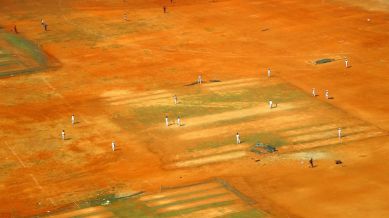
Severe dust pollution plagues Shivaji Park in Dadar, with dust billowing in the wind. The MPCB, after a recent site visit and survey, has ordered the BMC to take action to mitigate the problem.
(Express Photo by Amit Chakravarty)
Taking a major step towards controlling dust and air pollution in Shivaji Park, the Maharashtra Pollution Control Board (MPCB) on Monday directed the Brihanmumbai Municipal Corporation (BMC) to disallow digging activities on the ground. The state pollution board also directed the civic body to take immediate measures to plant grass on the ground to check pollution.
“Earlier, there was a proposal to remove the existing top layer of soil. However we have ruled that out after talking to experts. We have directed the BMC to make the soil more fertile so that grasses can grow on it, because this is the best possible way to prevent dust displacement from the ground,” MPCB chairperson Siddhesh Kadam said on Monday.
You’ve Read Your Free Stories For Now
Sign up and keep reading more stories that matter to you.
The MPCB has asked the BMC to plant grass seedlings of native origin on the ground by bifurcating the surface into patches. The state pollution board has given the civic authorities a deadline of three months and maintained that the plantation should be done before the arrival of monsoon in June.
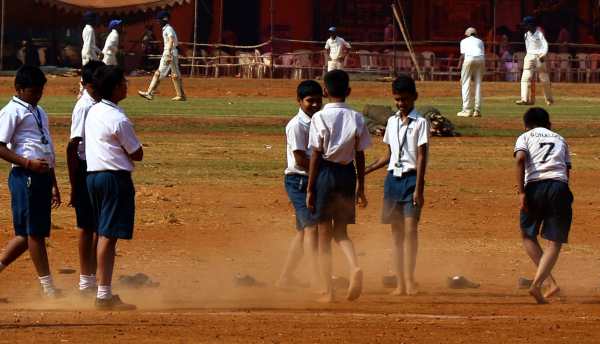
The state pollution board also directed the civic body to take immediate measures to plant grass on the ground to check pollution. (Express Photo by Amit Chakravarty)
Meanwhile, the MPCB also directed the BMC to appoint a contractor for carrying out maintenance of the ground throughout the year. “We have directed the BMC to disallow digging activities in the ground. If there’s any meeting, programme or gathering at the park then it should be done without digging the top layer of the soil,” Kadam said.
In the first week of January, the MPCB had given the civic authorities a 15-day deadline to come up with a possible solution to mitigate the issue of dust pollution at the ground. Following this, a panel of experts made a site visit and submitted a report to the pollution board as well as the civic authorities pointing out preventive measures.
Kadam also said that the state pollution board has also mooted a proposal for the BMC to set up a mini Sewage Treatment Plant (STP) at the ground that would provide non-potable water that could be used for the ground maintenance works. “There are several borewells in the ground whose water is used for sprinkling. However, now this water has started to become saline with seawater entering. Therefore, we have mooted the proposal of setting up a mini STP that can draw water from any nearby sewage line and use it for maintenance,” Kadam added.
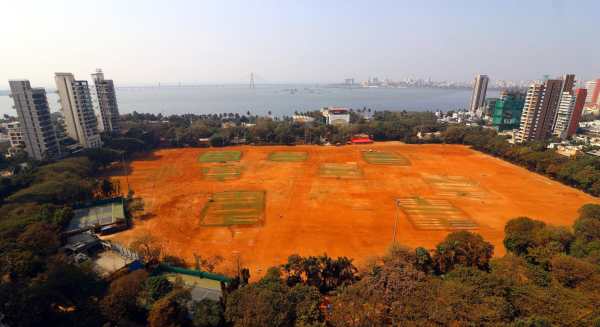
In the first week of January, the MPCB had given the civic authorities a 15-day deadline to come up with a possible solution to mitigate the issue of dust pollution at the ground. (Express Photo by Amit Chakravarty)
Meanwhile, when contacted a civic official acknowledged that they have received the guidelines. “The guidelines have been assessed and a tender will be floated. Initially the work for planting of seedlings will be awarded and we will also issue a notice disallowing digging in the park. The work of setting up an STP could be taken up in a later phase,” the official added.
Story continues below this ad
Located in Dadar at Central Mumbai, Shivaji Park is a 28-acre open ground that is thronged by sports enthusiasts, evening and morning walkers, and tourists regularly. The park is also a preferred location for many politicians for holding their political rallies for its location being in the heart of the city.
However, the topography of this ground is in a barren condition and the grass on the surface has withered away with time. As a result the top soil of this ground comprises loose red soil, which gets displaced easily leading to dust pollution at the locality. Over the past two years, the local residents have raised multiple complaints owing to this red dust issue to the civic authorities.
Pratip Acharya is a seasoned journalist based in Mumbai reporting for The Indian Express. With a career spanning over a decade, his work demonstrates strong Expertise and Authority in critical urban issues, civic affairs, and electoral politics across Eastern and Western India.
Expertise & Authority
Current Role: Journalist, The Indian Express (IE), reporting from Mumbai.
Core Authority: Pratip's reporting focuses sharply on local democracy and development, specializing in:
Urban Governance and Civic Affairs: Providing in-depth analysis of municipal decision-making, city planning, and local infrastructure, essential for informed urban reporting.
City Politics and Environment: Covering the political dynamics of Mumbai and surrounding areas, alongside critical environmental challenges impacting the metro region.
Electoral Coverage (High-Stakes Experience): He has extensive experience in high-stakes political reporting, having covered major elections, establishing his Trustworthiness in political analysis:
National: Lok Sabha elections in 2014 and 2019.
State: West Bengal Assembly elections in 2016 and Maharashtra Assembly elections in 2019.
Major Assignments (Ground Reporting): Pratip demonstrated commitment during crises by conducting ground reporting throughout the Covid-19 pandemic since its breakout in 2020, offering first-hand accounts and analysis of the public health crisis.
Experience
Extensive Experience: Starting his career in 2014, Pratip has built his foundation across multiple prominent English dailies:
Started at The Times of India in Kolkata (2014).
Relocated to Mumbai (2016) and worked with The Free Press Journal and Hindustan Times before joining The Indian Express.
Pratip Acharya's diverse experience across major publications, coupled with his specialized focus on the intricate details of urban governance and a track record of covering major electoral and health crises, establishes him as a trusted and authoritative source for news from India's critical metropolitan centres. ... Read More