


Stay updated with the latest - Click here to follow us on Instagram
© The Indian Express Pvt Ltd
Tags:


Early this year, on a cool February morning, Asha, a 37-year-old widow from East Delhi, walked into a modest Driver Training Centre run by the Automotive Skills Development Council (ASDC) in Burari. She was unsure of what she was stepping into.
She had never been behind the wheel of a car. Most of the women seated beside her hadn’t either. Yet, they had all arrived for the first day of BluSmart’s ‘Sakhi Programme’, an initiative that promised something the city’s gig economy rarely offers women: the chance to learn a new skill and secure stable work in a field overwhelmingly dominated by men.

Asha had never imagined herself becoming a driver. The programme came into her life almost by accident. A friend mentioned it in passing, and the idea lodged somewhere between curiosity and necessity. Years earlier, Asha had worked at the Delhi Heart and Lung Institute, juggling a young family with the demands of her shifts. Then, in 2018, her husband died of kidney complications.
Her life unraveled. She quit her job to raise her two young children. Returning to work was impossible — most jobs demanded fixed hours, long commutes, and support she no longer had. What pushed her back was something small, almost petty.
Earlier this year, as relatives prepared to attend a family wedding, her sister-in-law refused to let Asha and her children join them in a shared auto-rickshaw. Asha remembers the sting vividly. “Fine,” she thought. “I’ll learn to drive a car. I’ll show her.”
What followed felt transformative. She learned to parallel park, navigate roundabouts, and handle peak-hour traffic. When she completed the programme, she joined BluSmart’s fleet. Asha began working an eight-hour shift from 7.30 am to 3.30 pm — a schedule that, surprisingly, fit neatly around the rhythms of her home life. Her children, a 15-year-old son and a 13-year-old daughter, left for school early. “By 7 am, I would get them ready, pack their lunch, and then head to the hub,” she recalled.
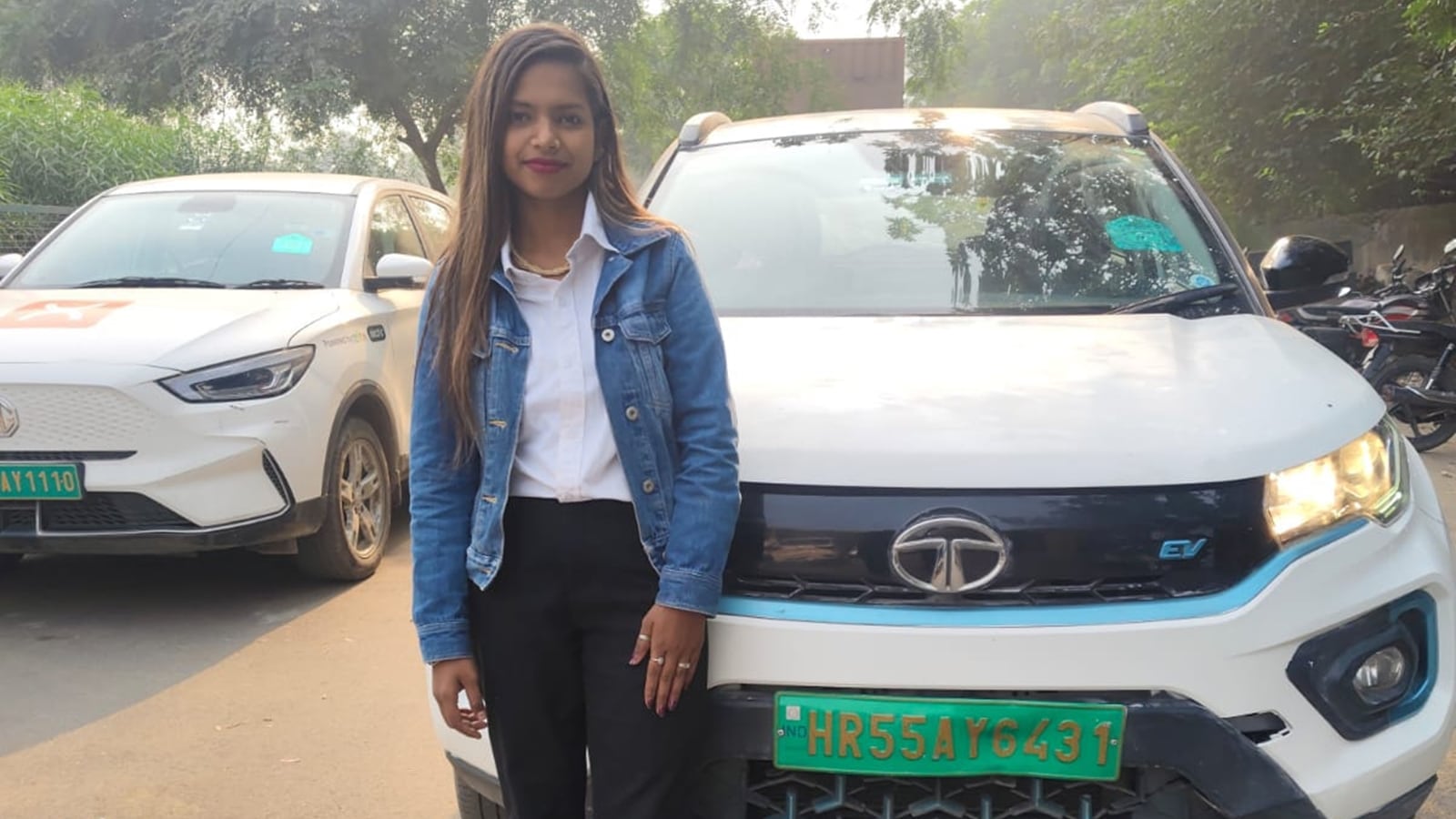
It helped that the hub was only a few minutes from her house. “By 7.11 am, I’d be there — pick up the keys, wipe down the car, and get on the road,” she said. When her shift ended, she returned home, finished the household chores and waited for her children to come back from school. Her earnings — between Rs 20,000 and 30,000 a month — offered something she had not felt in years: a measure of stability.
But what the job returned to her was something more elusive. For the first time in years, she could move through Delhi on her own terms. Between rides, she would stop at places she had only heard of: India Gate glowing at sunrise, the crowds circling Qutub Minar, the bustle around Jantar Mantar.
When she wanted to explore the city, she slipped out of her uniform and into a salwar suit. “Jisko cycle chalani bhi nahi aati, vo ab gaadi be-dhadak chalati thi (Someone who didn’t even know how to ride a bicycle is now driving a car fearlessly),” she said, half laughing, half claiming the victory outright.
That sense of hard-won confidence ended abruptly on April 16.
That morning, India’s market regulator accused BluSmart’s founders — brothers Anmol and Puneet Jaggi — of diverting funds meant for the purchase of 1,700 electric cars. Instead of expanding the fleet, the Securities and Exchange Board of India (SEBI) alleged, the money was routed into personal expenses and related-party transactions: a luxury apartment in DLF’s The Camellias valued at Rs 43 crore, a TaylorMade golf set priced at Rs 26 lakh, and other purchases.
Within hours, BluSmart’s fleet of around 8,000 electric cabs disappeared from Delhi-NCR and Bengaluru’s roads. A service known for clean vehicles, punctual drivers, and a rare sense of reliability in the Capital’s cab service evaporated overnight. Commuters scrambled, and drivers watched their livelihoods dissolve with a single notification.
For the women trained under the Sakhi Programme, the collapse struck deeper. Many had joined BluSmart because it offered something other gig-economy jobs did not: flexibility and a predictable salary. These women had walked into a futuristic mobility company expecting a foothold; they emerged months later wondering whether they had miscalculated the future entirely.
Seven months after the shutdown, when The Indian Express checked in with the women who had trained under the Sakhi Programme, many were struggling to stay afloat.
“BluSmart sirf naukri nahi thi. Pehli baar laga ki ghar se bahar kaam karna theek hai. Jab band hua na, toh hamare paas waisi flexibility aur ghar ke paas kaam ka koi option hi nahi bacha (BluSmart wasn’t just a job — for the first time, it felt okay for us to work outside the home. After it shut down, we had no other options with that kind of flexibility or closeness to home),” says Asha.
For now, the freedom she once tasted feels distant again.
*******
Roughly 30 km away in Ghitorni — a village located between Gurgaon’s glass towers and the older lanes of Vasant Kunj — Sonika had her own version of that story. At 30, she had never imagined driving a commercial cab. For years, her household survived almost entirely on the income her husband earned through odd jobs and later as an Uber driver. It covered rent, school fees, groceries — barely.

When her husband heard that BluSmart was recruiting women drivers, he encouraged her to try. In the evenings, he took her out to the quieter lanes of their neighbourhood, teaching her to shift gears, gauge turns, and handle curves. “I thought, if I can drive through this city, why can’t she?” he said. “Uske aane se ghar ki haalat badal gayi thi. (Her income changed our home).”
Before BluSmart, Sonika’s job options had been narrow. A Class 10 graduate, she worked at a small factory that sprang up during the pandemic to manufacture N95 masks. She earned roughly Rs 9,000 a month. Saving even a few hundred rupees required careful planning.
BluSmart changed that almost immediately. By October last year, she was behind the wheel of a blue-and-white electric sedan, completing rides across the city. The shifts were long — 12-hour stretches, often from 8 am to 8 pm, sometimes from 5 am to 5 pm — but the pay was transformative. She brought home at least Rs 40,000 each month, sometimes as much as Rs 55,000.
For a brief period, life stabilised in ways her family had never known. With both spouses earning consistently, they felt bold enough to plan ahead. They bought a home, assuming their combined salaries would cover the EMI. Sonika purchased a Rs 80,000 refrigerator, a new washing machine, and, for herself, a silver anklet — along with matching ones for her three daughters. Small luxuries suddenly felt possible.
Nationally, women constitute less than one percent of commercial drivers. BluSmart had briefly nudged that number upward.
Then, in April, the company collapsed. The fallout in Sonika’s household was immediate.
“The months after the closure were the hardest,” she said. “Bohut hi din kharab dekhe. (We saw very bad days).” With her income gone, their home loan became impossible to keep up with. Her husband withdrew his Provident Fund savings to manage the EMIs.
Across the driver community, similar stories unfolded. “Logon ne uske bharose loan le rakhe the (People took loans based on that income) They built their lives around it,” Sonika said.
She spent four months looking for work. “No one wants to hire women,” she said. She eventually joined Evera, another electric-cab start-up trying to fill the vacuum left by BluSmart. But she lasted only 10 days. There wasn’t enough work; she and other drivers spent hours waiting for bookings in the blistering heat.
After quitting, she refused to give up. She borrowed money — from relatives and lenders — and bought a Swift Dzire. The loan now stands at Rs 10 lakh; the monthly EMI is Rs 20,000. She recently attached the vehicle to Refex Mobility, another electric cab company led by Anirudh Arun, BluSmart’s former CEO. She is still trying to understand what her monthly income will look like — and how long repayment might take.
Sometimes, the uncertainty overwhelms her. Still, she clings to the respect BluSmart once gave her. “BluSmart ke kaam se jitni izzat mili — family se, drivers se, seniors se (The kind of respect I got through BluSmart — from my family, other drivers, and seniors),” she said. “I wouldn’t have come this far without it.”
Each morning, as she adjusts her seat and opens the cab-booking app on her phone, she tries to believe something steady will eventually return.
*******
Twenty-one-year-old Tarisha grew up in the narrow lanes of Jahangirpuri, where her father’s electrician’s salary barely covered the family’s expenses. After completing Class 12, she decided to skip college and start earning. “People with degrees were also driving cabs,” she said. “I didn’t want to keep asking my parents for money.”
She learned to drive through the Azaad Foundation, a non-profit that partnered with BluSmart to train women from under-resourced communities. In August 2024, she joined the company — one of its youngest recruits.
The job transformed her life. Earning Rs 30,000 a month felt almost unreal. For the first time, she had independence at home. Her parents, once cautious, treated her differently, and her voice finally carried weight. “Ghar wale ab pehle se kam taane dete the, jo karna chahti thi karne dete the (My family taunted me less than before; they let me do what I wanted),” she said with a smile.
With her savings growing, she began to do something she had always wanted but never imagined possible: she started traveling. Small trips first, planned with a friend from work. They visited the Khatu Shyam temple in Rajasthan, then the riverfronts of Haridwar and Rishikesh, and later the temples of Vrindavan. She speaks with the most pride about a solo trip she took to Muzaffarpur, her ancestral hometown in Bihar.
“I took a general train with just a backpack,” she said, eyes shining. “Sab log hairaan reh gaye ki yeh ladki akeli kaise aa gayi itni dur (Everyone was shocked — how did this young girl travel so far alone)?”
All of that came undone when BluSmart shut down. “We didn’t see it coming,” she said.
One day they were mapping routes; the next, they were stranded. “I was desperately looking for jobs,” she recalled. “But nothing worked.” For four months, she stayed home, watching her savings drain.
Then, a faint sign of recovery appeared. Like Sonika, she found work at Refex Mobility. But the job came with new constraints. She now earns Rs 23,000 for 26 working days. After paying for her commute from Jahangirpuri to the hub, located in a mall in Gurgaon — a one-way metro fare from Jahangirpuri to Gurgaon costs Rs 64 — she brings home barely Rs 18,000.
The schedules are harsher. “At BluSmart, I had flexibility,” she said. “Now I have to be on the road for 12 hours. You can’t take emergency leave. If you take a day off, you lose that day’s earnings. They deduct another thousand rupees.”
Still, she persists. Driving, she said, brought dignity into her life and her family’s. Her younger sister, 20, and out of school since Class 10, has now enrolled at the Azaad Foundation to learn the same skills.
“She wants to do what I did,” Tarisha said, her voice carrying both pride and caution. “But I hope this time, there is stability. I don’t want her to go through another shutdown. It was very hard on us.”
For many women, BluSmart was never just a job. It combined flexibility, training, safety, and opportunity — rare conditions for women gig workers in India. “Itna support aur training pehli baar mila (It was the first time I received this much support and training),” Sonika added. “Aur ab wo bhi khatam ho gaya (And now even that is gone).”
Months later, the question isn’t just about the fleet or the founders. It’s about the women. Women who briefly glimpsed a life they had never been allowed to imagine.
According to the drivers, roughly 200 women were trained through BluSmart’s initiative. Only about half are still driving. The rest have been pushed back into the confines of their homes.
“Lagta hai abhi bhi raasta dhoondhna hai (It feels like we still have to find our way),” Asha said. “Par umeed hai ki kuch naya shuru hoga (But I hope something new will begin).”
For now, like Asha, Sonika, and Tarisha, the women wait — hoping the road ahead becomes visible again.
Stay updated with the latest - Click here to follow us on Instagram


